
Narrative Synthesis: Group Studies and Explain Findings
Narrative synthesis compares studies without pooling results. Learn to group evidence, explain differences, and report limits with a traceable study table.
- Byline

Summary
Narrative synthesis brings study findings together when a review does not pool results. It requires more than a summary of each paper.
Group studies by a clear question. Compare results and settings, check possible reasons for differences, and show the source trail and limits.
SWiM helps authors report reviews of intervention effects without meta-analysis. It cannot choose or validate the review method.
Narrative synthesis compares findings across the studies in a review. The team decides which studies answer the same question and what the pattern can support.
A paragraph on each paper may help you extract facts. By itself, it leaves the reader to make the cross-study judgment.
If your assignment asks for one entry per source, see the literature review versus annotated bibliography comparison before turning those notes into synthesis.
Suppose three reports examine a campus study-support program. One reports a higher course-completion rate; another finds little difference after a shorter study period. The third omits that outcome. A sound account keeps those states separate.
In Atlas, you can compare the chosen reports. Open the source link behind each finding before you put it in a table. The review team still decides which reports belong in a group and what the gaps mean.

Atlas

Compare included studies in Atlas
Group selected reports, inspect citations, and save checked findings.
What narrative synthesis does
In a systematic review, narrative synthesis compares findings across the chosen studies. The team uses it when it does not pool results into one number.
The team must explain its groups, show each study's result, examine differences, and qualify its conclusion. The Cochrane Handbook calls for a clear method and a table or visual display. Unexplained prose can give some studies undue weight.
Narrative synthesis concerns how a review joins its findings. A narrative review is a type of review. It may use a less formal search and selection process. See the research-paper synthesis workflow if you are still gathering papers.
An umbrella review compares reviews rather than primary studies. It has an added problem: several reviews may include the same study. A simple grouping table cannot resolve that overlap.
Choose a defensible synthesis method
Start with the review question and chosen reports. For each planned group, ask whether studies involve the same people, program or exposure, comparison group, and outcome. Can their results and measures of doubt be compared?
A meta-analysis uses statistics to pool study results. One review may pool some outcomes and describe others in prose. A missing measure of spread, a different outcome, or just one study may leave no sound number to pool.
Studies may also differ in who took part or how they were done. That alone does not rule out a pooled result.
Cochrane Chapter 12 sets out ways to work with sparse data. The team should check those options before it falls back to prose.
Record the choice
The plan should name the outcome, each study's result, the grouping rule, the method, and the display. If the plan changes after reading the reports, record why.
Readers should be able to tell planned groups from those chosen later. Environmental Evidence's guide also calls for a clear plan and a record of such choices.
Group studies before interpreting
The grouping question is: Which studies are alike enough to support the same statement, and which differences must remain visible? A group might share a population, program component, comparator, and measured outcome.
Setting and study length may still change the reading of a result. Use the review question to form groups. Record any differences that could matter.
For each study, record what was measured, how it was measured, the comparison group, and the result. Add who took part, the setting, study length, and key limits. Keep the source passage beside each field.
When the source set is books or arguments addressing one shared question, syntopical reading offers a question-led comparison of each author's terms and answers. The study-outcome fields in this review would not fit those texts.
If one report defines engagement as attendance and another uses self-reported confidence, the labels match but the measures do not. Do not place them in one outcome column without explaining the difference.
Explain why any study selected for the review does not contribute to this outcome group. It may have measured a different outcome or omitted the result. Neither situation means that it found no effect.
Cochrane's guidance on structured tables makes study-level results visible so readers can see what contributed to the account.
A grouping rule you can reuse
Write a rule before filling the table. For this outcome, group studies with the same [people], [program or exposure], [comparison group], and [measure] over [study length]. Show other settings in separate groups.
Check each report against that rule. Mark a missing field as not reported. If the group changes, date the new rule and state why.
The rule prevents a jump from interesting paper summaries to a general claim without a reason for putting those papers together. For a broader way to organize source details before writing, see the literature-review process.
Compare findings within groups
The three studies and every result below are hypothetical. The table illustrates a working record for a campus program.
This made-up group asks whether a study-help program changes course completion for new students. It shows how each study was run and how long it lasted. Those facts may help explain the results.
| Hypothetical report | Group and context | Course-completion result and measure | Limitation or risk to check | Source locator and unresolved question |
|---|---|---|---|---|
| Study A | First-year residential students; weekly in-person program; one academic year | Reports higher completion than the comparison group; course-record completion | Program participation and background support may differ between groups | In a real review, inspect the Results table and Methods definition. Was the group assignment comparable? |
| Study B | First-year commuter students; hybrid program; one term | Reports little difference at term end; course-record completion | Shorter follow-up and a different delivery context | In a real review, inspect the outcome table and follow-up description. Would a later result alter the comparison? |
| Study C | First-year online students; remote program | Course completion not reported; other engagement outcomes described | Missing outcome result prevents a completion comparison | In a real review, inspect the outcomes listed in Methods and Results. Was completion measured but omitted? |
Table 1: The table shows that Study B found little change. Study C gave no result for this outcome. We cannot count Study C as for or against the program.
The two reports with results also studied different students, program formats, and lengths of time. This gives the team questions to test. In a real review, the team would add effect sizes and check each study for bias before it draws a conclusion.
This matters because Cochrane warns against counting only statistically significant results. Two studies may point to the same effect. One may miss the P-value cutoff because its estimate is less exact. Counting whether results point up or down has limits too. It hides effect size and study weight.
Draft the synthesis from the table
A bounded account for this imaginary group could read:
The two reports that measured course completion did not show the same pattern. The residential, year-long program report described a higher rate; the commuter, one-term report described little difference. Study length and delivery may help explain the contrast, but these examples do not test that idea. The online report omitted course completion, so it supports neither benefit nor no effect for that outcome.
That account names the contributing studies, preserves the disagreement, offers a testable idea, and marks the missing result.
In a real review, each claim needs a source link, and the conclusion must reflect risk of bias and certainty of the evidence. A reader should be able to move from the sentence to the extraction cell and original result.
Explain differences and uncertainty
When results differ, check what could have shaped them before you suggest a cause. Start with who took part, where, how much help they got, what each study measured, how long it ran, and how it was designed.
Ask whether results point in opposite directions, differ in size, or vary only in reporting detail. Choose separate groups if the studies measure different outcomes. Keep each type of gap clear.
Test a proposed explanation
Test the proposed cause with a counterexample. If longer study periods might reveal a benefit, does another long study report no difference? That would weaken the idea.
If only one report addresses the contrast, keep the idea tentative. The NIH Library's synthesis guide describes prose, tables, and figures as possible displays. The format does not test the interpretation for you.
Show risk of bias and missing results beside the findings. A study with serious design limits may deserve less weight, but the team must show its appraisal basis.
If an outcome is not reported, mark a gap in the table. If a study finds no observed difference, show its measure and uncertainty. Use those two distinct entries when you decide what the group supports.
The systematic-review versus meta-analysis distinction helps here. A review spans question, search, appraisal, and synthesis; meta-analysis is one possible statistical step within it. Narrative synthesis still needs a method and visible study trail. The scoping versus narrative review guide covers a separate choice between review designs.
Report the method and limits
Let readers trace each claim back to the reports. State the question, group, method, and study-level results. Show what changed from the plan, what the bias check found, and what remains unclear. If the report must then explain what those findings mean for practice or future work, the research implications guide shows how to keep that next claim within the evidence.
If the team chose not to pool results, give the reason. Studies that differ can still be pooled in some cases. Cochrane's guidance asks teams to check the data and methods first.
Where SWiM fits
SWiM means Synthesis Without Meta-analysis. The EQUATOR guideline record and Cochrane's SWiM training page place it in systematic reviews of intervention effects synthesized without meta-analysis.
SWiM helps authors report grouping, methods, results, and limits. It gives reporting guidance for its defined scope. The team still needs to choose and justify its synthesis method. Other review designs need guidance suited to their scope.
Next step: check each source
Atlas can help check sources after the team selects its reports. Add the papers and synthesis plan to one project. In chat, use @ to name the reports for a defined group. Ask for one row per report with the outcome definition, measure, result, study period, stated limit, and citation. Instruct Atlas to mark missing fields instead of guessing.
Open each citation to confirm that its passage supports the cell. If a claim combines reports, ask Atlas to separate each report's part. Save the corrected account and open questions in a note. The team remains responsible for search, eligibility, appraisal, grouping, and interpretation.
Atlas's public guides support this workflow with chosen sources. The research assistants guide covers other roles for research tools. The review team still picks the synthesis method.
The screenshot shows a source paper beside a cited Atlas answer. The paper is unrelated to the campus example. Inspect the citation before moving a result into the table.
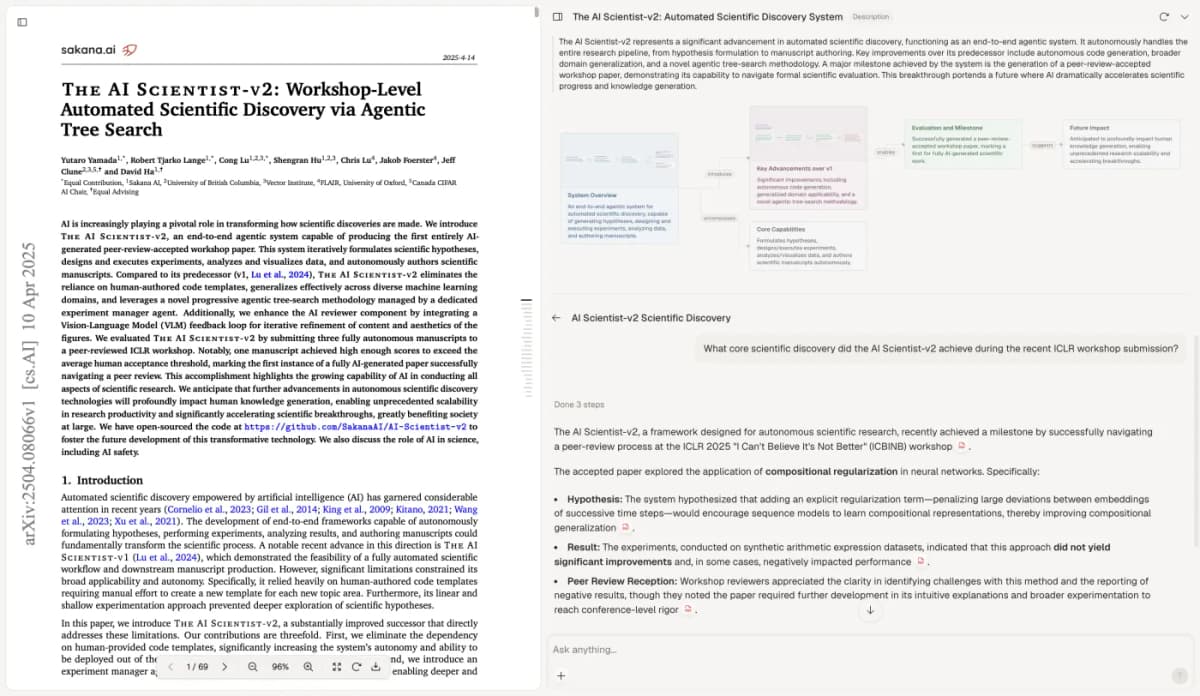
The team must still decide whether each cited passage supports the outcome, measure, and limit. A saved note should show which studies were grouped, where they differ, and which results were unavailable.
Atlas
Compare included studies in Atlas
Group selected reports, inspect citations, and save checked findings.
Frequently Asked Questions
It is a planned way to bring included-study findings together in a transparent account of patterns, differences, possible explanations, and limitations when a pooled effect is not used.