
Syntopical Reading: Compare Authors Around One Question
Syntopical reading compares books on a shared question. Learn to align terms, trace answers to passages, and distinguish real disagreements from wording.
- Byline

Summary
Syntopical reading is a way to compare several authors' answers to one question.
Compare relevant passages, translate key terms carefully, and record each author's answer before judging agreement.
Keep page references and unresolved differences visible so a later source can change the comparison.
Syntopical reading compares several books around a question you set. Do not write one book summary after the next. Ask what each author says about the same issue. Note where their terms differ and where their answers clash.
The result is a clear record: one question, key text, each author's answer, and where views match or clash. Sattler College's writing-center guide describes this comparison as the distinguishing work of syntopical reading.
Imagine three made-up authors who debate how a public library should use its rooms. One uses access to mean a seat available without a reservation; another means a welcoming place for group work. First, note what each means by access. Then ask if their plans clash. Atlas can cite text from the sources you choose. You still read the books and judge the claims.

Atlas

Compare selected sources in Atlas
Ask one question, inspect cited text, and save a checked comparison.
What syntopical reading means
Mortimer Adler and Charles Van Doren describe syntopical reading as reading across books on a subject. Their publisher lists the revised 1972 edition. A California State University Northridge guide lists five steps: find key text, set shared terms, frame questions, define issues, and present the debate fairly.
Analytical reading tries to grasp one book's case. Syntopical reading asks how many books address a question that matters to you. You may read some chapters in depth, yet you need not read every page at the same pace to study one narrow issue.
This is more than collecting quotes under a topic. If two authors say access, ask what each means. What does each claim? What proof do they give? Can both claims hold? A label alone cannot answer those questions.
The term is also written syntopic. Both names point to this cross-book task. Let the authors speak to one shared question. Do not force agreement or pretend an author answered a question that the book never took up.
Choose a question and reading list
Write a question narrow enough that a text span can answer it. “What do these books say about libraries?” will collect topics. “What tradeoff does each author make between quiet study and group access?” yields claims you can compare.
Make a first reading list. Inspect titles, contents, indexes, and chapter openings to find works that speak to the question. Sattler's guide calls this an inspectional pass. You first find the key books, then the key text.
Record why each work belongs: author, date, context, likely chapters, and any doubt about fit. A work that only mentions libraries may not discuss your tradeoff. Set it aside or keep it as background; do not invent an answer.
Your question can change as you read. If an author says the tradeoff is false, add that view to the table. Keep the old question in your notes so you can explain the shift.
Find the passages that address the question
For each work, locate a passage where the author makes a claim about the question. Capture a page, chapter, or other stable locator.
Then read before and after it to recover qualifications, definitions, and reasons. A sentence pulled from a concession can sound like the author's final view.
Ask three things of a text span. Does it address the shared question? What is the answer? How does the rest of the chapter support or limit it?
The University of Leeds Library's critical-reading questions call attention to the author's purpose, context, reasoning, evidence, and relationship to other sources.
Keep a small evidence record rather than a pile of highlights:
- Question and source: Which exact question are you testing, and which work is this?
- Locator and claim: Where is the passage, and what does the author assert there?
- Context: Is the claim a recommendation, example, objection, or qualified conclusion?
- Open check: Which adjacent page or later chapter could change your reading?
If you have only a chapter excerpt, label the comparison as chapter-level. Do not turn silence in that excerpt into a whole-book position.
Check terms against source evidence
Authors may use different words for similar ideas, or the same word for unlike ideas. Keep each author's own words beside any shared term you use. In the fictional library case, access could mean a free seat for one author and room for group work for another.
A shared term such as “chance to use the library” might cover both. It does not mean the authors agree on what makes that chance real. Keep their local meanings in view as you compare answers.
For each key term, write the author's word and what it means in that book. Then write your shared term. If one term hides a key gap, keep two terms and say why. Do not make an author answer in your words too soon.
The Sattler guide calls for finding shared views beneath different phrasing and then naming the issues that remain. Treat your term match as a guess to check against the text.
Compare answers in a question-led matrix
Here is a wholly fictional teaching example. Authors A, B, and C are made up. So are their text and page labels. The page labels show where real notes would point; they are not real citations.
The common question is: When floor space is scarce, should a public library give priority to quiet study or group activity?
| Invented author and passage | Term to clarify | Answer to the common question | Check before concluding |
|---|---|---|---|
| A, p. 12: argues for reservable silent desks during exams | “Access” means a reliable place for individual study | Give quiet study priority during peak exam weeks | Does A permit group space at other times? |
| B, p. 27: argues that group tables help newcomers participate | “Access” means being able to work with others | Protect group space even when desks are scarce | Does B reject temporary quiet periods? |
| C, p. 8: proposes movable rooms and published time blocks | “Flexibility” means changing use by hour | Set a schedule that gives each use predictable time | Does C treat both uses as equal in every setting? |
Table 1: At first, A and B sound opposed. The table shows a possible substantive issue: what should happen during peak exam weeks?
But A's seasonal limit and B's possible acceptance of quiet periods are unresolved. Their answers may overlap once the conditions are made explicit.
C's proposal is not automatically a compromise that solves the dispute. It may fail if the room conversion is costly or if a scheduled block does not meet one group's needs.
You would need the authors' fuller arguments and evidence to evaluate it. The table makes the next reading task precise: find each author's claim about the same period and the same users.
A synthesis matrix can sort many sources by a shared set of fields. This smaller table is organized by a single disputed question.
For academic-paper synthesis across several frameworks, see how to synthesize research papers.
Trace the disagreement and its limits
Once the terms and answers are visible, classify the relation carefully. Agreement means the authors make compatible claims under the same conditions. Terminological difference means they use different words or meanings without necessarily disagreeing. Substantive disagreement means their claims conflict when the question, scope, and conditions match. Silence means a work does not answer the question in the material reviewed.
These are working judgments. An author's concession on the next page can move a row from disagreement to partial agreement. New evidence can show that two apparently identical recommendations rest on different reasons.
The University of Leeds Library recommends asking how one source supports, contradicts, or challenges another and what remains to investigate.
Present each author's position in terms that author could recognize. Cite the passages that carry the claim. Describe your own synthesis separately.
If one source is an excerpt and another a full book, say so; unequal access limits the strength of your comparison. For historical records, the archival research guide adds finding-aid context, item IDs, and gaps in what has survived.
Syntopical reading can end with a map of the debate. You do not have to declare a winner. When you do evaluate an argument, explain what evidence or reasoning supports your judgment rather than letting the matrix's neatness stand in for proof.
Check selected texts with Atlas
If you have text you may use, add the key chapters, papers, or notes to one Atlas project. Type @ in chat and choose the sources for this question. Ask: “During exam weeks, what does each author say about quiet study and group space? Give a cited passage and key term for each answer. Flag any source that does not address this time period.”
Open each citation. Check the author, read nearby text, and compare the answer with your notes. If Atlas merges two authors or treats silence in one chapter as the book's final view, correct the record. The public Atlas guides describe source synthesis and cited questions. You still set the scope and judge the claims.
Save a checked note with the question, page links, original terms, shared terms, current view, and open checks. Revisit it when you add another chapter or book. Atlas helps you keep the trail; it does not read all books for you or decide which case is strongest.
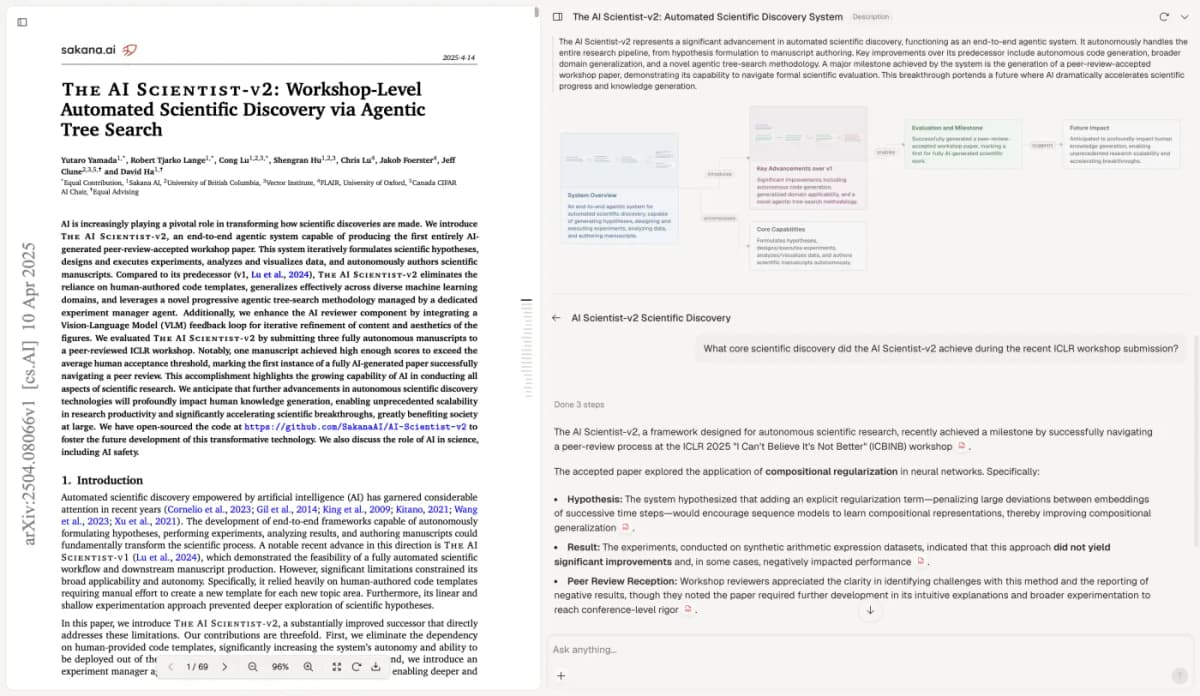
Atlas citation-inspection view. The visible paper is unrelated to the invented library authors and does not supply evidence for their claims.
Keep the conversation open
Before writing a conclusion, ask whether every author was compared on the same question and conditions. Reopen the passages behind apparent disagreements. Mark which claims are supported by a full work and which by a bounded excerpt.
As the reading list grows, update the table rather than append a fresh summary of each book. A new author may introduce another answer, reveal that an old translation was too broad, or show that a dispute rests on different assumptions.
Keep those revisions with the source locators and reasons. The result of syntopical reading is a fair map of what the works say to one another and where your own judgment begins.
The books remain the evidence; the comparison is your argument about their relationship. If you need broader tool options for a research corpus, see the AI research assistants comparison.
Atlas
Compare selected sources in Atlas
Ask one question, inspect cited text, and save a checked comparison.
Frequently Asked Questions
It is comparative reading across several works on one subject, organized around questions the reader asks rather than one author's table of contents.