

An interview protocol is the plan you use to guide a research interview. It brings together the opening, questions, follow-up prompts, topic changes, closing, and notes.
It also points to the study's agreed steps for consent and recording.
Start with what you need to learn, then write questions a person can answer from their own life. Source links explain the topic choice, but the wording still needs review and a pilot.
The worked draft below is for a hypothetical study of first-year students who commute. It has a source-to-question map and a pilot checklist.
It remains a plan, with consent and required review still to arrange.

Check your interview plan against its sources
Compare literature and approved requirements to refine your interview plan.
What an interview protocol includes
A protocol keeps the study's purpose and steps in view while you listen. Stanford's protocol checklist covers what to say and ask, follow-up prompts, topic changes, and notes on your role.
Terms vary. Some teams use interview guide, schedule, and protocol for much the same thing. Here, the guide is the question-and-topic part of the wider plan. For how to use a guide and adapt it as you listen, see the semi-structured interview guide. Follow your team's terms and required format.
At the top, name the study, version, purpose, who it is for, planned length, and sources. Then add the opening steps, main questions, optional probes, topic changes, closing, and space for notes.
A probe is a short follow-up that asks for more detail. Flag open points so a colleague can see what still needs review.
Set the study and procedure boundaries
For this example, the study asks: How do first-year students who commute choose whether to join campus events, and what do those choices mean to them? The plan explores how they describe what they did and felt. It does not test whether going to an event causes better grades. For actions seen in their setting, see the qualitative observation guide. An interview asks for the person's account.
Separate three kinds of input
Keep the study question, chosen papers, and approved study rules distinct. The question sets what you need to learn. Prior papers help you find topics and gaps. The rules set how to seek consent, run the session, and handle files for this study.
The National Ethics Project's protocol overview advises checking whether each question serves the study's purpose. Check that fit before borrowing topics from its ethics-education study.
Use a literature review process to build the source basis. Note why you chose each source and how its people or purpose differ from yours. Check for gaps beyond your chosen papers.
Keep consent with the approved procedure
Link the current study information, consent process, recording rules, and steps for leaving the study. Add what to do if someone needs a pause or becomes upset, where relevant. You and the review body must settle what applies before any session, including a pilot that collects research data.
HHS guidance describes informed consent as sharing information so a person can freely choose. A signed form alone is not enough. The legal and local rules still need checking for your study. Use your approved wording and process, with this article as a planning aid.
Map evidence to interview questions
Use the source as evidence for choosing a topic, then check whether your question fits the study. In her four-phase refinement framework, Castillo-Montoya starts with question fit, then the flow of the interview, feedback, and a pilot.
Translate the study question
People need something they can describe in their own words. Instead of reading the study question aloud, ask about a recent choice, what happened, and what it meant to them. Quirkos' guide to question wording advises clear, open questions that do not steer the answer. Use plain words in the session and keep specialist terms in your planning notes.
For example, replace "How did campus events improve your belonging?" with "Think of a campus event you thought about joining. What happened?" The first version assumes a gain and that the person went. The new wording leaves room for joining, choosing to stay away, or knowing little about the event.
If your study asks which events helped or hindered a specific activity, use the critical incident technique to define which accounts qualify. An episode prompt alone does not make the interview a CIT study.
Label the source contribution
A source can give you a reason to ask about connection without giving you tested questions. Van Kessel and colleagues' review of university belonging finds links with student outcomes, but its study designs cannot show cause and effect. It does not test the questions below or show that campus events improve grades.
Note what the source adds beside each topic. Label questions you wrote as draft wording. If you adapt a published question, record its source and check permission and fit. A link to a broad paper should not make your new wording look like a tested measure.
Worked interview protocol draft
Label the plan Commuter event choices, draft v0.1. Aim for a 40-minute session, with room for the opening, answers, probes, and closing.
Test this time budget in the pilot and adjust it to fit the study.
All wording in the four-row question map is new for this example. Main questions set the topic, while probes invite detail. The last row checks what the draft may have missed.
| Topic and purpose | Proposed main question | Optional probe | Source or researcher origin |
|---|---|---|---|
| Routine, to establish context | What is a usual day on campus like for you? | What happens between classes? | Researcher scope, with the easy-start sequence in the Florida guide |
| Event choice, to explore an episode | Think of a campus event you thought about joining. What happened? | How did you decide what to do? | Study question, with draft wording checked against Quirkos' guidance |
| Connection, to explore meaning | Can you describe a time you felt connected to university life, or did not? | What made that moment stand out? | Topic rationale from the belonging review, with researcher-origin wording |
| Uncovered experiences, to allow another topic | What else matters to your experience that we have not discussed? | Is there something you expected me to ask? | Researcher closing choice, with an open ending illustrated in the Shift protocol |
Table 1: If no event comes to mind, ask: "What do you know about events on campus, if anything?" Then move to connection rather than pushing for a story.
Build the rest of the document around these questions:
- Opening. Give your name and the purpose in plain words: "We want to understand how students who commute experience campus life and make choices about events." Insert the approved study information and consent steps, with time for questions. Keep recording off until the required permission is in place.
- Warm-up. Use the routine question and explain that the person can answer in their own terms. Follow the agreed rules for skipping questions, breaks, and stopping.
- Main topics. Ask about the event choice and connection. Use optional probes when they serve the study. Leave space beside each row for brief notes and topics already covered.
- Transitions. Link to the previous topic before moving on, such as "You mentioned time between classes. I would like to ask about events outside class." Check whether the person has already covered the next topic before asking it again.
- Closing. Use the open ending, invite questions, and thank the person. Insert only the approved text about what happens next, contacts, and any follow-up. Do not promise transcript access, payment, or deletion unless the study provides it.
- After the session. Follow the agreed rules for files and storage. Keep notes on wording, flow, and your own role apart from the person's account. Note the protocol version used.
Stanford's faculty sample shows how questions, probes, and notes fit inside a larger plan. Its promises about access to tapes and later destruction belong to that past project. They are not wording to carry into this draft.
Pilot the plan and record revisions
Read the draft aloud with a colleague before scheduling study sessions. Then arrange any pilot under the required study rules. Imperial's design guide advises testing meaning, order, flow, and timing. Reading aloud can reveal awkward words, but it does not replace a pilot suited to the study.
Check the whole session
Use the pilot to check the whole plan:
- Can the person explain what a main question is asking in their own words?
- Does the no-event branch work without steering the answer?
- Do probes invite useful detail without adding your own view?
- Is there enough time for answers, pauses, the agreed opening, and closing?
- Which topics are missing, repeated, unclear, or outside the study's scope?
- Can you follow the agreed recording and stop rules?
Review the notes with the team. Florida's guide explains how the way you listen and ask can shape a response. Before adding more probes, check why an answer was brief. The question may be unclear, matter little to the person, or need a different way of asking.
Keep a reason for each change
Record the date, question ID, old wording, new wording, reason, reviewer, and version. One possible change is to replace "How did campus events improve your belonging?" with the event question in the table. The old wording assumes a gain. This correction is a teaching example, with no claim that it arose from a real pilot.
The refinement framework treats feedback and the pilot as distinct phases. Keep the team's comments apart from what the pilot reveals. Check whether a change needs further review, update the version, and test the changed wording or branch again before use.
Check the draft in Atlas
Add chosen papers and approved study rules to an Atlas project using supported source options. Create a note with the study question and its scope. Use only files permitted under the study's rules, and keep data that could identify a person out of this planning example.
- Choose Start a chat and Project only beside +. This keeps new retrieval inside the project and supplied material. A fresh chat avoids earlier outside context entering the comparison.
- In Ask a question, type @ and select the study-question note, papers, and approved rules. Ask for a topic, draft question, optional probe, source basis, and open point in each row. Select Send.
- Open each citation. Check who the source studied, its claim and limits, and nearby text. If the citation opens only the related source, find the passage yourself. Ask Atlas to split out source claims that are hard to trace.
- Correct the draft wording and steps. Choose New, then Note, enter the checked protocol and open questions, and wait for Saved. Keep the source map and version alongside the plan for use in the session.
Ask: "Compare these sources with the study question. Show why each topic fits and where the question wording came from. Flag wording that steers the answer and missing approved steps. Do not invent consent text, answers, or pilot findings." If the draft asks how events improved grades, inspect the review's citation and limits. Remove that claim and ask about the person's own account, then record why you changed it.
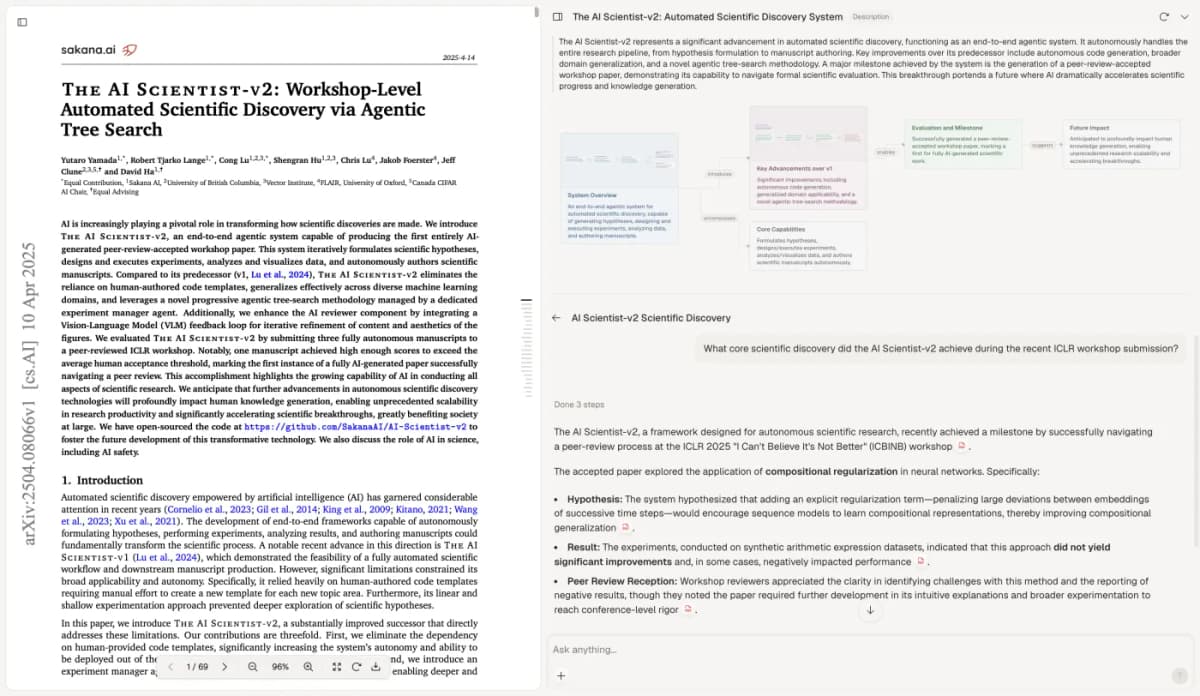
The screenshot displays The AI Scientist-v2 by Yutaro Yamada and colleagues, licensed CC BY 4.0. This unchanged capture illustrates source inspection. Its paper is unrelated to interviews and supplies no study findings or protocol approval; no author endorsement is implied.
Review before collecting interview data
Check the question map, full plan, pilot notes, and current version with your team. Settle the review process and consent steps before starting.
Virginia's interview guide shows why questions, recording, and possible distress need review. Its rules do not decide what applies at another institution.
Keep approved files, drafts, and reasons for changes easy to find using a research-note organization system. Atlas helps you prepare and check the written plan. You remain in charge of required consent and review, the pilot, the interviews, and deciding what the data can show.
Check your interview plan against its sources
Compare literature and approved requirements to refine your interview plan.