
Semi-Structured Interview: Build a Flexible Question Guide
Learn how a semi-structured interview works, then build and revise a guide with core questions, optional probes, pilot feedback, and checked research sources.
- Byline

Summary
A semi-structured interview uses planned topics and open questions while leaving room to follow a participant's answer.
Connect each core question to a research objective; keep neutral probes optional and test the guide before fieldwork.
Compare permitted pilot notes and prior sources with citations, then let the researcher decide what to revise.
A semi-structured interview follows a prepared guide of topics and open questions. The person asking questions can change their order, ask a follow-up, or explore an unexpected answer. The guide keeps the study's purpose in view without becoming a fixed script.
The University of Florida's interview guide places this format between a fixed sequence of questions and a largely unplanned conversation.
The person conducting the interview still needs to know which topics matter, what each question is meant to learn, and when a probe may help.
Suppose a team is preparing interviews about how students find library research help. In a pilot, one student mentions asking a friend first, an option the draft guide missed.
A revision record would link that pilot passage to the study aim, a possible neutral probe, and the team's reason for adding or declining it. This example is fictional. It shows a choice to check, not a finding about students.
Atlas can help compare a permitted pilot note, draft guide, and prior sources, with citations that the researcher opens before changing a question. Keep the final wording and the decision to use it with the research team.

Atlas

Check your guide against sources in Atlas
Compare permitted sources, inspect citations, and save a checked revision.
What makes an interview semi-structured
The structure is a set of topics or questions prepared before the interview. The flexibility is room to ask for clarity, change the order, or follow a relevant answer. DeJonckheere and Vaughn's methods paper describes a flexible guide with follow-up questions and probes.
A structured interview generally holds wording and order more tightly. At the other end, an unstructured interview may begin with a few broad topics and develop as the person responds.
A semi-structured guide gives each interview a common purpose while leaving space for that person's account. The University of Florida explanation says the guide can support similar topic coverage and still permit follow-up along a person's train of thought. Scribbr's comparison also shows how planned topics keep the study question in view.
This balance requires judgment during the interview. Asking every prepared question verbatim can close off an important account. Following every tangent can leave a study aim untouched. The guide helps the interviewer notice both risks.
Decide when a flexible guide fits
Match the method to the evidence
Use this format when you want people to describe experiences or choices in their own terms while still covering known topics. “How do students decide where to seek research help?” invites a story and follow-ups.
A study that only needs a fixed count of which help channel each student used may need a different instrument. The needed evidence, rather than a preference for open questions, should drive the choice.
The UCSF Product Toolkit recommends deriving questions from study aims and checking assumptions before settling on them.
“Tell me about the last time you needed help finding a source” may draw out a sequence of actions. “Was the library's confusing system the problem?” supplies a judgment the student has not made.
Allow for the work between questions
The interviewer must listen and decide when to probe. The Florida guide says practice matters as much as planning.
Before sharing notes or recordings, follow your study's consent and review rules. These rules vary by place and study.
Turn objectives into questions and probes
Write the shared core
Begin with a short statement of what the study needs to learn. If the aims are still vague, draft the research objectives first. Give each aim a question someone could answer from experience, and note which aims need another kind of evidence. This link between aim and question is the guide's evidence logic.
Kallio and colleagues' methods review places the guide draft between a check of prior knowledge and a pilot. That sequence helps you choose the main topics before you write questions. Core questions cover those topics; probes are possible follow-ups that ask for an example or clarify a term the person used.
Write in words the intended group would use. Ask about one idea at a time and leave room for a range of answers. The UCSF guide advises open wording, a warm opening, and a final chance to add what was missed. University of Florida distinguishes open questions and probes from wording that may lead an answer.
Leave room for probes
A neutral probe such as “What happened next?” can invite detail without naming a reason for the speaker. The pilot is a trial of whether that prompt is clear and useful, not proof that it works for everyone.
An interview guide can therefore contain:
- The research objective and topics that must receive attention.
- A short opening that explains the encounter and follows the study's consent process.
- Core questions in a sensible starting order, with optional probes beside each one.
- Space to note a term to clarify, a topic already covered, or a follow-up to return to.
- A closing prompt that lets the participant raise an important point the guide missed.
Do not turn optional probes into a second compulsory questionnaire. A participant may already have answered one, or it may not fit that person's experience. Keep the topic in view and use the actual answer to choose the next question.
See a worked guide revision
Imagine a fictional project about how first-year students find help with research assignments. The team wants to learn students' first steps, the problems they meet, and how they judge help.
The rows below are a draft guide. They are not observed responses or validated questions.
The table makes the purpose of each question visible. A researcher can see whether a probe follows from the objective or smuggles in an assumption. The final column is a reminder to check a pilot account before changing the guide.
| Research objective | Core question | Optional neutral probe | What to check in a pilot |
|---|---|---|---|
| Learn the first step | “Think of your last research assignment. Where did you start when you needed help?” | “What made you try that first?” | Whether “help” means a person, website, or something else to the student. |
| Understand a difficulty | “Tell me about a point when finding or using a source became difficult.” | “What did you do next?” | Whether the question invites a concrete event without assuming a library problem. |
| Explore trust | “How did you decide whether the help you found would be useful?” | “Was there anything that changed your mind?” | Whether the student has enough context to answer without a researcher-supplied criterion. |
Table 1: This fictional guide links each study aim to a core question, a probe, and a pilot check.
Compare the first row with an earlier draft: “Why did the confusing library website make you ask a friend?” That wording assumes the website was confusing, the student asked a friend, and one caused the other. The question in the table leaves those paths open. A mention of a friend can lead to a follow-up; silence on that point should not prompt the interviewer to force it.
The Quirkos guide by qualitative researcher Daniel Turner recommends questions tied to the study aim, familiar wording, and possible prompts.
The guide is a reference during an interview, rather than a text to read in lockstep.
Pilot the guide and record each change
Test the first version
Try the draft with someone suitable under the study's plan before relying on it. Check whether the wording makes sense, the sequence feels natural, topics receive enough time, and any question suggests its own answer.
The UCSF toolkit advises testing the guide and allowing time between interviews for changes. University of Florida also recommends review by skilled peers where appropriate.
Keep the version trail
A pilot gives feedback about one guide in one setting. It cannot certify that questions are unbiased or that the study will produce sound findings.
Revise with the study aims and ethics needs in view. If a change affects what people are asked, keep the earlier wording and note which version was used for each interview. Quirkos recommends this record.
The Kallio review also treats pilot testing and the completed guide as separate phases. A revision deserves a reason, not a silent overwrite.
The following log continues the fictional student-help example. “P1” and its locator are invented teaching labels. In a real project, record a real passage reference only after you have permission to use the pilot material and have checked it yourself.
| Guide version and check | Proposed change | Researcher decision | Reason to retain |
|---|---|---|---|
| v1; fictional pilot note P1, line 12 mentions a friend | Add “What made that person's advice useful to you?” as an optional trust probe. | Keep for v2 as an optional probe; do not assume every participant asked a friend. | It may clarify the trust objective while leaving the core question open. |
| v1; fictional pilot note P1, lines 21–23 show confusion about “source” | Replace “source” with “article, book, website, or other material” in the difficulty question. | Test the wording again before using v2. | The participant may have understood the research term differently. |
| v1; no pilot evidence for a proposed “library frustration” question | Add a question naming frustration. | Decline pending evidence or a clearer research reason. | The wording could steer a participant toward a problem the guide has assumed. |
Table 2: Fictional guide-version log showing a proposed change, human decision, and reason.
The log separates a pilot statement from the team's reading of it. One mention of a friend does not establish that friends are the main source of help.
It may still motivate a follow-up that the interviewer uses when the answer calls for it. A dated version lets a later reader see which questions each person was asked.
Compare selected sources in Atlas
If you have a draft guide, study aims, relevant literature, and permitted pilot notes, place them in one Atlas project. Use @ in chat to name the sources for this check. The team decides what it is allowed to add. The document question-answering guide covers questions that span documents.
Ask a bounded question: “Compare the objectives and draft guide with these pilot notes. For each objective, identify a question the guide already covers, a possible gap, and a neutral optional probe. Cite the pilot or literature passage that motivates each suggestion. Separate what a source says from your suggestion.”
Open the citations beside the answer. Read the nearby passage, check whether the gap is real, and reject a probe that leads the person or rests on missing context. Record the guide version, source locator, proposed change, and team's choice in a project note.
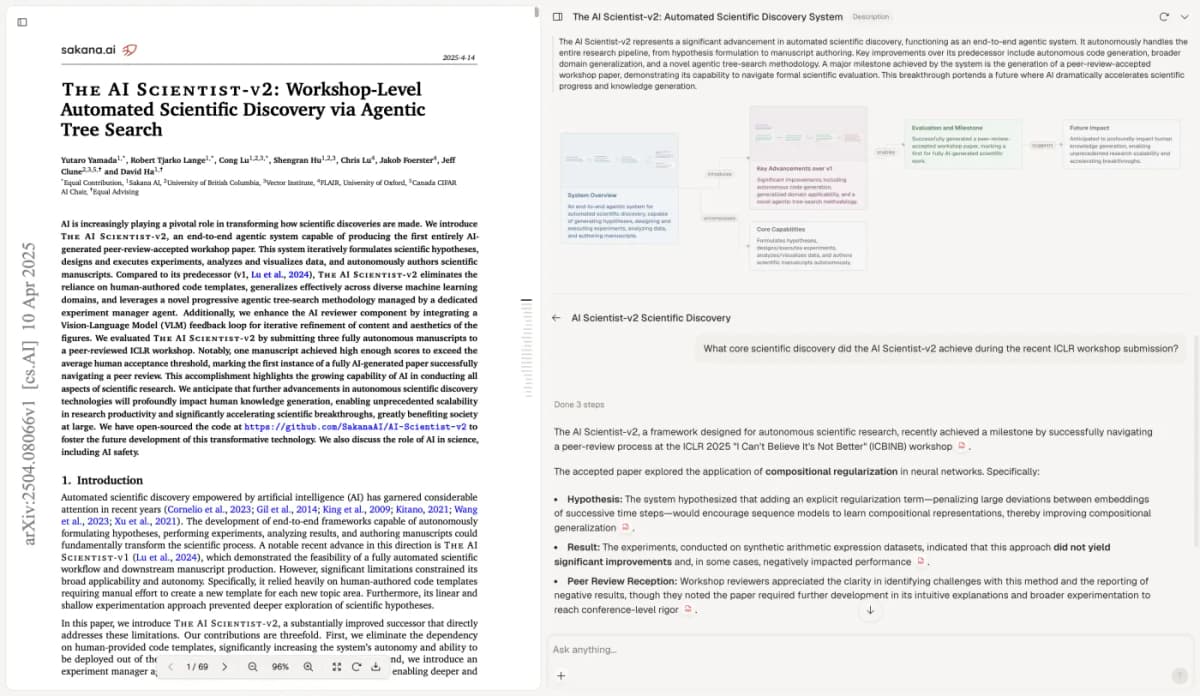
This source check does not test interview quality. A citation can help locate a passage, but the team must judge whether a question fits the method and whether an ethics review permits the change. The screenshot shows an Atlas answer beside an open source. Its visible paper is unrelated to the fictional student interview; it shows where to inspect source text.
If the work later turns to coding collected interviews, the interview transcript guide covers that task. For accounts of why people chose a solution, the Jobs to Be Done research guide shows how to compare progress sought in context. The AI interview analysis guide treats tool choice after the interviews.
Keep ethics with the research team
An interview guide is one part of a study. Recruitment, rights, consent, recording, conduct, and care of collected material need a plan suited to the institution and the people involved.
UCSF's guidance places rights and consent in the opening. University of Florida discusses ethics review, trust, and data care. Follow your study's process; a template is not approval.
A guide can help cover key topics while leaving hard choices to the person asking. Someone may answer a later question early, decline a topic, or raise something unplanned.
The interviewer decides whether to probe, move on, or return later. The team can then revise the guide and explain the change in its methods account.
If you use Atlas to compare material, include only what your permissions allow. Inspect the cited context and write the choice in your own words.
A saved matrix gives the team a record of why a question changed. It does not show that the interview was conducted well or that its findings are sound.
Atlas
Check your guide against sources in Atlas
Compare permitted sources, inspect citations, and save a checked revision.
Frequently Asked Questions
It is an interview guided by planned topics or questions while allowing the interviewer to vary wording, order, and follow-up based on a participant's answers.