
Jobs to Be Done Research: Trace the Progress Behind a Choice
Use Jobs to Be Done research to read customer interviews for desired progress, circumstances, obstacles, and social or emotional needs. See a cited example.
- Byline

Summary
Jobs to Be Done research asks what a person wanted to change and why they chose one way to do it.
Read each interview for the person's setting, goal, barriers, and other choices before naming a possible job.
Check each proposed job against contrary cases before using it to guide a product choice.
Jobs to Be Done research studies the progress a person wants to make in a specific situation. A course purchase could help one person change careers, a second meet an employer rule, and a third keep a study routine.
The product is visible; the reason for choosing it needs study. The Christensen Institute's theory overview frames a job around progress in a given context and a solution a person might “hire” to make that progress.
If you already have customer interviews, start with the choice story: what changed, what the person tried, what they chose, and what they hoped would be better afterward.
A job claim is a reading to test against other cases. A transcript alone cannot reveal an unspoken motive.

Atlas

Compare customer interviews in Atlas
Open cited lines, inspect countercases, and save a checked job note.
What Jobs to Be Done research studies
The focus is a choice in context. Ask what made an old way of coping fall short and what improvement the person sought.
One person may pursue several jobs over time. Several people may pursue a similar job. NN/g's comparison of personas and Jobs to Be Done explains why a role label does not supply the answer.
Researchers often distinguish functional progress, such as completing a task; social concerns, such as how a choice appears to others; and emotional concerns, such as relief. Microsoft Research's applied discussion describes these aspects alongside context.
Use the categories as prompts while reading. If an interviewee never mentions relief or social standing, mark that aspect unknown.
Separate the job from the solution
“Take an online course” names a chosen route. “Show enough work to apply for a new role while studying on weekends” names possible progress.
Both could be wrong for a given person. Check the person's timeline and other options before choosing the second wording.
A useful working distinction is:
- Circumstance: what had changed or constrained the decision? An upcoming application deadline differs from a manager's new credential rule.
- Desired progress: what did the person want to be able to do or feel afterward, in their own terms?
- Chosen solution: which course, workaround, colleague, free resource, or decision to wait did they use?
- Obstacle or tradeoff: what made the existing route insufficient, and what cost or risk did the person accept?
This split stops a team from turning every interview into a vote on course features. It keeps a role label such as “career switcher” from standing in for an observed job.
The research objectives guide can help state the choice the study must inform. The semi-structured interview guide covers how to ask open questions before this work begins.
Read decisions in their circumstances
For each interview, trace a short timeline: first sign of a problem, prior approach, trigger for looking, other options, point of choice, and what followed.
Ask what happened, without asking the person to endorse your proposed job. The User Interviews field guide offers interview prompts. Its advice cannot serve as evidence about your customers.
Record a source locator for each claim. “I compared three free videos” supports one option considered. It does not prove the person rejected free learning in general.
Read the nearby turns; a later answer might change what “free” meant. The interview transcript guide addresses preparing the text. The qualitative data analysis guide covers broader work after sources are collected.
When accounts disagree, keep the difference visible. Comparative analysis helps align cases on the same questions, and negative case analysis shows how an awkward case can narrow an early conclusion. The goal is a job description that explains a choice without erasing the evidence that resists it.
Compare three fictional course choices
The table below is a wholly fictional teaching example. Its labels and locators are invented; they do not represent customer data or a market sample. Each row stays close to what its brief passage would warrant. Save similar locators when working with real, permitted transcripts.
| Fictional source and passage | Choice and alternative | Candidate progress in circumstance | Limit or contrary reading |
|---|---|---|---|
| C-01, lines 18–29: “I can study Saturday; I need work I can show before I apply.” | Compared a paid project course with free videos. | Build credible work for a role application within weekend study time. | The passage does not establish that a certificate matters or that all career switchers share this aim. |
| C-02, lines 41–48: “My manager needs proof I finished an approved program.” | Chose an employer-approved course over self-study. | Show the required record at work. | The manager's rule may drive this choice. A project portfolio may have no role. |
| C-03, lines 12–22: “I already know the basics; I keep putting practice off.” | Chose a cohort schedule instead of a library of on-demand lessons. | Make practice happen through an external schedule. | Whether peer accountability or fixed dates mattered more remains unclear. |
Table 1: C-02 counters an early theory that all three bought a course to build a portfolio. C-03 raises doubt about adding more lesson content. A researcher could seek a second employer-funded learner, an experienced learner, or a non-buyer to test these readings. Three invented rows establish no prevalence, segment size, or demand forecast.
The market research challenges guide discusses gaps between evidence and market decisions. If a team must decide which course route to test, it needs further recruitment and an explicit sampling rationale. The theoretical sampling guide describes choosing a next case to challenge an emerging interpretation; it does not make a small set representative.
Draft and test a job statement
An initial note might say: “Customers hire a course to change careers.” That sentence hides the timing, the alternative, and the different jobs in C-02 and C-03. It is too broad to guide a next interview.
For C-01, a narrower working claim is: “When weekend study time is limited and a role application is near, make enough credible work to apply.” This wording uses the passage's practical aim.
Adding “with confidence” would require a spoken passage about confidence. The claim applies to this case; more cases would be needed before extending it.
Keep a short revision memo beside it: “Changed from change careers after C-02 showed a credential rule and C-03 showed a schedule problem. Ask C-01 whether showing work, learning skills, or a deadline mattered most. Speak with a similar non-buyer.”
The memo shows why the wording changed. Abductive coding handles a plausible account that still needs testing. Member checking concerns how participants may respond to a researcher's reading.
Some schools write jobs as desired outcomes. Others focus on a story of progress. Strategyn's account shows one outcome-based form.
Choose terms that fit the choice at hand. Show what backs your wording and what else could explain the case. Do not present the schools as one fixed method.
Check passages in Atlas
Add only interview transcripts you are permitted to use to an Atlas project. Select a small, relevant set with @. Ask: “For each interview, cite passages about the situation, desired change, other options, obstacles, and any stated social or emotional concern. Put guesses in a separate column.”
Atlas's public guides show how to choose sources and get cited answers. You still decide if each quote backs the proposed job.
Open each cited passage and its nearby context. Correct the table when a quote is cut short, a speaker is misread, or a later turn changes its meaning.
Save a checked note with locators, a candidate job, contrary cases, and the next fact that could change your view. Atlas helps locate and compare supplied text. It does not conduct the interview or decide what the customer wanted.
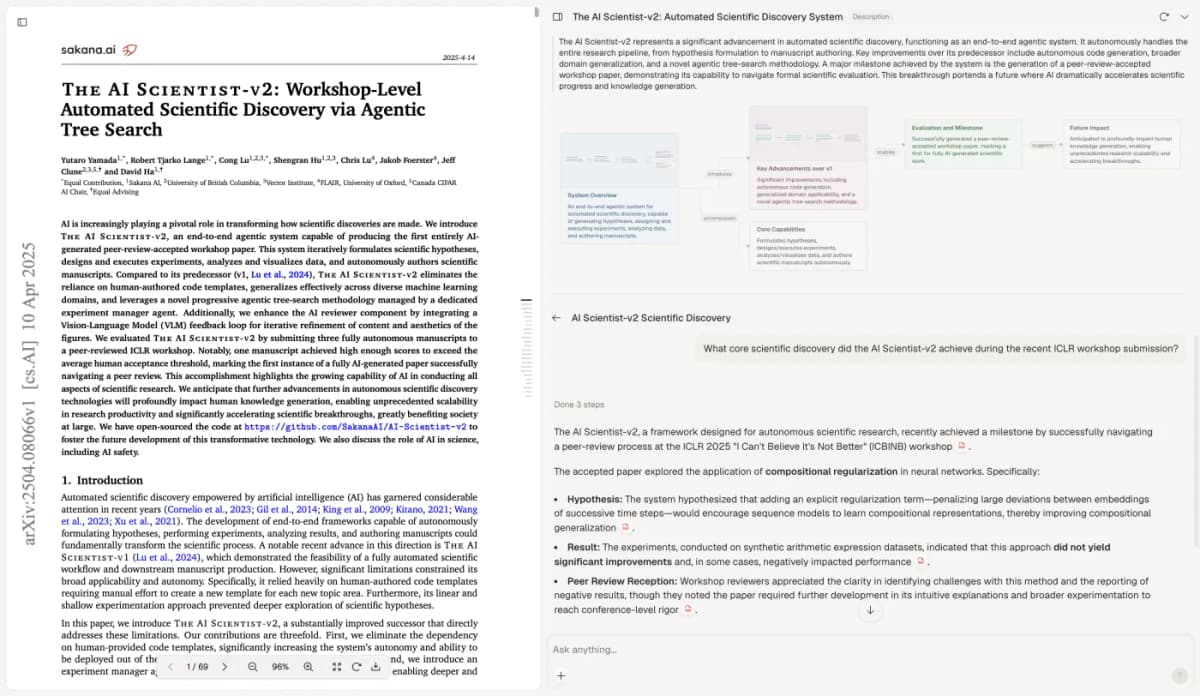
The screenshot shows an Atlas answer beside an open source for citation checking. Its visible paper is unrelated to the fictional course interviews and does not substantiate the example.
Keep inferred motives provisional
People may describe a practical goal and leave other concerns unstated. A researcher can ask a neutral follow-up about a tradeoff. A tool cannot fill a gap about status or anxiety with a claim about the person's mind.
Record said, suggested, and unknown separately. That matters when a polished job claim will reach people who have not seen the transcript.
People may explain a choice after the fact, and one purchase can serve more than one aim. Compare the story with actual options and timing. Seek cases that might prove your reading wrong.
A researcher triangulation discussion can surface other readings. A peer debriefing session can challenge assumptions. Both still depend on customer source material.
This work cannot show that a feature will sell or that a need is common. It cannot show that a new offer will work.
To learn more, speak with a case chosen to test the claim. Watch what people do where that is ethical. Test an offer if the team needs to know whether it helps. Each step calls for its own proof.
Carry the job into the next study
Take one possible job, its source lines, and its strongest contrary case into the next study. Ask: “When a job application is due soon, what proof do similar non-buyers seek?”
Some may seek work samples; some may seek a formal record. Their answers could change the current claim. The question also points to whom the team should speak with next.
If the interviews are done, compare their choice stories before planning features. The AI interview analysis guide covers more ways to read transcripts. The research implications guide shows how a narrow finding can guide a choice.
Keep the source lines with your advice. A teammate can then check the reasoning.
Atlas
Compare customer interviews in Atlas
Open cited lines, inspect countercases, and save a checked job note.
Frequently Asked Questions
It studies the progress a person seeks in a given circumstance and the choices, workarounds, and tradeoffs they make to get there.