
Peer Debriefing in Qualitative Research: Worked Example
Peer debriefing in qualitative research, with a worked example: choose a colleague, test a claim against excerpts, and record what changed after source checks.
- Byline

Summary
Peer debriefing asks a knowledgeable colleague to question a qualitative study's choices, evidence, and developing claims.
Bring a claim, relevant source excerpts, and a question to the session. Record the challenge and what the researcher did next.
A useful debrief can expose a weak interpretation. Agreement alone does not prove that a finding is true.
Peer debriefing is a planned talk about a study's choices and claims. A colleague asks the researcher to show the source, consider another reading, or explain a method choice. The researcher checks the material and records what they decide.
Imagine a researcher writes, “Students avoid office hours because their schedules clash.” A peer asks which excerpts mention time. They also ask about a student who feared looking unprepared.
The researcher checks both points and may change the claim. That checked answer is the useful outcome.
Atlas can help gather permitted excerpts, open citations, and save a checked reply. The colleague asks the hard question. The researcher decides how it fits the study.

Atlas

Check excerpts before peer review
Inspect cited passages and save a checked response to peer feedback.
What peer debriefing does
A peer debriefer is a colleague who can question the study in an informed way. They might probe the design, choice of cases, code wording, or a new claim. Meet while those choices can still change.
Spall's original study of peer debriefing found that trust shaped how students chose a peer. Its abstract reports a focus on method. Some met in pairs and some in small groups.
Shenton's methods paper says peers can question assumptions that are hard to see from inside a project. The researcher then checks the source and explains the next choice.
A quick “check my themes” request gives the peer little to test. Name a specific claim, show its basis, and write down the question the peer asked. Keep that record whether you accept the feedback or decline it.
Choose a colleague who can challenge you
Choose a peer who understands the method well enough to ask about your approach. Field knowledge helps when a claim turns on specialized language. Distance from the project makes a familiar explanation easier to question; trust makes the question easier to voice.
The choice also sets an access boundary. Agree on what the peer may see and how notes will be stored, then check that the study plan permits access. Even a passage without a name may reveal a person or site, so share only material the peer is allowed to review.
Power can blunt the talk. A junior peer may hesitate to challenge a supervisor, while a close partner may agree too quickly. Williams and Todd's account of a critical-friend exchange stresses trust and the risk of speaking up. Agree on the role before meeting: the peer asks hard questions while the researcher leads the analysis.
An outside peer still brings their own view. Ask what they know, what they might assume, and how they will flag a disagreement.
A study of five teachers in a long-running peer group found that commitment and continuity mattered to them. It does not set a meeting schedule for every study.
Prepare a focused evidence packet
Do not bring an entire corpus to a one-hour conversation and hope a useful challenge appears. Pick one decision the study is ready to test. State the research question, the current claim, and how you reached it.
The packet should give the peer enough context to see the basis and its limits:
- Current claim: one sentence that can be questioned.
- Source excerpts: short, permitted passages with IDs and locators so the researcher can reopen the full context.
- Alternative case: a passage that may not fit the claim.
- Current rationale: the analytic memo or decision note that explains why the claim seemed useful.
- Question for the peer: an open prompt such as “What have I assumed about these cases?”
For example, “Students avoid office hours because of scheduling” is a claim. Two interviews may support a time barrier. A third, about feeling judged, may challenge the one-cause wording.
Bring all three so the peer can test the wider claim. Seeing only the first two would hide the conflicting case.
Keep the packet small enough to read closely. If the discussion reveals a gap, note which additional cases or documents to revisit after the meeting. The peer should not have to guess whether a quote is a participant's words, an observation, or the researcher's summary.
Ask questions that test the claim
Open the session with the researcher's claim and the evidence packet. Give the peer time to describe what they see before defending the interpretation. Their task is to probe the reasoning and point to a possible weakness or alternative.
These questions can keep the conversation concrete:
- Evidence: Which passage most strongly supports this claim? Which passage makes it harder to defend?
- Boundary: Does the claim describe all relevant cases, or only a subgroup or setting?
- Alternative: Could the same words or action mean something else in context?
- Method: Does this inference match the study's analytic approach and research question?
- Next check: What source, case, or question would change our view?
Shenton's account of peer scrutiny treats challenges to assumptions as chances to refine the method and argument. The questions above turn that idea into a session agenda. They are prompts, not a scoring tool.
Write down the peer's exact concern and the researcher's reply. “Peer agreed” gives too little detail.
If the peer suggests dropping a case, ask why. If the researcher declines, explain the source or method behind that choice. A recorded dispute may teach more than quick agreement.
Follow a fictional peer debrief
This example is fictional. Its interview IDs and time marks are made up. The log reports no real peer session or Atlas result.
Imagine a small study of students seeking help in office hours. The first claim is broad: “Students avoid office hours because their schedules clash.”
The table shows a challenge log the researcher could complete after talking with a peer. Each row keeps the peer's question separate from the source check and the decision. That separation prevents the peer's first suggestion from silently becoming the final finding.
| Peer question | Fictional source check | Researcher decision and next step |
|---|---|---|
| Which students explicitly mention time? | P1, 03:18, describes a work shift during office hours. P2, 07:42, says the posted hours conflict with a lab. | Keep scheduling as one possible barrier. Reopen both full interviews before writing the claim. |
| Does every hesitant student describe a time conflict? | P3, 12:06, says the time was open but they felt unprepared to ask a question. | Narrow the one-cause claim. Keep P3 visible as a different reason for hesitation. |
| Could “unprepared” mean not knowing the office-hour format? | P3, 11:38–12:55, describes not knowing what to bring. The short quote alone is unclear. | Mark two readings as open. Ask a later participant how they understand the format; do not assign a cause yet. |
| Should the team drop P3 to make the schedule theme cleaner? | P3's account is within the study's question and consent scope. It challenges the broad claim. | Decline to drop it. Memo the disagreement and compare other cases before naming a wider pattern. |
Table 1: This fictional peer-challenge log shows why the source locator matters. The P3 excerpt sounds like fear of judgment when clipped. The surrounding passage might instead concern unclear instructions. The researcher has to check before choosing either reading.
A short memo after the session might read:
Before: “Students avoid office hours because their schedules clash.” Peer challenge: P3 had a free time slot; what kept them away? Source check: P3 describes uncertainty about how to prepare, while P1 and P2 describe time conflicts. Current decision: Treat scheduling as one barrier and P3 as an unresolved alternate case. Next check: Read the full P3 passage again and compare later interviews before naming a broader pattern.
The memo changes the claim while leaving the three invented cases as an example. The same method works if the researcher keeps a claim. State the peer's challenge, the checked passages, and the reason the claim still fits.
Qualitative coding workflows can organize early labels. The debrief asks whether those labels support the claim.
Check the challenge against sources
Atlas can help prepare the packet and revisit it after the meeting. Add only study material you are allowed to use. Mention the selected records in a project chat and ask a narrow question: “Compare the passages about office-hour timing and uncertainty. Put each case in its own row with a citation. Show any case that does not fit the time-conflict claim.”
Treat the reply as a draft source table. Open each citation. Check that the passage is from the intended record and read the surrounding material. Ask a follow-up if Atlas blends two participants into one conclusion. Save only the comparison you have checked, along with the peer's question and the researcher's decision.
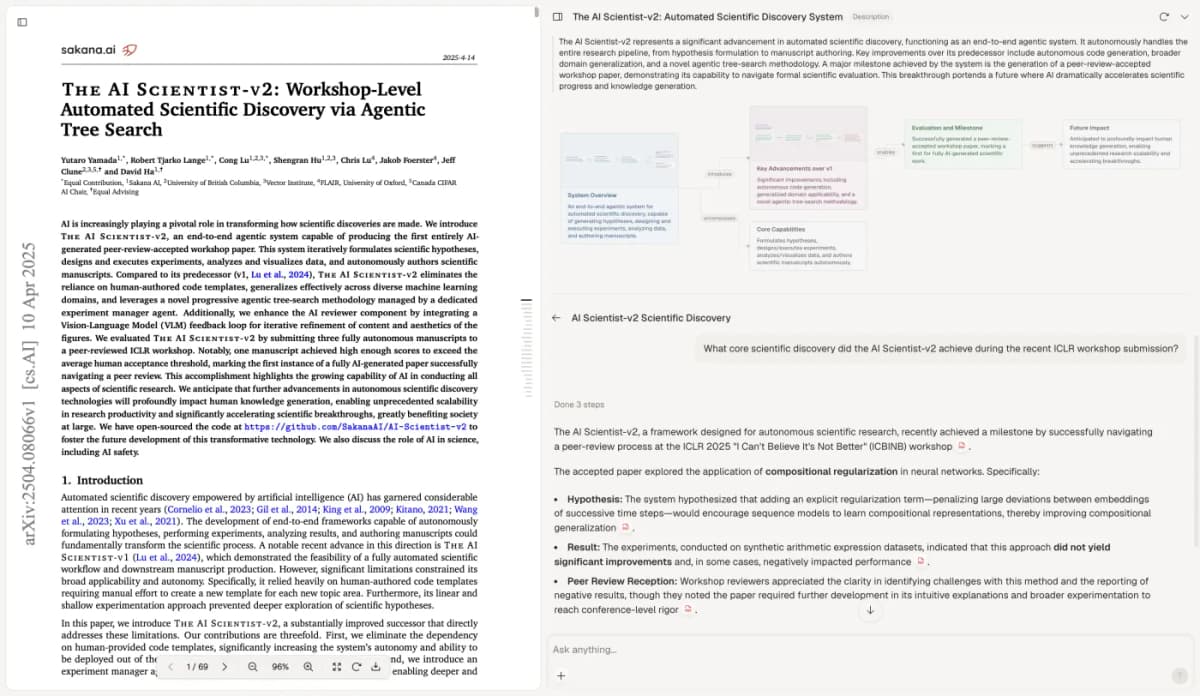
This first-party Atlas screenshot shows an answer beside an open paper on AI science. It illustrates where to inspect a cited passage. It does not depict the fictional student interviews or a peer-debriefing session.
The Atlas workflow supports source review and a saved note. The broader qualitative data analysis with AI guide explains how to keep generated summaries tied to the original material. Atlas cannot ask the independent human questions that make a peer debrief useful. The researcher owns the sharing, method, and interpretation decisions.
Keep the roles and limits clear
Peer debriefing, member checking, and reflexive writing have different roles. A peer questions the researcher's choices. In member checking, a study participant responds to data or a claim.
A reflexive note records how the researcher's own view may shape a choice. An audit trail shows how study choices changed over time.
Shenton's paper lists peer scrutiny, reflective notes, and member checks as separate methods. The university methods chapter also draws a line between an outside peer and a study participant.
Use the methods that fit the study. Report what each one added.
Peer debriefing cannot prove that a finding is true. A colleague may miss a case or share the researcher's view. Show the question asked, the source checked, and the reason for the reply.
Shenton's discussion of an audit trail supports recording choices over time. If a challenge stays open, say so and name the next check.
If the material is sensitive, the permission boundary is part of the method. An outside peer may need an approved role or a version of the evidence they can review safely. If that is unavailable, discuss the analytic question without showing restricted passages, and record the limit on what the peer could assess.
Atlas
Check excerpts before peer review
Inspect cited passages and save a checked response to peer feedback.
Frequently Asked Questions
It is a planned discussion in which a knowledgeable colleague questions a study's decisions and interpretations so the researcher can recheck evidence and explain the next choice.