
The critical incident technique, or CIT, studies events that matter to a clear goal or experience. Keep where it happened, what people did, and what changed together. Then explain why the event fits your study and what its account can support.
The three library-help accounts below are made up for this guide. Two tell us what happened and what changed.
One gives a view with few details. The worked review shows what you can write from those words and what still needs an answer.

Keep incident claims linked to the account
Compare supplied accounts, inspect citations, and save a checked incident note.
Define what makes an incident critical
Critical means that the event matters under the rule you set for the study. It need not be a crisis or rare event. Serrat's method chapter makes that distinction. A small action may help someone reach a goal or get in the way.
State which approach you use. Classic CIT focused on watching what people did. Later work also uses people's accounts of events and what those events meant to them, as Gremler's research synthesis describes. An event recalled by a student and one seen by a researcher give you different kinds of evidence.
CIT connects the study's aim to collection, analysis, and reporting. The five-stage methods overview sets out that sequence.
A list of striking stories is not enough. Readers need to see how you chose the accounts and reached the findings.
Set the rule before comparing accounts
Name the activity and the study question
For the fictional example, ask: What actions in library help sessions do students describe as helping or hindering their use of a source before a seminar?
The activity is getting usable source help. The unit reviewed is an event account, with its context retained.
Twelker's planning manual starts with the activity's aim and defined conditions. Here, the question does not ask whether a whole library is good or whether help improves grades. Those claims would need other evidence.
Write an inclusion rule you can explain
For this worked review, keep an account in the event table when it tells us about a source-help session, an action, and what changed for source use. Keep accounts with missing details aside for follow-up.
This rule serves the example; it does not set a rule for every CIT study.
Gremler's reporting checklist asks researchers to define which events count, which do not, and what they analyze. Record the choice beside the passage. A reviewer should be able to see why it was kept or held aside.
Ask for detail without supplying the answer
Draft prompts might ask: What were you trying to do? What happened next? What did the person do? What difference did that make for you, if any?
These are new teaching prompts, with no claim of a tested interview guide.
The ECIT procedure paper uses follow-up questions for unclear or incomplete points. For collection planning, the interview protocol guide explains neutral prompts and a pilot. Settle the study's required review and consent process before collecting accounts.
Worked incident selection example
All three accounts below are invented. No students were interviewed, no library was assessed, and no coding check was carried out. The rows show how the same text can support a narrow claim and leave a broader one open.
Retain context and the reported result
Account A describes needing a passage for a seminar. A staff member opens the right edition, finds the passage, and explains that it does not support the student's broader claim. The student reports using a narrower claim with a traceable reference in the seminar.
Account B describes asking for a particular edition. The reply links to another edition. The student reports finding that the required passage is absent and going back to ask for the correct source before the seminar. Account C says only, “The help was poor.”
The inventory's columns follow the setting, behavior, and result distinction discussed in Serrat's chapter.
| Account | Context and action reported | Effect reported | Decision under the example rule |
|---|---|---|---|
| A | Seminar passage needed; staff finds the right edition and checks claim scope | Student uses a narrower, traceable claim | Retain as a helping event for source use |
| B | Specific edition requested; reply points to another edition | Passage missing; student asks again for the correct source | Retain as a hindering event, with later outcome open |
| C | Only a negative opinion about help | No action or effect described | Hold for clarification; preserve the opinion separately |
Table 1: The three-row inventory preserves what each fictional account supplies.
Correct an invented consequence
Suppose a draft turns C into “Staff ignored the request, so the student missed the seminar.” Neither detail appears in C. Remove both. The checked note says that the account lacks a described event and result; it does not say that no event occurred.
Ask what happened and why the person viewed the help that way, where the study permits follow-up. Butterfield and colleagues describe noting items without stated impact for later clarification. Here, there is no actual follow-up answer to add.
State what the comparison can teach
A and B suggest source edition and claim fit as possible topics, not validated categories or a library-wide pattern. The methods overview ties categories to the study's purpose: source use here. Preserve C's opinion and selection status without inferring unreported behavior.
Read A and B side by side before deciding that one simply shows good help and the other bad help. A tells us that a claim became narrower. B tells us that the student had to ask again. They do not report the same kind of result. The table makes that difference visible so a broad label does not hide what each person said changed.
Keep the order of actions in B as well. A link to the wrong version came first, the student checked it, and then the student asked again. The account ends there. A later reply might have solved the problem, or it might not. Neither ending is in the text. A useful note preserves the last reported step rather than making the story feel finished.
Keep account evidence and interpretation distinct
An opinion leaves the event unclear
“Poor help” tells you how the person judged the experience. It leaves open what happened.
Keep that judgment in the record while explaining why it does not yet meet this example's event rule. Do not quietly discard it or translate it into actions the person never reported.
Twelker's conditions guidance helps make event selection specific. Apply your chosen conditions openly and record uncertain cases. A rule should make the decision visible, not make a short account appear complete.
A recalled effect retains its source
Write “the student reported needing to ask again.” That wording tells the reader where the claim comes from.
Keep what the person said changed separate from your reading of why it changed. Put your explanation in a note with its own label.
Gremler discusses recall and coding limits. The account may leave out context or reflect what the person thinks now. Citation checks trace your summary to the text; they do not verify the memory. The citation-checking guide supports that narrower task.
Desired support is not a reported action
“I wish someone had checked the edition” describes a desired action. It should not become “Someone checked the edition.”
Preserve the wish with its own label if your design collects that material.
The ECIT authors distinguish wish-list items from help or hindrance that was present. This guide's table does not implement their full enhanced method. Name adaptations in your study rather than treating all CIT variants as interchangeable.
Build categories that preserve the event
To build categories, read the data closely and group events by what they have in common. A category is a named group with a rule for what belongs in it. The CIT methods entry describes this as an inductive process: the groups grow from the accounts as you compare them. Keep the source passage attached while you work.
Here, “staff performance” would hide the difference between finding the right book version and checking whether a claim fits. Try “source edition checked” as a draft label. Its rule might include an action that confirms the requested version, while leaving a general offer of help outside that group. This is a proposed grouping to review, not a tested finding.
Keep the source excerpt, draft group rule, and reason for placing it there together. A contains two actions: finding a version and checking a claim. Your coding rule must explain how to treat an event that fits more than one group. Do not count it twice without saying what each count means. These two made-up events cannot settle the groups for a real study.
Butterfield and colleagues' procedure revises groups while retaining people's items. Their enhanced approach includes checks on the work. Choose checks that fit your method and report how you carried them out. A model grouping text is not evidence that you completed a check with a second coder or the people in the study.
A reviewer can compare the passage, label, and rule and explain a different reading. Keep both views in the review note and say how the team resolves them. Gremler's checklist calls for reporting coding and reliability checks in content analytic studies. The present example has no agreement score: no second coder has reviewed it, and a teaching table cannot stand in for that work.
If prior studies shape your choices, note what they add and their limits. Use a literature review process to separate method guidance from your own data. A published list of groups does not show that your accounts have the same meanings. It might help you ask a question about A or B, but you still need to show how the passage fits the rule you used in this study.
Compare supplied incident accounts in Atlas
Use texts that you are allowed to add under your study's data rules.
For this demonstration, use the made-up accounts above, their selection rule, and a note with the claims you want to check. Atlas helps compare text; you decide whether the answer stays true to each account.
- Add the accounts and rule to a project using supported source options. Wait for processing to finish.
- Start a chat, type @, and select those exact sources and the claim note.
- Ask where each event happened, what people did, what changed, and which details are missing, with supporting passages. Keep source text and your reading of it distinct.
- Open each numbered citation and read nearby text. If it opens only the source, locate the passage directly before accepting the row.
- Compare the answer with your rule. Remove actions, effects, or motives that the text does not support. Keep open choices about which events fit.
- Choose New, then Note, save the checked inventory with recognizable source references, and wait for Saved.
Use a focused request: “Compare these supplied accounts against this rule. Leave unreported details open. Identify the passage behind each statement. Do not invent events, effects, or participant motives.” For a larger source set, the research synthesis workflow helps organize the comparison without making it a complete CIT analysis.
Check C closely. If an answer says the student missed a seminar, open its citation and read the whole account. C contains no such result.
Remove the claim and save the missing-detail note. The model's confident wording does not add evidence.
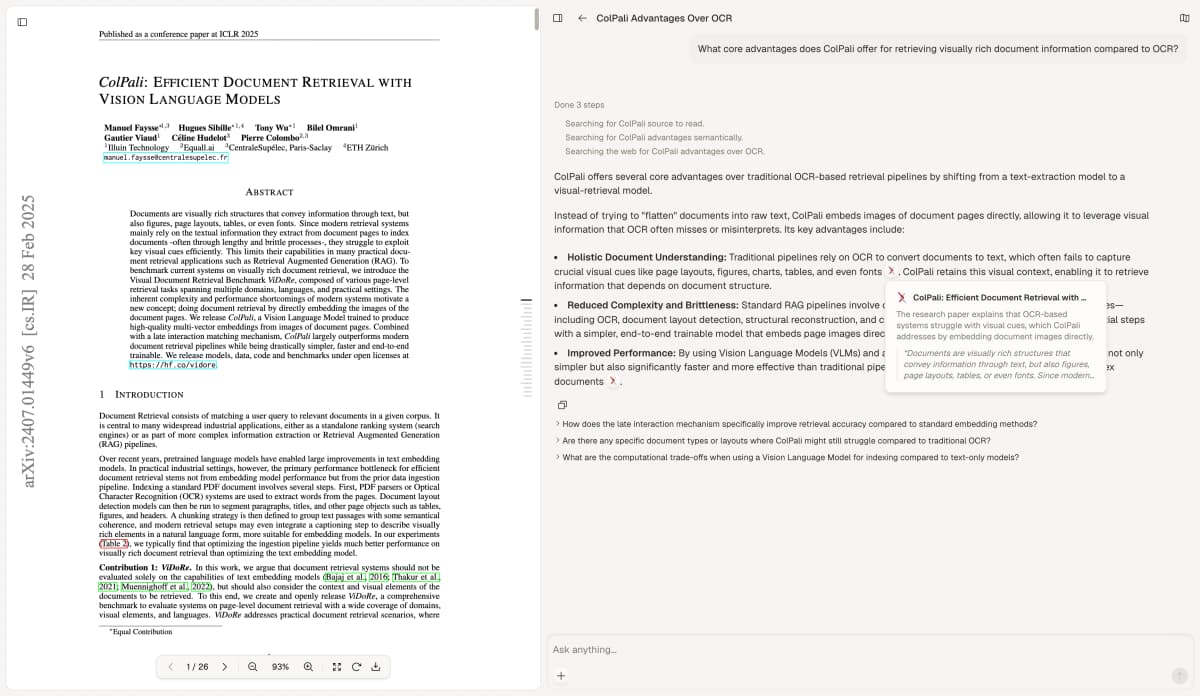
This existing Atlas capture uses an unrelated ColPali paper. It shows a source page beside an answer so you can inspect a cited claim. It shows no incident accounts, interviews, group checks, or completed study of the example.
Paper shown: ColPali, by Manuel Faysse and colleagues, under CC0. Atlas captured the interface; the displayed paper content was not edited.
Write the findings with their limits
Describe how the material became findings
Explain the study aim, approach, who gave accounts, and how you gathered them. State which events you kept and how you formed groups. Show excerpts behind the findings and explain cases left out or open. Gremler's report guidance connects those decisions to what readers need to assess the study.
Keep event counts separate from counts of people. One person can report several events. Say what you divided by if you report a share. The ECIT procedure paper keeps track of who gave each item when working out participation rates. Those rates describe the study's accounts. They do not show how often an event happens among everyone outside the study.
Leave broader claims for suitable evidence
For this example, write: A and B meet the stated event rule, while C needs more detail. A describes useful source help; B reports needing to ask again. These statements stay within the accounts' limits. They cannot show how often either event occurs or whether a service change works.
Serrat frames incident analysis as a starting point for learning from experience. Treat a possible change as something to test further.
Keep the checked table, group rules, open questions, and next evidence needs together so a researcher can follow how you reached the findings.
Keep incident claims linked to the account
Compare supplied accounts, inspect citations, and save a checked incident note.