

Qualitative observation records what people do and say, along with the setting in which it happens. A useful account keeps enough detail for a reader to follow the scene. The meaning a researcher gives that scene needs its own support.
An observation-description-context note puts those parts beside each other. Name the record, describe what it reports, retain the observer's view and focus, and mark any proposed meaning. That helps a reader spot where a claim goes beyond the account.
The worked note below reads published method examples. It is our teaching aid, with no new fieldwork, access to private patient records, or judgment about clinical practice. Its purpose is to keep a source check clear and bounded.

Check descriptions against observation sources
Keep observed actions and inferred meanings in separate fields.
What qualitative observation records
Qualitative observation gives a detailed account of actions, speech, objects, or settings that matter to a research question. Researchers may join in or watch with little direct involvement. The IPA practice guide explains those roles and how to record context.
A numeric measure asks a set count or score question. A descriptive record keeps the scene and what happened within it. The Scribbr guide explains this broad difference. Choose the record type that fits the question, and keep its limits visible.
Numbers can still supply context
A date, time mark, room number, or number of people can help locate a scene. A digit alone does not turn a field note into a numeric analysis. Check what the value does: mark the record, describe the setting, or measure a defined feature.
In Lindorff and Sammons' classroom study, numeric ratings sit alongside field notes, time codes, and researcher memos. The paper reads three recorded lessons. Its mixed record types show why the whole study need not fit a words-versus-numbers split.
Prepare the record and evidence scope
Begin with an evidence checklist for the materials you are allowed to review. Name the record version, date or scene, author or observer, source location, study aim, and protocol. If a file contains sensitive details, use the version the study permits for this kind of review.
State what kind of source you have
A raw field note, an expanded account, a methods paper, and a report of themes are different sources. They may describe the same work at different stages. Label each one before comparing claims, so a later summary does not stand in for a full scene.
The published methods paper by Weston and colleagues provides the examples used below. We read its method sections and selected accounts. We have not examined the study's full private corpus or checked what happened beyond those published passages.
Keep role and timing attached
Record whether the observer joined the activity, watched from nearby, or reviewed a recording. Keep the stated focus and any viewing limits with the account. A camera angle, closed door, or choice to follow one person can shape what enters the record.
The IPA guide's record-writing advice separates descriptions, the researcher's part in the scene, and reflections. Use that distinction to check a supplied note. Do not assume that a fluent paragraph makes all three parts equally well supported.
Keep quick notes and later additions traceable to their stage. A timestamp may mark the event, the recording, or when someone wrote the note. Read the key or protocol before treating all such marks as exact event times.
Worked observation-description-context note
The following four rows draw on Weston and colleagues' published method examples. Each keeps a source location beside the kind of detail it supports. Our checking questions are a teaching aid, with no claim to a complete audit of the study.
| Source location | Reported detail | Context to retain | Bounded reading |
|---|---|---|---|
| Observer type and role | Equipment use and task sequence | A non-clinician's detailed account | Keep actions before summary labels. |
| Collecting observation data | A team has twelve members | The note follows one doctor | Do not treat it as every member's record. |
| Collecting observation data | An action may be outside view | Viewing limits affect the record | Unseen does not establish unperformed. |
| Ensuring data quality | Peer or recalled details are added | Additions are annotated after comparison | Keep where each addition came from. |
Table 1: The section locations refer to the original methods paper. These are short paraphrases of published examples, with our checks beside them. They supply no new patient data, compliance score, or claim that all relevant actions were captured.
Check a completeness overclaim
Suppose a draft says, "The record describes what every team member did." This is an invented claim for the source-reading exercise.
The focus row gives a reason to reject it: the observer followed one person within a larger team. The fuller scene helps us check how far the record's claim can go.
The corrected note should name that selected view. A count of people present gives context, but it does not supply a complete behavior count for each person. Leave the rest of the team's activity outside the supported claim.
Keep missing views separate from non-use
A second draft might say, "The action did not happen," when the source only says it was not seen. Keep the viewing limit in the correction. The note may support a claim about what the observer could see, while leaving the full event open.
A clear field record can also state that an action was absent during a defined watched interval. That is a more specific kind of evidence. Check the exact wording, focus, and interval before choosing between absent, unseen, and unknown.
Do not fill the gap with a likely routine. Ask which source could resolve it under the study's rules. If none is available, keep the gap in the checked note rather than adding a smooth account of what probably occurred.
Correct interpretations without losing context
Descriptions are selective accounts, even when they are detailed. Researchers choose a question, a place to look, and words for what they see. A checked note makes those choices visible so later readers can review the proposed meaning.
Actions and inferred meanings
A phrase such as "the participant was disengaged" gives a meaning to behavior. Read the record for the actions that support it.
What was said or done, when did it occur, and which part of the scene did the observer follow? Keep those details beside the proposed reading so others can assess its support.
If the source lacks those details, mark the meaning as an inference with limited support. Do not invent posture, speech, or movement to make it sound more concrete. A citation beside an unsupported feeling label does not supply the missing scene.
Recorded speech can help explain a person's view, but it also needs its context. State who spoke, whether the words were captured or recalled, and how the record links them to the event. A researcher's paraphrase should remain labeled as such.
The IPA guide's field-team guidance asks researchers to consider how observer characteristics can shape the record. Its section on self-awareness also addresses the researcher's background and assumptions.
Use those questions to review what the observer brings to the scene. The guide does not establish how well a specific field note fits the event.
Observer position and later changes
Keep the observer's own reflections beside the scene they concern. A role, prior knowledge, or active part in the event may shape what was noticed. Stating that position helps review the account and leaves its meaning open to scrutiny.
The autoethnography guide explores personal experience in its social context. It can help when thinking about the researcher's position.
A field record about others and an account centered on the researcher's own experience have distinct jobs. State the chosen method so a reader knows whose experience the account seeks to understand.
When a note changes after discussion, identify the new source of detail. A peer's account and the first observer's later recall may both matter. Their value is easier to assess when the record keeps those routes visible rather than silently merging them.
Look for places where the proposed meaning does not fit the record as well as places where it does. Preserve alternate readings that have support. The task is to make the reasoning reviewable, with no promise that one note can settle every motive or meaning.
Review observation sources in Atlas
Add notes, protocols and method guides you are allowed to use. Wait for source processing and check that the files are readable. Use the source-synthesis workflow to keep each record's role clear as you compare sources.
Start a fresh chat and mention the chosen sources with @. Ask for separate fields for what was seen, counts or scores, context, inferred meaning, and open gaps, each with a cited passage. Project only limits new retrieval, while prior chat context remains relevant. Keep the question tied to the records.
Open each cited source and read around the passage. Use exact passage navigation where available, or read the source section. Check the answer against the record's focus, view and timing, then correct any added motive, action, or claim to a full account.
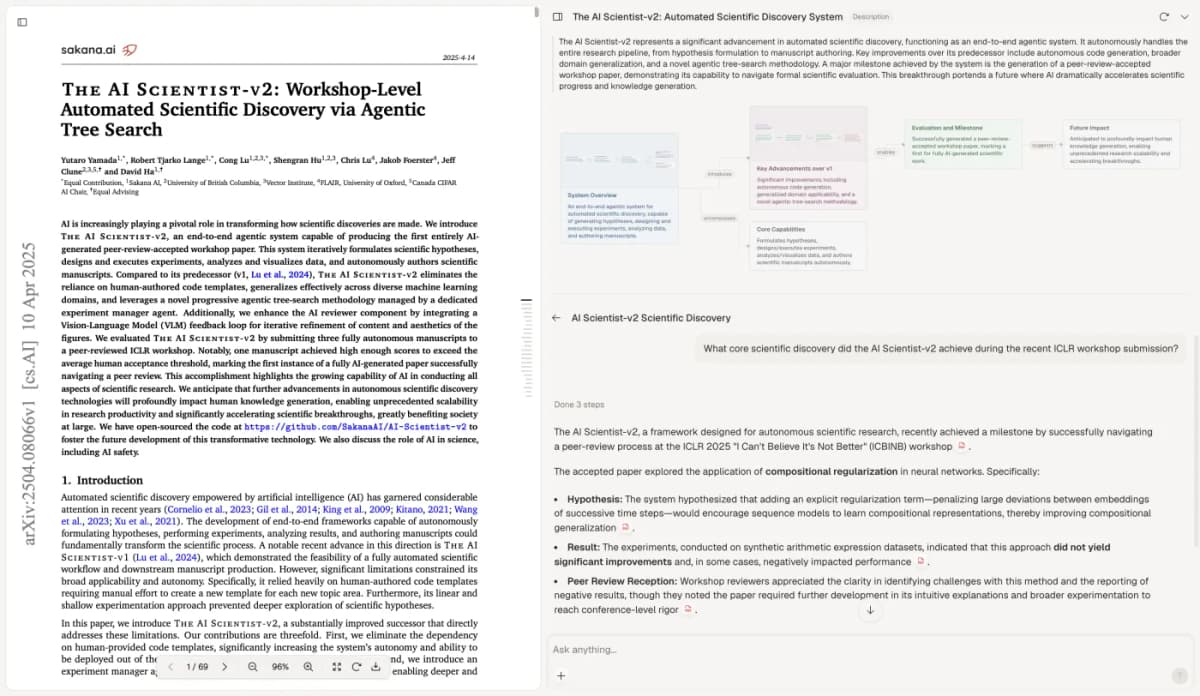
The unchanged Atlas screenshot shows Yutaro Yamada and colleagues' The AI Scientist-v2, under CC BY 4.0, beside a cited answer. It shows no private notes, observation test, or verified reading of the healthcare examples. The worked note is a teaching aid.
Retain the checked record and limits
Save the corrected account through New, then Note. Name the record and scope in the title, enter the checked fields and open questions, and wait for Saved. The research-note guide helps make those checks easy to find later.
Keep a link or precise location for each source claim. State which files you reviewed and which were absent.
This record of scope lets a later reader judge whether a new protocol, fuller scene, or revised note changes the reading. Retain the prior note when the study's version rules call for it.
Before combining studies, check whether they watched similar settings, roles and spans of time. A shared topic may hide a different view of the event. The literature review process gives this check a place in the wider research task.
Researchers remain responsible for consent, permissions, confidentiality, fieldwork and analysis. A source-linked AI answer does not certify those matters. Removing a name alone also supplies no guarantee that a record cannot reveal the people involved.
The checked note should preserve what can be supported and what remains open. Use it to guide the next source review or research discussion. Keep coding choices and final interpretations with the researcher, and return to the record when a claim needs fuller evidence.
Check descriptions against observation sources
Keep observed actions and inferred meanings in separate fields.