
Autoethnography links the study of your own life to the study of culture. You read your account alongside its setting, other research, and your place in the work. The research question gives the account a purpose beyond telling a story.
An experience-context-positionality note makes those links easier to check. It keeps what the account says beside the sources that help you read it. You also state how your role shapes that reading. Each part needs a source or a clear account of your judgment.
The worked note below uses Jane Edwards's paper about her own writing. We draw on a small part of her account to teach source checking. We did no fieldwork and had no access to her earlier memoir, which she chose not to publish.

Connect your account to its context
Compare your accounts and literature with your research position in view.
What autoethnography connects
In their original method overview, Ellis, Adams, and Bochner link close study of one's own life with the study of culture. They describe several forms of research and writing. The focus on self, others, story, and analysis can vary with the question and approach.
A diary entry can supply a source for that work, but the entry alone does not explain what it means in its setting. Show the question, the context, and the reasoning that links them. A study of belonging at work might place a recalled event beside the writer's role and research on that setting. The writer must explain why these sources belong together.
The Simply Psychology overview explains this link between your own accounts and wider context. Chris Drew's guide also places stories within social research.
These guides help new readers find their way into the method. Use the original method papers to support research choices in your own project.
Prepare accounts and contextual evidence
Give each source a clear job before you compare it with another. Your own account supplies what you recall or wrote down. Research on the context offers ideas and findings that may help you read it. A reflexive note records how your life and role affect that reading. Keep those source roles clear in the evidence note.
Record when the account was made
The Cooper and Lilyea method guide, in its section on data sources, sets later recall beside records made at the time. A later memory may focus on an event that gained meaning only afterward. A dated journal may keep what you noticed then. Neither source gives a full view of every event or bond with other people.
Record the date of the event where known, the date of the account, and any gaps. Say when you are unsure of a date.
A source can support a date or event without proving what it meant to you. A later draft should keep both the recalled meaning and the limits of factual support.
Describe your position in the setting
Positionality means your place in the setting and the research. Your role, training, access, ties with others, and changes in status may matter to the question. Explain how they affect what you can see and how you read it. Show why each detail matters rather than listing labels about who you are.
You may know a setting well while feeling new to its language or methods. Later work can change how you read that experience. The reflexivity guide helps examine those changes. For an online group's shared practices, the netnography guide helps keep members' accounts and community context distinct from your own experience. An online setting alone does not determine the method.
Worked experience-context-positionality note
Edwards's paper on ethical writing recalls her work as a music therapist in a children's teaching hospital. She reports feeling out of place among science-based work despite kind treatment. A later visit to another science setting prompted memories of that earlier time.
In the section on an ethic of autoethnography, Edwards describes a memoir she shared at seminars but chose not to publish. She had concerns about consent and whether others could be recognized.
We can read her paper about that choice. The earlier memoir is not part of the supplied evidence.
We wrote the following teaching note from the paper, placing source locations and limits beside each reading of the account.
| Part | Account or context | Source location | Interpretive limit |
|---|---|---|---|
| Experience | Edwards reports feeling out of place despite being treated kindly. | Edwards, hospital recollection in the ethic discussion. | A reported feeling does not establish colleagues' motives. |
| Context | Her psychosocial work sat within a medical setting with scientific research. | Edwards, description of the hospital and later scientific visit. | One account does not describe every hospital or research culture. |
| Position | She writes about her earlier work from a later point in her life. | Edwards, hospital account and the later visit that prompted memories. | The later view may shape which earlier events she attends to. |
| Comparison | Personal experience can inform cultural inquiry while implicating other people. | Ellis, Adams, and Bochner, research process and relational ethics sections. | Method literature informs the reading without verifying the remembered events. |
Table 1: Each row sets a reported detail beside the claim it might support. The last row draws on the original overview's sections on process and ethics. It gives us a way to read the account. It adds no new record of events at Edwards's workplace.
Connect literature to a specific passage
A useful note explains what an idea helps you notice. Here, the account places felt discomfort beside kind treatment. Those details raise a question about the link between a work role and a sense of fit.
They do not answer it for every worker or explain what other people meant to do.
Add the exact passage location before you extend the claim. If an idea fits only part of the account, name that part. Another passage may give a different view.
The research synthesis guide explains how to keep source roles clear while you develop a shared reading.
Write an interpretation with limits
We wrote the next paragraph as a reading of Edwards's paper. It is not a quote or her own stated conclusion. We did not verify the events ourselves. Its scope is the hospital account and the later view described in her article.
Edwards's account suggests that kind treatment and a sense of being out of place can coexist. It raises a question about how a person's work role relates to a science setting. Her later life gives her a point from which to revisit those memories.
The supplied paper supports this question and reading. It leaves others' motives and the wider workplace culture open.
That reading ties a narrow claim to reported details. You could study the question further with suitable sources and a chosen research approach.
The scope-of-the-study guide helps state which setting, account, period, and question a note covers. A wider claim needs a reason beyond the appeal of the story.
Correct an unsupported cultural claim
Suppose a draft says colleagues rejected Edwards because her work was different. Her paper describes kind treatment alongside discomfort, which does not support that claim.
Keep both reported details in the draft, then mark the question about fit at work as a reading to explore.
Do the same when a source seems to explain a memory too neatly. An idea may shed light on an event while leaving other meanings open. Keep details that resist your preferred reading.
Cooper and Lilyea's discussion of records and quality also helps set checking an event apart from understanding its meaning to a person.
Check account sources in Atlas
Review consent, private details, and effects on others before deciding which sources to supply. Add suitable accounts you own, research on the context, and reflexive notes to a project. For this teaching example, the supplied account is the article. Do not describe a memoir you cannot access as a source you inspected.
Start a fresh chat and mention the named sources. If you use Project only, it limits new retrieval while earlier chat context can remain. Ask Atlas to compare the account, sources about its setting, and notes on your role. Request a source location for each reported detail and a clear label for any proposed reading.
Open each citation and read the text around it in the source. Atlas opens the related source and goes to the cited passage when available. Otherwise, find it yourself. Check who is speaking, when they wrote the account, and which limits they state nearby. A citation to a method paper cannot replace support in the account itself.
Revise any claim that lacks support. Use New → Note to keep the checked comparison, its source locations, the date, and open questions. Wait for Saved before closing. The research-note organization guide helps you trace the account, research sources, your reading, and later changes as the project grows.
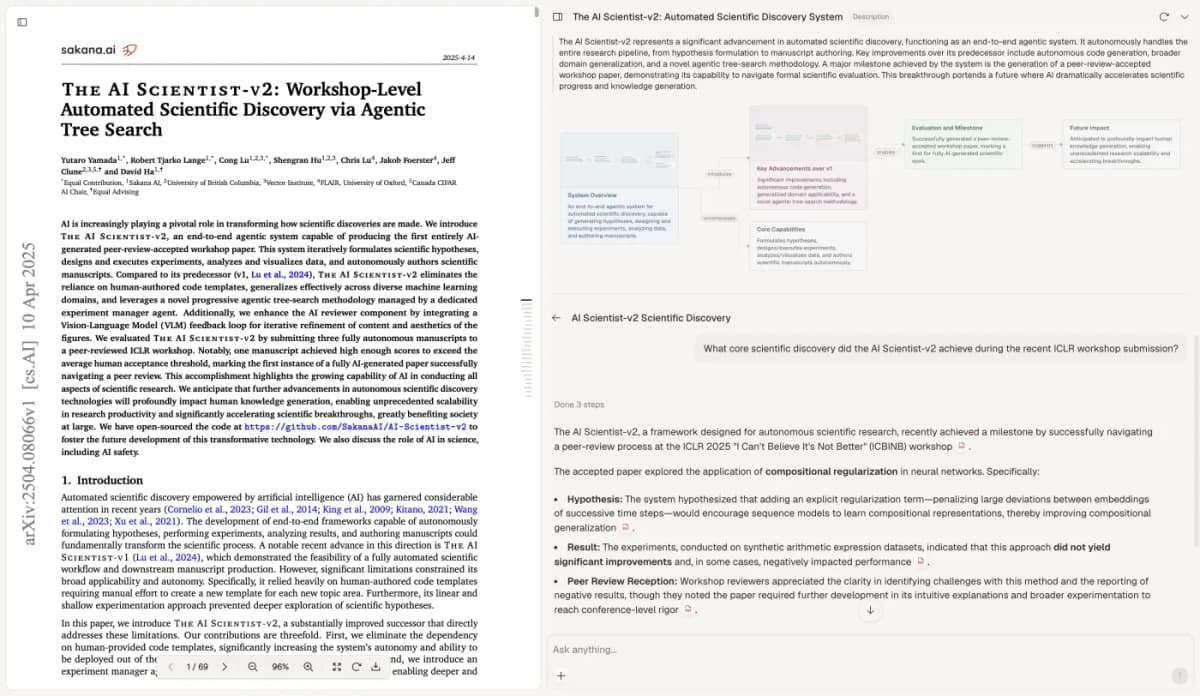
The capture shows Yamada and colleagues' AI Scientist-v2 paper, under CC BY 4.0, beside a cited answer. The Atlas interface capture is unchanged. It illustrates source inspection and supplies no evidence about Edwards's account or this worked note.
Review what the note can support
Before using the note in a draft, read the account without the comparison beside it. Check that your reading still fits its wording. Then read the source about the context and ask what it adds.
A strong paragraph should keep the reported event or feeling distinct from the meaning you propose for it.
Consider people within your story
Writing about yourself can reveal others through their roles, ties to you, places, and known events. Changed names may leave those clues intact.
The original overview's relational ethics section makes those ties part of the writer's ongoing judgment. Edwards's choice to withhold the earlier memoir shows how such concerns shaped her writing.
For your project, follow the research rules that apply and consider the effects of sharing each account. The note cannot supply consent or ensure that no one can be recognized.
You may need to change what you share, seek guidance, or leave out a source. Keep the reasons for these choices in your research record when appropriate.
Finally, check the note's limits. Name missing records, uncertain dates, other possible readings, and the scope of the claim about culture. Keep the version of your reading that fits the evidence you can inspect. Researchers remain responsible for the account, the reasoning, and what they choose to publish.
Connect your account to its context
Compare your accounts and literature with your research position in view.