
Netnography adapts ethnographic research to online cultures and communities. It asks what people's words and practices mean in their social setting. The digital setting and the researcher's role also shape that reading.
A folder of posts can inform a study; it does not, by itself, explain a group's way of life.
Keep each excerpt beside the context that changes its meaning. Record the local rules, who is speaking, what happened before and after, and what you still cannot tell. This guide shows how that works with an invented repair group and a checked context note.

Keep community context beside each claim
Compare permitted excerpts with the rules and field notes that explain them.
What netnography tries to understand
Kozinets' encyclopedia entry defines a qualitative, interpretive approach to online ethnography. Its abstract includes digital context, close involvement, and ethics. In plain terms, the aim is to understand what practices mean within a group. Words need that setting rather than being treated as detached data points.
Imagine a group in which members often show repairs before asking for advice. A count could tell you how often photos appear. A cultural question asks what showing a repair does: invite help, show effort, teach a shared skill, or mark belonging. Those meanings need support from the group, not a guess based on a keyword.
In his Library of Congress interview, Kozinets explains how technology, archives, and corporate control shape online settings. He also stresses the researcher's own role. Ask how the platform and your presence affect what can be seen.
Costello and colleagues warn against using netnography as a label for any study of online text. They argue for active involvement; this is their methods position, not proof that one approach fits every setting. Separate the qualitative research design from the data source and software. Using forum posts does not settle the design. A tool that compares excerpts cannot supply the study's relationships or ethics work.
Keep context beside the excerpt
Begin with the research question and the group's purpose. A repair group, a grief forum, and a game's fan server may use the same phrase for different reasons.
Explain why this setting can inform your question and which parts you studied. The posts you can access may not speak for everyone who belongs.
Keep the order of the exchange. A brief reply may look blunt on its own but follow a long exchange of help. Retain enough surrounding text to test that reading within the allowed scope. Kozinets' direct account links focus and relevant records with close attention to the researcher's role. The aim is not to gather everything.
Record local terms, rules, and how members explain them. A rule shows what is asked of members, not proof that all members follow it. Compare it with actual practice and mark any mismatch.
Keep a member's account distinct from your own reading. Both can matter, but they support different claims.
Write a field note about your role. State whether you watched, joined exchanges, asked questions, or already belonged to the group. Note how you gained access and how your interests shaped what you chose to read. The Costello methods synthesis stresses both involvement and a clear account of what was done. Explain your choices without inventing a role you did not have.
Record platform features that shape what you read. A pinned rule, deleted reply, ranked feed, or demand for an image can affect which accounts you see. Save dates and source locations in the records you are allowed to keep. A later change should not vanish from the account. These notes help you revisit a claim when its context changes.
Use an analytic memo when your reading of an exchange changes. Connect the idea to permitted excerpts, record another possible explanation, and name what you need to check next. Keep that reasoning apart from what a member actually said.
Worked online-community context note
The following records are wholly invented for teaching. The group, members, phrases, rules, field note, and permissions are all made up. They are not scraped posts or findings from actual fieldwork.
Suppose the question is: how does a repair group ask newcomers to make a problem clear?
The supplied text contains four records. Keep what is stated and your reading in separate columns. A plausible meaning should not quietly become an observed fact.
| Invented record | Context in the supplied material | What it can support | What remains unknown |
|---|---|---|---|
| Thread T1, reply 2: a member asks a newcomer to show their patch | The newcomer asks why a seam keeps opening; the first reply seeks a view of the stitching | A visible example is requested in this exchange | Whether the newcomer feels helped, judged, or unable to comply |
| Thread T1, reply 3: the newcomer says they cannot upload a photo | The exchange continues after the request | An image barrier appears in this thread | The reason for the barrier and other members' barriers |
| Moderator note M1: a written description is also welcome | The note explains that photos help diagnosis but are optional | A stated text alternative qualifies the image request | How consistently members honor the alternative |
| Researcher note F1: two later replies ask about thread and fabric | The note records further questions in the same invented exchange | Help in this thread continues through text | What happens in other threads or to people who stop posting |
Table 1: An initial reading might say the group excludes anyone who cannot share a photo. That claim goes beyond these records. The request alone does not prove that reading.
The moderator's note gives a text route to help. Later questions also show that this exchange did not end with the missing photo.
Revise the cultural claim
The revised note describes a request for a repair image to show the problem. A moderator states that text is also welcome, and later questions proceed without an image. These records suggest a norm of making a repair clear through either format. They do not show how every member feels about that norm.
This change does not prove that the group is welcoming. It narrows the claim to what the records can show.
A newcomer may still find the first request hard to meet. The group may allow text in its rules yet reject it elsewhere. Keep both as questions to check rather than turn either into a finding.
Preserve the missing view
The next question is what happens to people who do not reply. These four records cannot tell you whether silent readers feel left out, find answers, or simply leave. Do not give them a shared motive. Any further study would need support beyond this exchange and must fit the project's scope and permissions.
Zent and colleagues' original workshop study explored research concerns through nine workshops with four online communities. The authors stress group goals and harms alongside concerns for each person. The choice of groups and those willing to take part also limit whose views were heard. Name missing views rather than assume a posted account speaks for the whole group.
Check permission and interpretation limits
An open page does not settle whether you may collect, store, quote, or share its text with another service. Keep those choices separate. Review the project's rules, the group's expectations, permissions, and intended use before adding records to a tool. Do not upload text when the allowed use does not cover that step.
The AoIR 3.0 guidelines treat ethics as a process shaped by context across research stages. They pose questions for judgment; they do not grant approval for a study. A choice made when you gain access can need review again when you write a report or change how data is stored.
Changed usernames do not ensure that a person cannot be found. An exact phrase may be found through search even after a name is removed.
AoIR discusses quote traceability, including risks from string search and data matching. Decide how to handle excerpts within the report's allowed scope. Do not promise that a changed name solves the problem.
Keep the cultural claim within the observed scope. One thread can support an account of that exchange. It cannot prove a group's shared values, members' private motives, or an effect on all newcomers. Platform features and your choice of records may also leave relevant views out.
The community-engaged study presents a framework that needs further testing and does not replace ethics review. Use it to ask who may gain from the work and who may be harmed.
An AI-written note is not a checked ethical or cultural account just because it sounds fluent.
Compare permitted material in Atlas
Atlas can help when you already have text you are allowed to process in this way. Add the allowed excerpt file, local context, relevant reading, and the project's ethics notes. Wait for sources to finish processing.
Use distinct source names. A later answer should keep a member's words, a rule, and your field note apart.
Start a fresh chat if earlier outside sources would cloud the reading. Choose Ask a question and mention the sources with @. Use Project only beside + to keep new retrieval within the project. Earlier outside chat context can remain; this control alone does not erase it.
Ask: “Compare T1 with M1 and F1. State what each record supports about repair images and the text option. Keep the supplied evidence apart from a possible cultural reading. Do not infer silent readers' motives. List missing views and use limits.” This keeps the task tied to the records and their distinct roles.
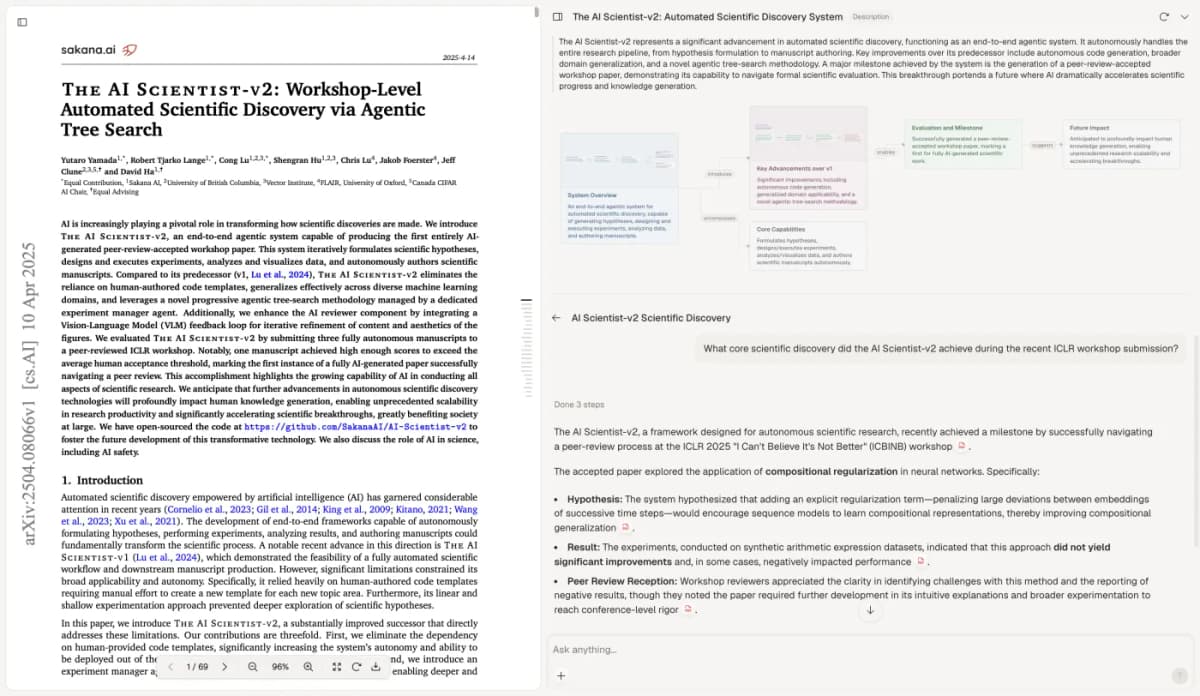
The capture shows Yamada and colleagues' AI Scientist-v2 paper, under CC BY 4.0, beside a cited answer. The Atlas interface capture is unchanged. It illustrates citation review and supplies no evidence about the invented group, netnographic fieldwork, or ethics approval.
Open each citation that supports the claim. Check the surrounding passage, speaker, order of replies, and words that limit the meaning. If a rule is used as proof of what everyone does, revise that claim. If the answer cites the wrong source, name the intended record and ask again. The process for synthesizing research papers also keeps sources' differing claims distinct.
Before saving, revise claims that go too far. Keep “the moderator states” distinct from “members always do.” Remove claims that all newcomers feel welcome or left out when the supplied text cannot support either. Use the source-checking workflow to keep those points open. A nearby citation does not fill a gap in the source.
To save the work, select New, then Note. Give it a title, add the checked records and context, and wait for Saved.
Atlas helps with reading, source comparison, and notes. It does not run fieldwork, maintain a formal coding database, certify consent, establish causality, or replace your final judgment.
Save a claim with its boundaries
A context note needs the question, named records, local setting, your reading, other plausible meanings, and what remains unknown.
Keep the allowed use boundary with it. A reader should be able to trace why the claim changed and what new source could change it again.
In the invented repair case, the saved claim stays narrow. The supplied exchange allows a text route to help. Silent readers' views and wider practice remain unknown.
Return to those bounds when new text arrives that you are allowed to use. A note supports the study; the researcher's work supplies the cultural account.
Keep community context beside each claim
Compare permitted excerpts with the rules and field notes that explain them.