
An analytic memo records how you make sense of source text. Connect an idea to the excerpts that prompted it, consider another explanation, and state what you need to examine next. Date the note so later readers can follow how your thinking changed.
This guide builds a fictional study-space memo from two invented accounts. It shows how to move from a broad claim about silence to a narrower question about interruptions.
The structure supports source reading and your own reasoning; it does not establish a finding or replace your study's method.

Trace memo ideas in Atlas
Compare excerpts, inspect citations and save your checked reasoning.
What an analytic memo records
An analytic memo is a place to work out meaning, rather than only store a quotation. Write what caught your attention, why it matters to the research question, and where your thinking remains uncertain. The memoing review treats this writing as part of how the researcher thinks and makes choices in the work.
A code gives material a label; a memo develops an idea about that text. Several passages might share a label such as interruptions, yet describe different kinds of interruption. In Sale's worked paper, one set of code labels helped the team explore more than one line of thought. A set of labels did not settle which account to report.
The memo can share some aims with other notes without taking over their job. A reflexivity note examines how your position and assumptions shape the work. An audit trail retains decisions and records. Here, the focus is the early idea: what might this passage mean, what casts doubt on that reading, and what should you read next?
There is no universal length or format for this work. The Oregon State chapter explains how ways of doing the work can differ. A short note can be useful if its logic is clear; a long one can still hide a leap. Follow your chosen approach rather than treating this guide's structure as a required research standard.
Start with one question and excerpt
Choose a question small enough to think through with the text at hand. For instance, ask what a participant means by being able to focus in a particular space. That gives you a reason to return to the account rather than collect each remark about rooms.
Keep the source location beside the idea from the start. A note saying this person preferred quiet leaves too much unstated: which interview, which passage, and what question led to the answer? A location lets you check those details when the idea changes.
- Name the question. State the aspect of the research question you are exploring today.
- Locate the passage. Retain a source identifier, version and page, line or other stable location.
- Read its context. Include enough surrounding material to understand the prompt and the speaker's account.
- Write your claim. Say what you think the passage suggests, separately from the speaker's words.
- Record an alternative. Identify another reading and the evidence that would help distinguish it.
- Choose a next question. State what further reading or allowed inquiry could change your view.
The CDC methods and practice paper includes first notes while getting to know the sources and retains them for later work. Its authors illustrate an adaptable process through their own research applications.
Their team procedures are not a rule that every qualitative tradition must use the same coding or agreement checks.
Separate words, inference and alternatives
Keep the excerpt and your claim visibly distinct. If someone says a room is quiet, that does not by itself explain why quiet matters. You might link it to comfort, task demands or the wish to avoid breaks. Those are ideas to explore, rather than extra words you can attribute to the speaker.
Read the exchange around the excerpt. Was the participant comparing two places, recalling an unusual day or responding to a leading prompt? Sale's discussion of source support connects claims with quotations and attention to accounts that do not fit. A compelling sentence should not stand in for reading the wider set of sources.
Make the alternative specific enough to affect your next step. Silence matters and silence may not matter are too vague to help. The task may shape the choice of space. That gives you a clear rival claim to explore: was the person writing, reading, meeting others or doing routine work?
Keep importance separate from frequency. The CDC paper's meaning-making discussion cautions against treating the most frequent idea as necessarily the most important. Repeated excerpts from one person also differ from accounts across people.
Your memo should say why the idea matters. Its presence does not show how common a view is.
Mark gaps as gaps. If nobody asked about access to a library, silence about access does not show that every person had the same options. Write not established in these passages, then decide whether the missing context matters to your reading. Do not supply a plausible biography to close the gap.
Keep the scope open to change. In Sale's analytic-direction account, early ideas could need more support before the team chose one. The memo is a place to preserve such possibilities and reasons for pursuing them. A confident heading or fluent summary does not make an early idea a settled theme.
Build a fictional interpretation memo
The following teaching example is wholly invented. It uses two short excerpts of the kind you might read in a study with consent. They are not real accounts or facts about learners.
The identifiers and dates exist only to make the reasoning traceable.
Imagine memo M1, dated 2 October, asks how learners choose a place to focus. Invented account A, lines 18–20, says: “I use the quiet library because people don't stop me to chat.” Invented account B, lines 31–33, says: “The cafe works when I have headphones. I choose when to talk.”
The first draft reads: Learners need silent rooms to focus. Account A makes that reading tempting, but the stated reason concerns people stopping the speaker. Account B describes a setting that can work despite cafe noise. Both passages leave other features of the task and setting unclear.
This invented memo links ideas, excerpts and open questions.
| Memo element | Source or reasoning | What remains open |
|---|---|---|
| Initial idea | A names a quiet library and unwanted chat | Does silence matter apart from interruptions? |
| Contrasting account | B describes a cafe with headphones and chosen conversation | Does the task or headphone use explain the difference? |
| Revised interpretation | Control over breaks and contact may help explain these accounts | Do wider accounts support, challenge or narrow this reading? |
| Next inquiry | Compare task, access and interruption context in available records | Further inquiry requires the study's consent and method boundaries |
Table 1: The new idea does not claim that both people prefer noise or share one motive. It names a possible relation between their accounts: who controls the timing of contact.
The gap between unwanted and chosen chat gives you a question to explore. It is not a reason to erase the contrast.
Keep two rival claims beside it: the people may be doing different tasks, or they may have different access to spaces. Since neither is shown by these passages, seek context that could help you choose between them. Do not ask a person to agree with your preferred story.
This example draws its teaching structure from a general source-reading problem. It does not reproduce a published study's data. Sale's worked example shows how notes and team talks helped them explore more than one idea.
The study-space memo here is a separate, invented exercise.
Revise the claim with contrasting evidence
Use clear criteria before keeping the silence claim: whether the wording shows that silence is needed, whether the contrast fits, and what else could explain it. Account A links the library to avoiding unwanted chat, while B gives a cafe account that challenges the broad claim. Neither establishes what all learners need.
Replace the first draft with: In these two fictional accounts, control over breaks and contact may help explain the choice of space. Silence alone does not account for the cafe example; task type and access remain open rival explanations. Keep that sentence as a claim to explore, with the excerpt locations beside it.
Our negative-case analysis guide explains how to pursue accounts that challenge an emerging claim. Use that more focused workflow when you need to examine a contrast across the wider set of sources. This memo records why the contrast matters and which question it opens; it does not finish that search.
The memoing review stresses how thought and choices can change.
Retain the earlier note with its date, then say what changed your view. Replacing the old sentence without a reason loses the useful record of the first claim and why you changed it.
A colleague may offer another reading rather than endorse yours. Sale's discussion of multiple analysts treats more than one point of view as a way to add to and question an account. Choose ways to discuss the work that fit your method. Agreement is not a test that can settle the quality of all such work.
Inspect memo sources in Atlas
Atlas can help you read selected source files alongside a draft memo. Use material you have permission to process, with the privacy safeguards your study needs. Keep the formal source record and study steps under your control; this reading workflow does not turn Atlas into a coding database.
Add the permitted files and wait for processing. Start a chat and use @ to select the excerpts or source documents you want compared. Our source synthesis guide covers bounded comparisons; a memo question should stay tied to the selected material.
Compare these selected excerpts with memo M1. Separate source wording from my inference. Show what backs or casts doubt on the idea about breaks and contact. Name a rival claim and cite each point. Mark missing context without inferring a participant's motive.
Use Project only beside + to block new outside retrieval for this question. Earlier chat context can still remain, so start a fresh chat if prior material could blur the intended source set.
Read the answer as a proposal for checking, not proof that every relevant passage has been found.
Open each citation and inspect the nearby text. Our citation tracking guide explains why returning to the source matters.
Correct an answer that merges separate speakers, attributes your claim to them or omits a qualification. Then revise the memo in your own words.
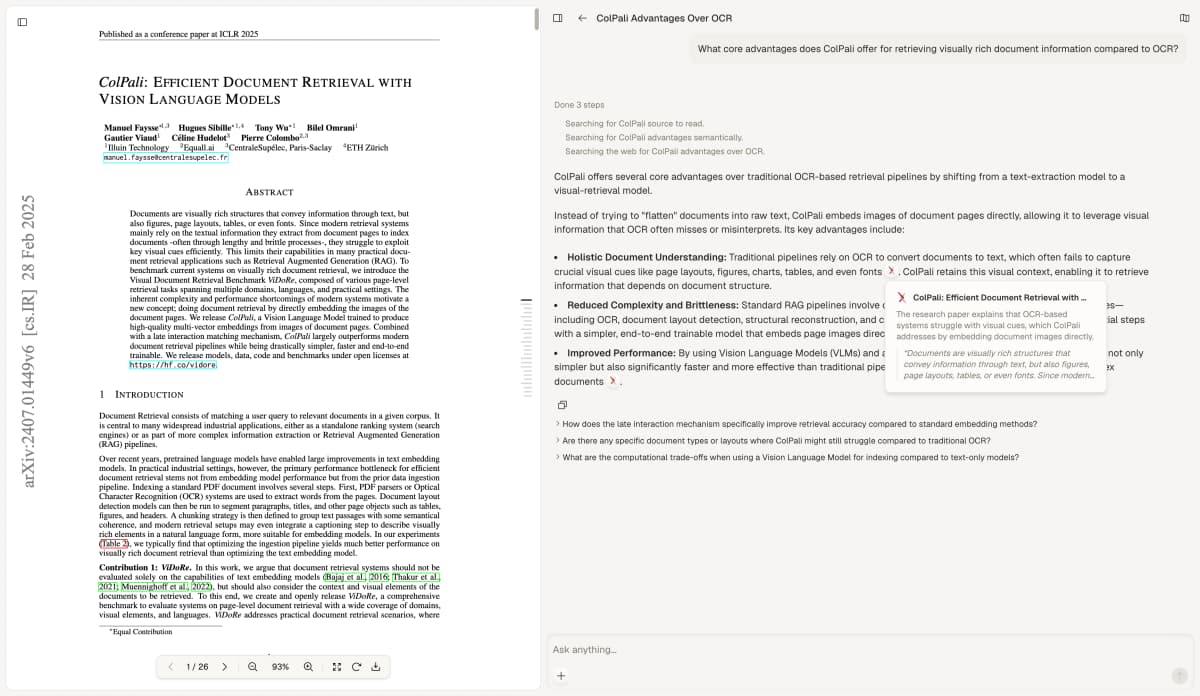
Atlas screenshot of ColPali by Manuel Faysse and colleagues, CC0 1.0. Lossless WebP; content unchanged. It illustrates source inspection, not the invented study or completed qualitative analysis.
Save the version and next question
Save the checked memo as a dated note with its source locations, early claim, rival reading and next question. In Atlas, choose New, then Note, and wait for Saved. Preserve earlier versions in the record your study uses so the revision remains understandable.
Before reporting a finding, return to the wider set of sources and your chosen analysis method. The CDC paper's reporting section sets out why you need to explain a theme, rather than just supply many quotes. Your memo supports that work by keeping the thought you still need to explore.
For the invented example, the next step is a bounded comparison of task, access and interruption context. Keep the result open: further reading could support the new idea, narrow it or point to a new idea. The value of the memo is that another reader can follow why you asked that question.
Trace memo ideas in Atlas
Compare excerpts, inspect citations and save your checked reasoning.