

Purposive sampling chooses cases on purpose because they can help answer the research question. The reason might be a person's role, what they have lived through, or a site's place in a process. To read the design, connect that reason to what the study needs to learn.
A methods section can name the approach without making the link clear. Find the question, the case criteria, and why each rule matters. Keep access limits and missing views alongside the reason for choosing cases.

Check the reason for case selection
Connect each case criterion with its research question and source passage.
What purposive sampling aims to learn
Imagine a study asking how people navigate a grant process. A person who completed it, someone who faced a long delay, and a staff member who handles errors may each reveal a distinct part of the process.
Cases are information-rich when what they know helps answer the question. The term describes the fit between case and task. It does not mean these people are more valuable or more truthful than others.
The NHS England guide describes choosing people for their relation to the topic. Insight into how people think or feel is a different goal from counting how many share a view.
Easy access alone gives another reason. If people were chosen because they were nearby or willing, the convenience sampling guide helps trace that route. If the study uses both access and purpose, explain the role of each.
Match the criterion to the question
Start with the exact question. “How did people resolve grant delays?” calls for cases with direct knowledge of delays. People who received swift approval may tell you less about that task, even if they are easy to interview.
Criterion sampling sets a condition for including a case. Maximum variation seeks contrasts useful to the question. Homogeneous selection narrows the group to explore a shared experience in depth.
The UConn teaching resource sets out these case logics. Typical cases can help explain routine events. Unusual or extreme cases may show a process under stress.
A study of routine steps may need ordinary cases. A study of failure may seek breakdowns. The question makes each choice useful; a method label alone does not tell you which one is best.
Check the basis for labels such as “typical” or “expert.” The report should explain the context for that judgment. A person does not become an expert just because the researcher assigns the label.
A scholarly sampling framework places case choice within the whole research journey. Keep the first case plan and later choices visible, so one label does not stand for the full design.
For an interview paper, the qualitative research question gives you the point of comparison. Ask whether the case rules seek answers to that question or drift toward another task.
Worked case rationale for a process
This example is invented. A study asks: “How do people and staff resolve delays in a local grant process?” The methods describe interviews with approved and delayed applicants and two staff roles. People who left before finishing were not reached.
The question-information-rich-case rationale table connects four case groups to the parts of the question they can discuss. It is a way to read the design, not a plan for a real sample or a claim that these interviews took place.
| Case group | Rule for inclusion | What the case may explain | Gap to keep |
|---|---|---|---|
| Approved applicants | Completed the process | A route that reached a decision | May not recall early barriers |
| Delayed applicants | Faced a documented delay | Obstacles and attempts to resolve them | Only reached people have a voice |
| Front-desk staff | Handle queries | How problems first surface | Do not see every later decision |
| Review staff | Handle stalled grants | Review and escalation steps | Give the organization's account |
Table 1: The table shows what each group may add without claiming that all views are covered.
The plan fits the delay question in several ways. People who faced delays can describe obstacles; staff can explain how the office responds. Approved cases can offer a contrast with routes that reached a decision.
The missing group matters too. People who stopped before finishing may have faced barriers others did not. The excerpt gives no account from them. That gap affects what the study can say about the whole process.
The NHS guide seeks useful, diverse insight. Apply that aim here as a question: do the chosen groups let us understand the delay process, including how people leave it?
A checked note could say: “The rules cover several roles and outcomes, but people who left early were not reached.” It should not claim that maximum variation ensured all views. Useful contrasts do not establish complete coverage.
If the full report explains why that group was left out, add the passage. The reason may explain the study's scope. It does not supply the absent group's views. Keep an explained absence distinct from a filled gap.
Check missing cases and claim scope
A purposive sample can help explain a process or a lived experience in depth. Its case plan alone does not tell you the share of a wider group that has that experience. Claims about meaning and claims about frequency need their own basis.
The official non-probability guide explains the boundary for population estimates. That task differs from judging how well interview material answers a focused question.
No universal case count settles adequacy. For interview studies, Malterud and colleagues' information-power model connects sample size to the aim, case fit, theory, dialogue, and analysis. Read the study's own rationale; a count alone does not settle it.
The qualitative design guide helps you read those choices together. If a paper claims saturation, find what stopped changing and how the team judged that. Do not infer it from the interview count.
New case choices can also follow emerging analytic categories. The theoretical sampling guide covers that grounded-theory process. It is not just another name for choosing cases on purpose.
Ask what could challenge the account. The UConn resource includes cases that confirm or challenge an early analysis. Seeking an exception can test the explanation instead of adding only accounts that agree.
Sources use different lists of sampling types. Follow what the researcher actually chose and why. A long list of labels cannot explain a missing reason for choosing one case.
Trace the case rationale in Atlas
Add the published question, methods, case account, and relevant guidance to one Atlas project. Use material you have permission to share. Published case descriptions are enough for this reading task; named interview records are not needed.
Open a chat and use @ to name the study. Ask: “Link each case rule to the research question. What can this case help us learn? Cite the method passage. Keep stated reasons apart from your inference. Mark views the study did not reach.”
The inspected Atlas capture below shows a paper next to a cited answer. It illustrates checking source context. It does not show people being recruited, the grant study, or a completed case table.
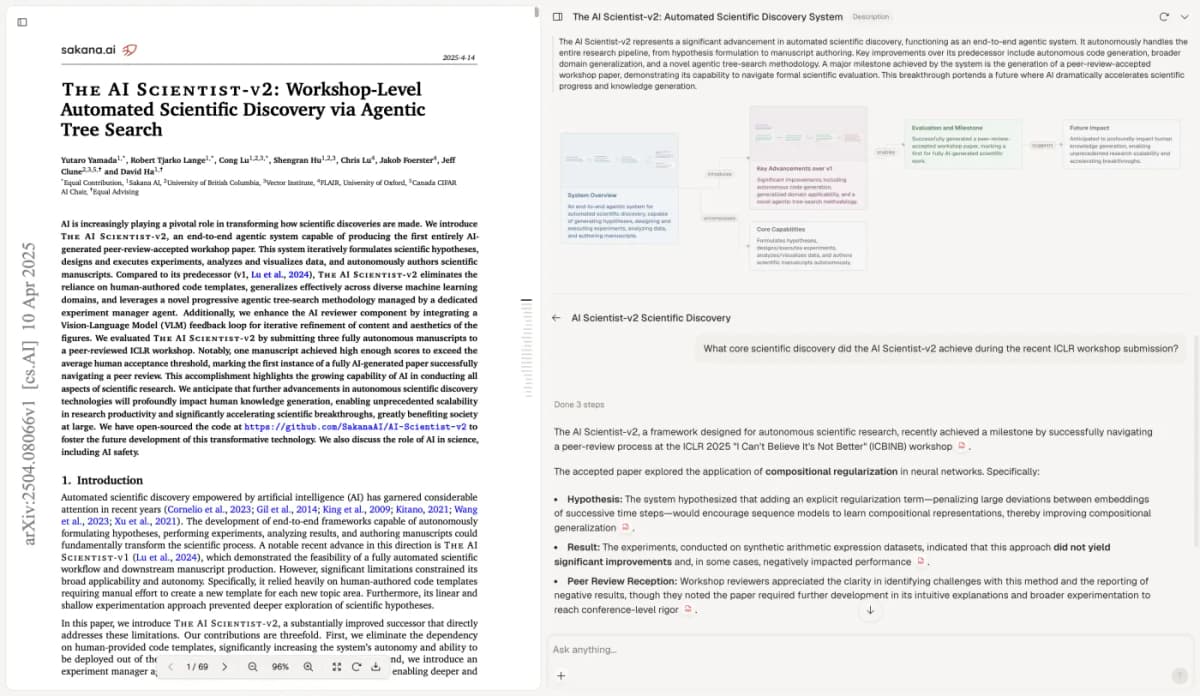
Open the methods passage and check whether it states the case rule and the reason assigned to it.
The visible paper is The AI Scientist-v2 by Yamada et al., licensed under CC BY 4.0. This Atlas screenshot is reused unchanged.
Suppose the answer claims all applicant views are covered. Open the case passage. If it lists current applicants but no people who left early, correct that claim. Keep the useful variation and the missing group together.
If the reason for a rule is your inference, mark it as such. Ask again for the author's stated reason. A sound reading can still go beyond what the author explicitly wrote.
Create a note through New → Note. Save the checked table, source locations, and the question about people who left early. Wait for Saved. The research synthesis workflow helps apply the same checks across studies.
Save the rationale and remaining gap
The final note should explain what the chosen cases can illuminate and which missing view affects the answer. Keep the author's reason and your own reading distinct, with source locations for both.
When a new case account or appendix arrives, check whether it changes the gap. Revise the affected claim. Do not treat every extra case as proof of complete coverage; the case plan stays tied to the question the study asks.
Check the reason for case selection
Connect each case criterion with its research question and source passage.