

Convenience sampling chooses people or cases because they are easy to reach. It is a non-probability method: the route does not give known chances of selection across the wider group. To read a study using it, trace the access route before judging how far its claims can go.
A clinic, class, library, or online group can supply useful findings. Ask who could enter through that route, who took part, and whether the paper speaks only for those people or for a much broader group.

Check who the study could reach
Compare the recruitment route with the claims it supports.
What convenience sampling selects
The sample might be students in one class or people at one event. The researcher can contact them easily. That access explains why these people entered the study, rather than others who also meet the broad entry rules.
Statistics Canada's non-probability guide explains that these designs have unknown selection chances. More replies do not turn the route into a random draw.
Access differs from choosing cases for what they can tell you. A clinic may be easy to reach, while the study seeks people there with a specific experience. The MacEwan methods chapter describes these different ways of choosing cases.
The purposive sampling guide focuses on why cases can inform a question. If a study combines an easy-to-reach site with question-linked case criteria, keep both in your account. One label may not explain all its choices.
Trace access before judging the claim
Find the site, time window, invite route, entry rules, and consent process. They tell you who had a chance to take part. “We asked adults” gives less detail than “we asked adults at one library on weekday mornings.”
Keep people who could qualify apart from those who could be reached. All city adults might qualify, but only people at that site and time saw the invite. Broad entry rules do not create broad access.
An open link adds a further choice: who wants to reply. Interest in the topic may affect that choice. The official guide discusses both convenience and volunteer samples.
For a study with several levels, inspect the last step. A school might be randomly chosen, while pupils come from those present that day. The multistage sampling guide explains why a random first draw does not settle the later rule.
Group targets can also hide an access-based sample. Choosing easy-to-reach people to fill each target does not establish a probability draw. The stratified sampling guide keeps group counts and draw rules apart.
Record the route before reading the conclusion. It gives you a basis for checking whom the claim describes. If the method leaves a step unclear, keep it as a gap; do not guess a random rule or a specific direction of bias.
Worked library recruitment evidence note
This is an invented example. A team asks adults at one city library about opening hours on three weekday mornings. It approaches 120 people; 60 reply. Of those replies, 42 rate the hours positively.
The accessibility-selection-limitation note below connects the route to the strongest claim the excerpt supports. The counts are made up for teaching. They are not study findings or a plan for a real sample.
| Detail | Reported fact | What it supports | Limit to keep |
|---|---|---|---|
| Access | One site, three weekday mornings | Who could see the invite | Other sites and times were not covered |
| Entry rule | Adult visitors | Who could take part there | The rule does not show city-wide reach |
| Replies | 120 approached; 60 replied | Half of those approached replied | Reasons for nonresponse are unknown |
| Rating | 42 positive replies out of 60 | 70% of replies were positive | This is not a figure for all city adults |
Table 1: The note keeps people reached, people who replied, and the wider group apart.
The fraction 42 ÷ 60 = 70% describes the replies. Using 120 as the base asks a different question: what share of those approached gave a positive reply? Neither fraction describes every adult in the city.
“70% of city adults approve” goes beyond the excerpt. The route misses people who do not visit and those who come at other times. It also leaves the views of the 60 people who did not reply unknown.
The MacEwan chapter distinguishes a sample from the group researchers want to understand. Use that distinction before widening a claim about replies.
The corrected sentence is: “Among the 60 adults who replied during the stated windows, 42 rated the hours positively.” It says what the invented count supports. It does not claim the unheard adults agree.
A next step could seek evening, weekend, and non-user views. More routes can add useful evidence. They do not, on their own, create known selection chances. Broad access and a probability design remain different questions.
Separate useful findings from population estimates
An access-based sample can reveal unclear survey wording or problems in a procedure. “Several people misunderstood this question” can guide a change without claiming how often that happens across the city.
The pilot study guide distinguishes trying a procedure from reaching a final conclusion. The exploratory research guide covers looking for patterns worth further study.
More replies from the same route may give a clearer view of those who respond. They need not close the gap between that group and the people the route misses. A large morning sample could still miss people who work then.
A design-based margin of error relies on the sampling design. Putting this sample's count into a random-sample formula does not give a valid city-wide margin. Official guidance warns about that inference boundary.
Models can also be used to analyze such data. Their assumptions need a separate basis. A software output does not supply the missing draw rule or resolve who the route could reach.
Make the limit concrete. In this example, the team could reach weekday morning users; it could not reach evening users or non-users through that route. The limitations guide connects missing coverage to the claim it affects.
Compare recruitment and limits in Atlas
Add the published methods, limitations, and method guidance to one Atlas project. Use sources you have permission to share. Published descriptions are enough for this task; you do not need named participant records.
Open a chat and use @ to name the study and guidance. Ask: “What made people easy to reach? Keep those who qualified, those approached, and those who replied apart. Check the broad claim against the route. Cite each passage and mark gaps.”
The inspected Atlas capture below shows a paper next to a cited answer. It illustrates checking source context. The paper is on another topic; the image does not show recruitment or the invented library survey.
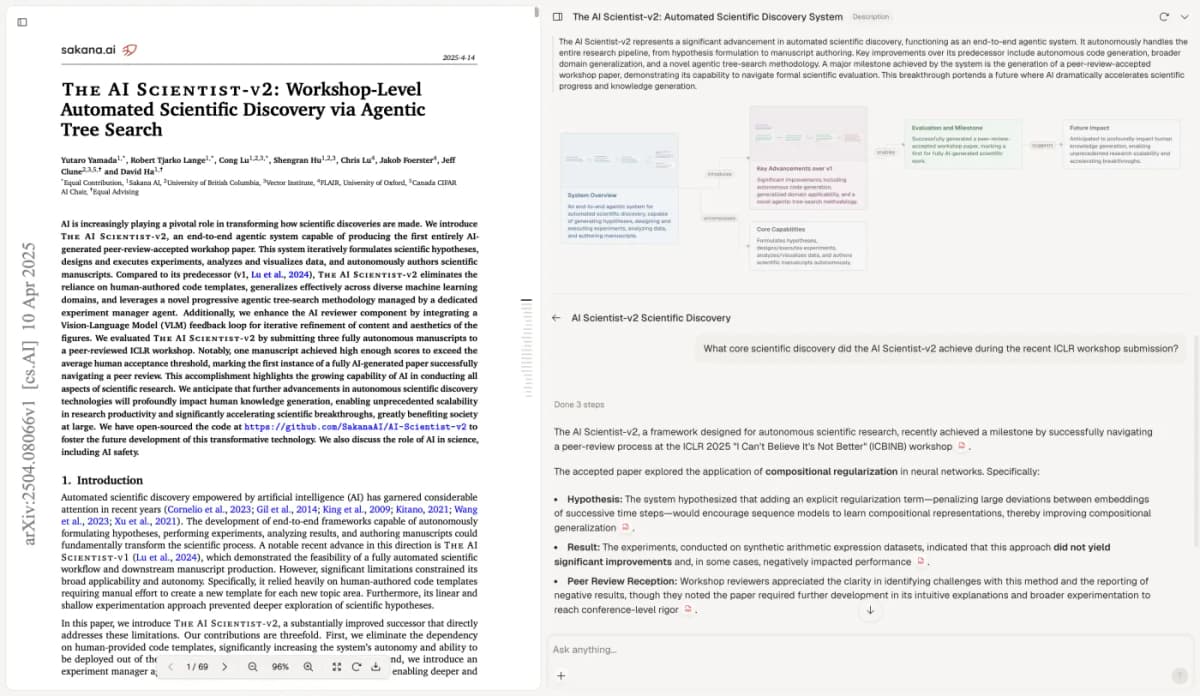
Open the methods passage and check which group its wording describes before saving the claim.
The visible paper is The AI Scientist-v2 by Yamada et al., licensed under CC BY 4.0. This Atlas screenshot is reused unchanged.
If the answer says “70% of city adults,” open the source for that phrase. A table with 42 positive replies out of 60 supports a claim about replies. Correct the note to name that group and the site and time window.
If the paper states the restricted route as a limitation, retain its scope. If it does not, mark the limit as your appraisal. Do not make the author appear to report a concern they never discussed.
Create a note through New → Note. Save the route, counts, corrected claim, source locations, and open question. Wait for Saved. For several papers, the research synthesis workflow helps keep these checks consistent.
Keep the claim within its evidence
A useful note does not call every such study worthless. It states what the reached people can tell you, which wider claim is not supported, and what evidence would help you judge that claim.
For this survey, keep the 70% reply figure and the three morning windows together. When a broader account arrives, revise the claim from that account. Keep the original route so you can trace what changed.
Check who the study could reach
Compare the recruitment route with the claims it supports.