

A key informant interview is an in-depth talk with someone chosen for what they know about a topic, place, or process. You might speak with staff who run a service or people who know local routines. Someone who has used the service for years may have useful knowledge too.
Begin with the research question, then ask who can help answer each part. A senior title is not enough. The useful match is between the knowledge you need and what the person's experience lets them describe.
This guide uses a made-up library service to show that match. You will build a role-topic-evidence note: who to ask, what to explore, which source explains the choice, and what remains unknown.

Connect interview topics to source evidence
Check program reports against your informant-role criteria.
What a key informant interview provides
Key informants can explain how something works, describe local history, or suggest why reports may differ. The Wisconsin community data guide includes leaders, staff, and people affected by an issue among those you might ask.
They offer a view from their own position. A manager may know who made funding choices but not why a person stopped using a service. Someone who uses the service may know problems absent from a formal report. Neither view stands for what everyone else thinks or has done.
Choose this method when depth and context matter to your question. If you need to estimate how common a view is across a population, plan an appropriate sampling and measurement approach instead. A count of comments from selected informants is not a population rate.
When your question concerns how participants respond to each other’s accounts, consider focus group questions that make room for differing views in a shared discussion.
Choose roles for the knowledge needed
List the topics the study must address before you list people's names. For each topic, ask what someone would need to have seen, done, or decided to speak about it. This is often called purposive selection: choosing people for the knowledge needed rather than drawing names at random.
Knowledge and access
A job description can suggest relevant knowledge, but check the person's actual involvement. Someone who joined after a program change may know the current routine without knowing why the change happened. A coordinator may handle referrals while a front-desk worker sees failed attempts to book.
The AHRQ interview appendix asks about the groups someone worked with and the methods they used. It shows how to make a topic specific. Use that approach in your setting; its questions about health research are not a script for every study.
Differing views and missing voices
Look for people whose roles expose different parts of the process. A manager and a volunteer may disagree because they see different events. Keep the source of each account clear before deciding whether one is wrong.
Also ask whose view is absent. The Wisconsin guide includes people with local influence who have no formal title.
A contact with many ties can help you find people, but may keep your list within one network. Check which views that network leaves out.
Worked plan for a library service
Imagine a team asking why some residents cannot complete a booking for a library skills session. The program report, roles, and examples here are made up. No library data were collected and no interviews were conducted.
Match the topic to the role
The made-up report lists bookings made and sessions held. It has no record of people who tried but failed to book. Use that gap to plan questions. Do not assume the list shows all demand.
The four roles below offer different kinds of knowledge; choose actual people only after checking their involvement and your study's requirements.
| Knowledge role | Topic to explore | Limit to preserve |
|---|---|---|
| Booking desk worker | Steps taken when a booking fails | Sees contacts that reach the desk, not all failed attempts |
| Session coordinator | How rules and schedules are set | May not see the booking experience |
| Resident who tried to book | What happened during one attempt | One account does not estimate how common the barrier is |
| Community outreach volunteer | How residents hear about sessions | May hear second-hand reports that need a direct check |
Table 1: Each role suggests a topic to explore. Check the person’s knowledge before relying on their answers.
Repair a question that assumes the cause
A first draft might ask the coordinator, “Why did the online form exclude older residents?” The report has not established the form as the cause, the age group involved, or exclusion. Leading-question guidance explains how a question can smuggle these assumptions into an answer.
Ask instead: “What do you know about attempts that did not lead to a booking?” Follow up on how the person knows. If the coordinator knows only completed bookings, record that limit and ask who may have more direct knowledge. Keep a resident’s account as a separate source. The coordinator’s role alone cannot establish what that resident experienced.
Build questions with room for follow-up
A topic guide helps you cover shared areas while leaving space for an unexpected answer. A semi-structured interview uses this flexible approach. You can use it with key informants, though the term key informant describes the reason for choosing the person rather than a single fixed question format.
Start by explaining the study purpose and what the talk will involve. Discuss recording, notes, and how you will use answers before you begin. Upstream Consulting's practical guide stresses trust and consent to recording.
Follow your study's approved rules for consent and keeping responses private.
Invite a broad account of the person's involvement. In the library example, you could ask a desk worker to describe the last booking they helped with. Probe using their words: which step they mean, who was involved, and what happened next.
NN/g's user interview guidance distinguishes these reported accounts from direct observation.
Ask how the person knows a claim. Did they see it, hear it from someone else, or read it in a report? All three may be useful, but they need different checks. Ask for a permitted record or another source when it would clarify the answer. Do not imply that the informant must supply private records.
Before closing, ask about gaps: what they do not know, who sees another part of the process, and what topic you missed. The AHRQ protocol asks about stakeholder groups that were not included. A similar prompt can make your own role coverage easier to review.
Write notes soon after the interview, keeping the account and your reading of it distinct. If you later use AI interview analysis, retain role, time period, and source context. A theme that appears in several interviews still needs interpretation; shared wording alone does not establish why a barrier exists.
Check the planning sources in Atlas
Atlas can help when program reports and your role criteria already exist as text. Add only sources you may use and remove details you do not need. Put your planned roles in their own note so your choices stay apart from what the records say.
Compare the named sources
Open the project and start a chat. Type @ to select the context, report, and role-criteria note. Ask a focused question such as:
Compare these sources for our question about failed library bookings. Suggest topics for each of the roles I supplied. Cite the passage that supports each topic, explain what the role may know, and mark missing sources or voices. Do not invent informants or treat completed bookings as all booking attempts.
This request helps plan the topics and evidence to review. Recruitment still requires decisions about actual people and their availability. If Atlas adds a role you did not supply, decide whether it is a useful new suggestion and label it as one. It is not evidence that a suitable person exists or is available.
Inspect support and correct the plan
Open each citation and read the text around it. In the made-up example, the report helps frame a question about booking. It does not show that older people were excluded. Remove that claim and keep the gap about failed attempts.
The source-and-answer view below shows how you can read a document beside a cited answer. Its research paper is unrelated to the fictional library material. Use the interface to check whether a proposed topic is supported before you keep it.
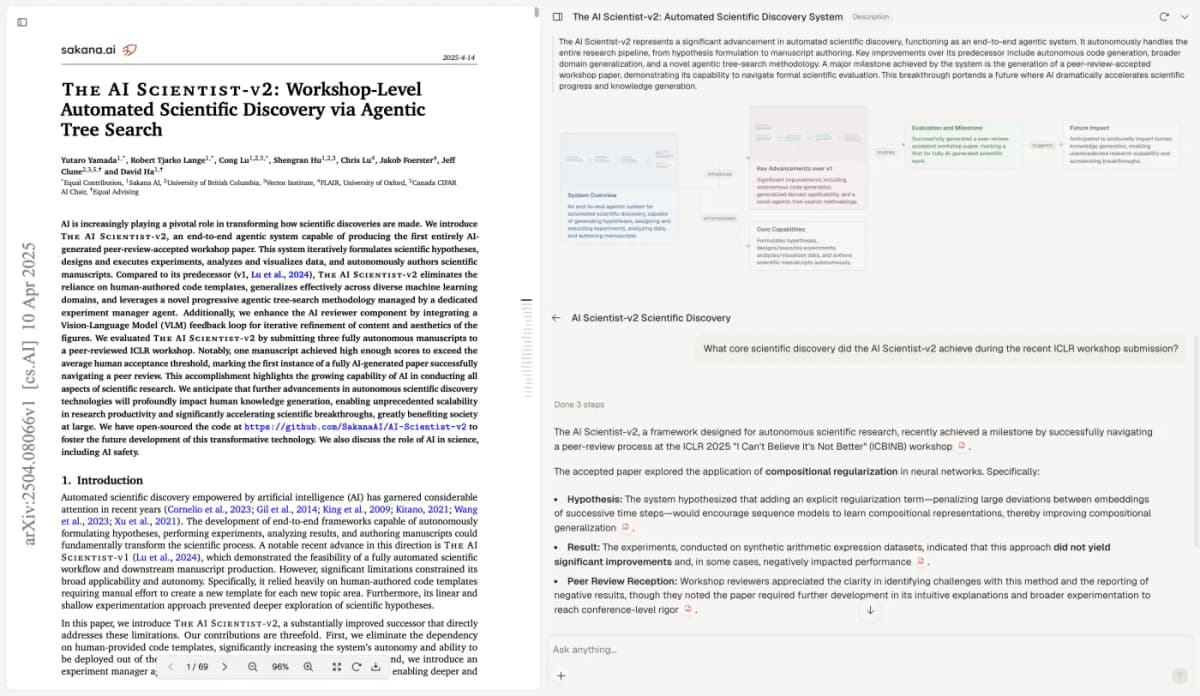
Check the passage before keeping a role claim. Unchanged capture: Yamada et al., AI Scientist-v2, CC BY 4.0.
If a citation is wrong or missing, name the intended source and ask for support from that material. Keep an unresolved topic on the missing-source list. A fluent answer cannot fill a gap in program records.
Save the role-topic-evidence note
Select New → Note and title it for the study question. Record each role, topic, supporting passage, knowledge limit, and open question. Wait for Saved before closing.
For the fictional library plan, keep the completed-booking report and the absent failed-attempt record as separate entries. The topic guide asks about possible barriers without declaring their cause. Once interviews exist, qualitative coding can help organize accounts, with checks against the original text.
Review coverage before starting fieldwork
Read the plan with someone who knows the setting. Can someone in each role speak to the topic? Which views differ, and whose voice is absent? AHRQ's worked protocol shows how questions about roles and gaps can help with this review.
Keep the method decision with the research team. You still need to decide who to approach, how to invite them, which permissions apply, and how to handle records and sensitive accounts. The checked note supports those decisions; it does not certify role coverage or replace conducting the interviews.
Connect interview topics to source evidence
Check program reports against your informant-role criteria.