

The PEDro scale checks how a physiotherapy trial was run and how its results were reported. It has 11 criteria, or items to check. The first asks who could join the trial. This eligibility item adds no point, so the score is out of 10.
Start with what the report says. For each item, save the passage, where you found it and what you still need to check. The worked table below shows how to prepare that evidence. A human then uses the scale's rules to rate the trial.

Find evidence for PEDro criteria
Check trial passages and keep missing descriptions visible for human review.
What the PEDro scale assesses
PEDro's official FAQ explains two aims of the scale. One is internal validity: how well the trial's methods guard against bias. The other is whether the report gives enough numbers to make sense of the results.
The total does not tell you how large a treatment effect is or whether it applies to a given patient. A high score alone cannot answer “Does this treatment work?” You still need to read the results, their uncertainty and any harms.
PEDro's rating-process explanation describes trained raters and checks on their ratings. Be clear about the status of your own work. A student's practice table is not a confirmed rating in the PEDro database.
Choose a tool that fits the study. Oxford Health's appraisal resources point to tools for different types of evidence. For a review with a mix of study designs, check the scope of a mixed-methods appraisal before choosing the scale.
Read the criteria before searching passages
Use the official PEDro administration notes to apply the scale. Read the rule for each item before you search for evidence. This overview helps you find your way through a report, but the notes supply the rules.
The first items ask who could join, whether assignment was random, whether it was concealed, and how similar the groups were at the start. Three more ask about blinding: did participants, treating therapists and outcome assessors know which group a person was in? Check each role on its own.
The remaining items cover outcome follow-up, analysis under the rules for assigned groups, comparisons between groups, and estimates with a measure of spread. The first eligibility item stays on the checklist even though it adds no point.
Random allocation and concealment need different evidence. A trial can use a random list yet let the person deciding who can join see the next assignment. Those are two distinct checks. Knowing that an assessor was blind also tells you nothing on its own about the therapist's knowledge.
Check the name and version on a form before using it. UNSW explains that PEDro-P adapts PEDro and changes criterion 4. If your review calls for original PEDro, use its own instructions.
Prepare a traceable trial source set
Save the trial report and any supplements with clear titles and versions. For each passage, keep the page, section, table or paragraph where you found it. Another reader should be able to go straight to the same text.
Read beyond the abstract. The methods may describe how groups were formed. A flow diagram may show how many people stayed in the trial. A results table may give the estimates and their spread. You may need all three to check different items.
Keep plans apart from what was done. A protocol says what the team intended to do. The trial report may say that the plan changed, or it may leave the actual steps unclear. Label the source of each passage so a plan does not become proof of conduct.
If you lack a document, say so in the table. “Not found in the supplied material” is a limit on your search. It does not prove that the detail is absent from every linked paper or supplement. Leave a clear task to check the missing source.
A CONSORT checklist can help you find parts of a trial report. It checks reporting, while PEDro has its own rating rules. Name the question you are using each tool to answer. Finding a heading does not settle whether an item is met.
A worked criterion evidence table
Trial T below is a fictional teaching example. The passages and their locations are made up. They say nothing about a real study or treatment.
The table links each passage to an item. It also leaves a question for the trained reviewer. No point or total is assigned.
| Criterion area | Fictional report passage | Locator | Human check |
|---|---|---|---|
| Random allocation | Groups assigned with a computer-generated random sequence | T Methods, paragraph 2 | Check the reported assignment procedure |
| Concealed allocation | An assistant kept the sequence | T Methods, paragraph 2 | Storage alone leaves recruiter knowledge unclear |
| Assessor blinding | Outcome assessor did not know group assignment | T Methods, paragraph 4 | Check which key outcome and assessors are covered |
| Outcome follow-up | Flow diagram lists assigned and measured participants | T Figure 1 | Compare relevant counts under the item rule |
| Estimates and variability | Result table gives means without a spread measure | T Table 2 | Search report and supplements for variability |
Table 1: The rows lead to three follow-up tasks:
- Check who could see the next assignment. The random list alone cannot settle concealment. Check participant and therapist blinding apart from the assessor statement.
- Keep the number first assigned beside the count for the outcome being checked. A count from a different group used for analysis may answer a different question.
- Look for the missing measure of spread in the report and supplements. Note where you searched before you decide whether the item is met.
A working note could say: “T Methods, paragraph 2 describes random assignment. It is unclear what the recruiter knew. Check whether assessor blinding covers the key outcome. T Table 2 lacks a measure of spread. Supplements were not supplied.” This note keeps the search limits visible for the next reviewer.
Resolve missing and ambiguous descriptions
Keep three states apart. You may still be looking for a passage. You may have checked the report and found no description. Or you may have found wording that is unclear. Record which state applies so the next person knows what to do.
An open question in this table means that review work remains. It does not add a new category to the scale. Under official PEDro rules, award a point only when the item is clearly met. The evidence table helps prepare that decision without changing the rule.
Review disagreements
When two reviewers disagree, save both reasons beside the passage. A later reader should be able to see how the team reached its decision. Follow the review's rating procedure:
- Name the item and the passage both reviewers read.
- Keep each reason, including different readings of the nearby text.
- Use the review's rating procedure to resolve the decision. Save the reason for the final choice.
Keep tool choice explicit
Moseley and colleagues' tool comparison examined PEDro and Cochrane judgments. The tools should not be treated as interchangeable ways to choose the same trials. Do not assume that a result from one is a result from the other.
Use critical reading to trace a claim through the full report. Keep the tool named in your review protocol clear. If a tool does not fit the study, more effort filling out its checklist will not fix that choice.
Locate criterion passages in Atlas
Add the trial report you are allowed to use, its available supplements and the official scale guidance to the same project. Give them names you can recognize. Check that the text is readable before asking Atlas to compare it.
Start a chat. Type @ in Ask a question to select the report and guidance you want to use. Choose Project only to retrieve new evidence from project sources. Earlier chat context is still available, so check the answer's sources.
Ask: “Find passages about allocation concealment in Trial T using the supplied PEDro instructions. Keep what the report says apart from what you infer. Give locations and citations. Flag missing detail. Do not award points or work out a score.”
Open each numbered citation and read the nearby text. Is it about making a random list or hiding the next assignment? Check which document the passage comes from. A protocol or supplement should not be passed off as the trial report.
If Atlas claims concealment because an assistant kept the list, correct it: “That passage does not show what the recruiter knew. Keep that question open. Find any direct account of who could see the next assignment.”
Check the revised citations. Select New, then Note, and save a table of PEDro items, Trial T passages and open questions. Include the places you checked and the questions for human review. Wait for Saved before closing the note.
Atlas can help find and compare supplied text. A trained human applies the scale and decides the rating. If the assistant fails to find a passage, check the source yourself. A failed search does not prove that the report lacks the detail.
Keep ratings separate from treatment conclusions
The figure comes from Albanese and colleagues' validation study. It shows ratings for each item across 345 trials in that study. Read the bars as a view of that dataset. They are not a current count for all physiotherapy research.
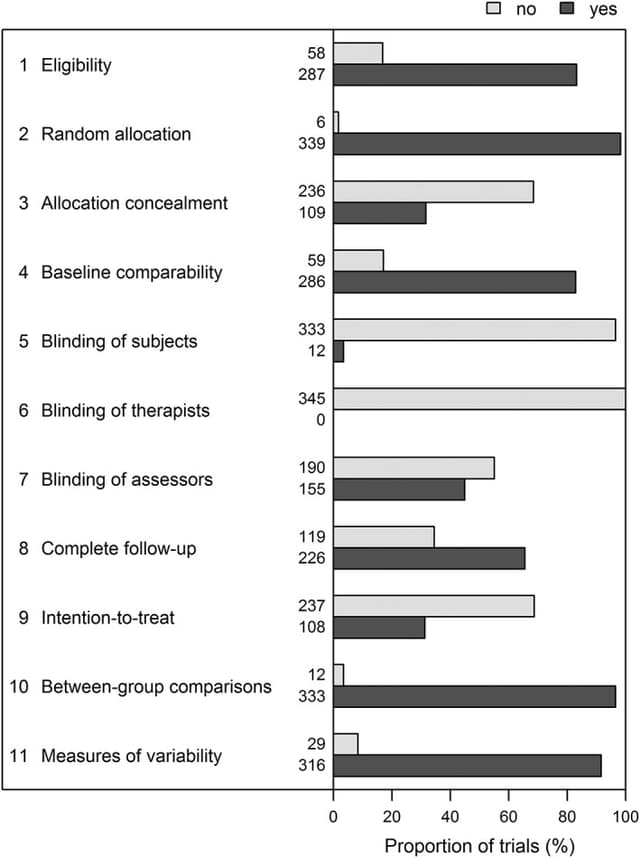
Albanese, Bütikofer, Armijo-Olivo, Ha and Egger's Figure 1 is reproduced unchanged under CC BY 4.0. Random allocation and therapist blinding have very different distributions. The eligibility row appears even though it is excluded from the total. The bars describe that study's dataset, not the trial you are appraising.
The authors questioned whether the total measures one underlying construct. They argued for attention to each item. Keep the passage and reason for each rating so the total does not hide a concern about how the trial was run.
Save the final human decisions and their source passages in an audit trail. Then read the trial's effects and their clinical importance as a separate task. The rating alone does not decide what is right for a patient.
Find evidence for PEDro criteria
Check trial passages and keep missing descriptions visible for human review.