
Critical reading asks how a text reaches its claims. You identify what the author argues, trace the support, and judge the steps between them. It goes beyond remembering facts, but it also requires a fair grasp of the text before you challenge it.
Useful critical reading strategies produce a note you can check: the claim, its evidence, what may be assumed, and the questions still open.
Keep the author's words distinct from your own inferences. That makes it easier to write a response without turning a guess about the argument into a fact about the author.

Check the links in an argument
Compare a text's claims with its evidence and your reading questions.
What makes reading critical
Reading critically does not mean finding fault with every sentence. It means examining how the text works. Deborah Knott's guide asks readers to attend to the argument and the use of evidence, rather than gather isolated facts. You may conclude that a claim is well supported. Explain why, just as you would explain a weakness.
Begin by understanding the author's position. A summary tells you what the text says; a critical note also asks how the text supports it.
Leeds's reading guidance starts with what the text says, then asks how it argues and how well its support holds up. That order helps you avoid attacking a claim the text never made.
Adjust the depth to your task. A reading for class discussion may need a central claim and two questions. A source you will use in a paper may need a closer method and context check. The Open University's learner guidance asks you to examine and compare sources, then use them in your own argument. No single checklist can replace the subject knowledge needed for each text.
Read for the argument's moving parts
Set a question before reading. You might ask, “What is the case for this recommendation?” or “What does this study allow me to claim?” Look at the title, headings, opening, and conclusion to find the main argument.
Nevada Reno's reading guide links the preview, close reading, and later review. A preview helps you decide where to focus. It does not replace reading the text you need to check.
State the claim in plain words
Write one sentence that captures the main claim and its scope. Preserve words such as “may,” “in this sample,” or “under these conditions.” Then compare your sentence with the text. If your version is stronger, revise it.
Keep smaller supporting claims beneath the main one so you can see which part each piece of evidence serves.
Trace the evidence to the claim
Ask what is offered as support. It might be a study, theory, record, or a comparison with another case. Note where it appears and what it shows.
Bowdoin's reading guide asks readers to inspect how an argument is built and which point the evidence supports. A source may contain sound facts but still make a leap between those facts and its conclusion.
Mark questions without losing context
Use short notes such as “scope unclear,” “possible assumption,” or “another cause?” Return to the full passage before accepting the note.
Knott's advice stresses context when using part of a text in your own writing. A limit stated elsewhere may answer the question you first wrote in the margin.
Worked claim-evidence-assumption-question note
The passage below is original fictional teaching material. Its campus, survey, numbers, and bus trial are invented. They are not research findings.
Read it first for what it states, then for the steps connecting its evidence and recommendation.
A campus survey asked students about evening transport. Forty-four people answered an open online form during one week; thirty asked for more late buses. After a later-bus trial began, the number of late arrivals recorded at one evening class fell from twelve to five. These results show that students prefer later buses and that the trial solved the attendance problem. The campus should fund late buses before other transport changes. The report notes that the trial week had dry weather but does not compare it with the earlier week. It gives no details about the students who did not answer the survey or the costs of other options.
The following note keeps what the text supplies apart from the reader's questions. The assumptions are links the reader thinks the argument may need. They are not facts about what the author believed.
| Claim in the passage | Evidence supplied | Possible assumption needed for the inference | Question to check |
|---|---|---|---|
| Students prefer later buses. | Thirty of forty-four online respondents asked for them. | The respondents reflect the wider student group. | Who answered, and who was missing from the open form? |
| The trial solved the attendance problem. | Recorded late arrivals fell in one class. | The bus change caused the fall, with no other important changes. | Were weather, class attendance, or other conditions comparable? |
| Late buses should come before other changes. | Survey responses and late-arrival counts. | These outcomes outweigh cost and other transport needs. | Which decision criteria and alternatives were considered? |
| The results support a broad campus decision. | One survey period and one class record. | Those settings cover the groups affected by the decision. | What can the text support beyond its described setting? |
Table 1: Notice the narrow claim that survives scrutiny. The fictional passage states that thirty respondents asked for later buses. That is different from establishing a preference among all students.
Your response can preserve the reported count while questioning the broader inference. Criticism does not require discarding every part of the text.
Write a bounded response
A possible reading note is: “The report gives a reason to look further into evening transport. Its survey describes the people who answered. We do not yet know if other students share their views. The fall in late arrivals could reflect a benefit from the trial, but the passage does not rule out other changes. The case for funding also needs clear rules for judging the options.”
This response stays within the invented passage. It does not claim that weather caused the fall or that the author tried to bias the survey. Those would be new claims needing evidence. It shows gaps between the support and the conclusion, then names what could help resolve them.
Ask what would change your view
For each open question, state what further evidence would matter. A clearer account of who answered could change the scope judgment. Records from similar weeks might help assess the claim about late arrivals. Costs and access needs could change which option looks best. These are proposed checks. We do not know if such records exist or would favor one option.
Challenge the inference without inventing motives
A counterargument tests whether the support is enough. In the worked example, late arrivals might have fallen for more than one reason. Naming another cause does not prove it true.
The Open University guidance asks readers to question what is assumed, what is left out, and which other views matter. Use those questions to decide what needs checking.
Separate a text's emphasis from an author's private purpose. “The passage gives no cost comparison” is a statement you can inspect. “The author wants to hide costs” is a motive claim that the passage alone does not establish.
Replace the second with the first unless you have relevant evidence beyond the text. Even then, state the source and limits of your interpretation.
Check whether the author has already addressed your objection. Read the discussion and limits, not only the abstract. A stated boundary may turn an apparent flaw into a fair, narrow claim. When the issue is how far findings can travel, inspect the study's limits and scope before widening the criticism. That check helps you judge the claim the author actually makes.
Keep disagreement proportional to the evidence. A weak policy leap need not make a descriptive count false. A missing contextual detail may justify an open question rather than rejection of the whole argument. Leeds's evaluative questions ask how a text relates to other evidence and your research. Make that relation explicit in your note.
Check a reading note in Atlas
Add the permitted academic text and the context sources you intend to use. Wait for processing to finish. Give them distinct names so a source claim cannot be confused with commentary about it.
Use a multi-source reading workflow when the context includes other texts, keeping their different positions visible.
Start a chat. In Ask a question, type @ and select the named text and context sources. Choose Project only beside + to prevent new web or literature searches. Earlier chat context may still contain outside material; start a fresh chat if that context would blur the task. Ask for a limited argument check rather than an authoritative verdict.
Compare the named text with my reading note. For each claim, identify its cited passage, the evidence used, and any assumption I have inferred. Keep author statements separate from reader inferences and possible counterarguments. Mark unanswered questions. Do not invent author motives or contextual facts.
Open the citation markers and read the passages around them. Check that the answer preserves qualifications and does not turn an open question into a result. A claim-to-source check helps test whether the passage supports the proposed reading. If the wrong source is cited, mention the intended text and ask again.
Remove claims that you cannot support.
When you find a claim that goes too far, revise it yourself. Change “the author concealed costs” to “the supplied passage does not compare costs” if that is what the text supports. Then reread the full source to check whether costs are discussed elsewhere.
If you dispute a step in the reasoning, use close reading of the paper before settling your response. Atlas cannot certify the author's intent or your reading.
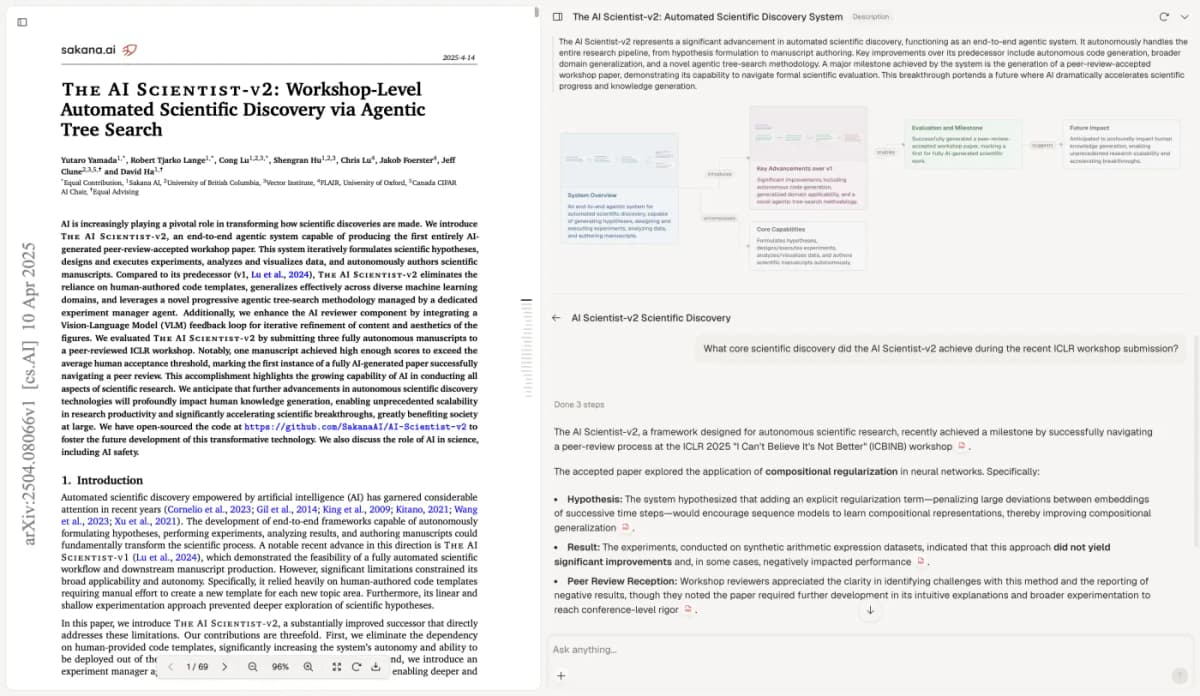
This real Atlas archive screenshot depicts an AI Scientist-v2 paper and citation review. It illustrates inspecting source support, not analysis of the fictional transport passage or a certified interpretation.
The displayed paper is AI Scientist-v2 by Yutaro Yamada and coauthors, licensed CC BY 4.0. It appears in an unedited archive screenshot, with the source on the left and a knowledge map and cited answer on the right.
To save the work, select New, then Note. Add the corrected claim-evidence-assumption-question map, passage locations, source links, and your bounded response. Wait for Saved. Keep unanswered questions visible so later reading can update the note. The note records your judgment; it is not proof that every possible interpretation has been checked.
Write a response you can support
Before using the note in class or a paper, check that your paraphrase is fair. Does it preserve the central claim and its stated limits? Can you point to the support for each criticism?
Revisit the passage when a sentence in your response says more than the text or context sources establish.
Keep a small set of strong questions rather than a long list of vague doubts. Nevada Reno's review guidance recommends returning to confusing passages and parts you will use in your argument.
Resolve what you can, and state what remains uncertain. That makes the next reading purposeful.
A useful final response says what the text argues, how it supports the claim, where the reasoning is strong or limited, and what further check would matter. It is grounded enough for another reader to examine. Critical reading ends with a reasoned position, while remaining open to evidence that could change it.
Check the links in an argument
Compare a text's claims with its evidence and your reading questions.