

Observer bias is systematic error in what people notice or record during a study. If a rater expects one group to do better, that view can affect how they judge an outcome. Start by checking what the rater knew when the score was made.
Then read the rule used to record the outcome and the safeguard meant to protect it. “Two independent raters” and “blinded raters” are different claims. A paper needs support for the claim it actually makes.

Check the recording behind the outcome
Compare what raters knew with the rule they used, then save the cited gaps.
What observer bias means
The Catalogue of Bias describes systematic errors in what people observe and record. A judgment, habit or prior view may shift a score. This can affect an observer who is trying to be fair.
For example, a teacher expecting a workshop to help might count a brief glance at the board as engagement in one class but not another. That illustrates a possible path to bias. It does not prove that any real teacher or study did this.
People may also change how they act when they know they are watched. That is a different concern. The observer-effect guide explains how it differs from biased recording. Both may matter, but they call for different checks.
Trace the observer and recording rule
Find the rater for each outcome
Find who judged the outcome. Did a teacher, outside coder or study participant make the score? A paper can use different raters for different outcomes. Do not let one blinding label stand in for all of them.
For a device reading, check who set up the tool and who interpreted or entered its output. The measurement method and the human assessor are separate details to retain.
Cochrane's guidance asks who judged the outcome and whether what they knew could affect it. Apply those questions to the score you are reading about. A count of who came to class and a rating of engagement need different judgments.
Check knowledge at the scoring stage
Find what the rater could see when making the score. Were group names hidden? Could a video, file name or spoken comment reveal the group anyway? Was the score made before or after access to other results?
Blinding means hiding relevant facts from a named person at a named stage. A pupil who does not know their group does not show that the rater was also unaware. The handbook treats the person judging the outcome as a separate role.
Read the rule and its application
Look for the rubric: which acts counted, which did not and how uncertain cases were handled. Raters need a rule for “engaged” if their scores are to mean the same thing. Ask whether the rule was fixed before scoring began.
The observer guide describes training and set rules as safeguards. Find what was taught and recorded. A statement that raters were trained does not show how the rule worked when a case was hard to judge.
Worked check of classroom engagement ratings
Suppose a made-up study compares two classes. One uses a workshop and one has regular lessons. Two outside raters score engagement from video. The report says they worked independently, then claims observer bias was removed. This case supplies no ratings or results.
Trace the report through these four checks. Raters working on their own can help, but you still need to know what each saw and how the rule was applied.
| Check | Fictional source statement | What can be retained | What needs another passage |
|---|---|---|---|
| Rater role | Two outside raters scored videos | They did not teach the classes | Whether they had preferences or prior involvement |
| Group knowledge | Raters worked independently | They made initial scores separately | Whether workshop labels or clues were hidden |
| Recording rule | Engagement rubric was used | A named rubric guided scores | Exact criteria and uncertain-case handling |
| Safeguard result | Raters agreed well | Agreement was reported | Calculation, sample coverage and disagreement process |
Table 1: These statements belong to a fictional report. A real trace should cite the source for each retained fact.
Correct the independence claim
Do not change “independent raters” to “blinded raters” in a summary. Revise the claim to: “Two raters made scores on their own. The report does not show whether group facts were hidden at scoring or how uncertain cases were resolved.”
Another part of the report may give those facts. Mark them as missing from your source set rather than claiming that masking failed. A paper-analysis workflow helps you find the method, extra files and results for that score.
Ask about ambiguous behavior
Suppose the rubric counts on-task looking, but a pupil looks away briefly. Did the raters use the same time window? Did they exclude that moment, count it or refer it for review? The rules can change a score without anyone trying to skew it.
If the protocol gives a planned rule and the report uses another, keep both passages. Ask when and why the rule changed. Do not silently choose the version that makes the study look better or worse.
Read blinding and agreement claims carefully
Name the person and protected information
A paper may call itself double-blind. Ask who the two blinded roles were and which facts were hidden from them. A label alone does not show that the person judging your outcome lacked group knowledge at that time.
For scores that need judgment, Cochrane's guidance asks whether knowledge is likely to affect the score. Lack of blinding does not by itself show an effect. Keep the outcome and its recording process in view.
Separate consistency from accuracy
Raters may agree because the rule is well understood. They may also agree because they share the same view or mistaken rule. Matching scores do not show how close the ratings are to the intended outcome.
The BCcampus chapter explains why consistent scores need not be valid scores. When a report says agreement was high, find the measure, material scored and uncertainty. That claim does not prove that all observer bias was removed.
Keep other recording risks separate
A device can reduce some human judgment, but its output still depends on setup, rules and data handling. A second coder adds a check, but may share access or assumptions with the first. Ask which risk the safeguard addresses.
If the score comes from someone recalling past events, use a recall-bias check too. That concerns whether the memories are accurate. The observer check asks how the reports or other sources were noticed, judged and recorded.
Save the safeguard trace in Atlas
- Add the report, protocol, recording rubric and any rater-training or agreement appendix to one project. Use permitted, suitably de-identified material. Keep outcome names and document versions consistent.
- In Ask a question, type @ and select those sources. Ask: “For this outcome, who made the score, what group information could they see, and which recording rule did they use? Cite each fact. Separate independent scoring, blinding, training and agreement evidence.”
- Open each numbered citation and check the role and stage named in the passage. If an answer treats participant blinding as rater blinding, correct it. Find a rater-specific passage or keep the gap.
- Revise the fictional bias-free statement using the note above. With real sources, retain unknown access and disagreement rules. Use a source synthesis workflow to keep protocol plans apart from reported practice.
- Select New → Note, save the checked observer note, and wait for Saved. Atlas supports document comparison and notes. It does not observe classrooms, recode videos, estimate bias or certify a formal appraisal.
The image shows source text beside a cited answer. Use that view to check the exact role named in a safeguard passage. Its visible AI paper is unrelated to the classroom example and does not demonstrate an observer-bias assessment.
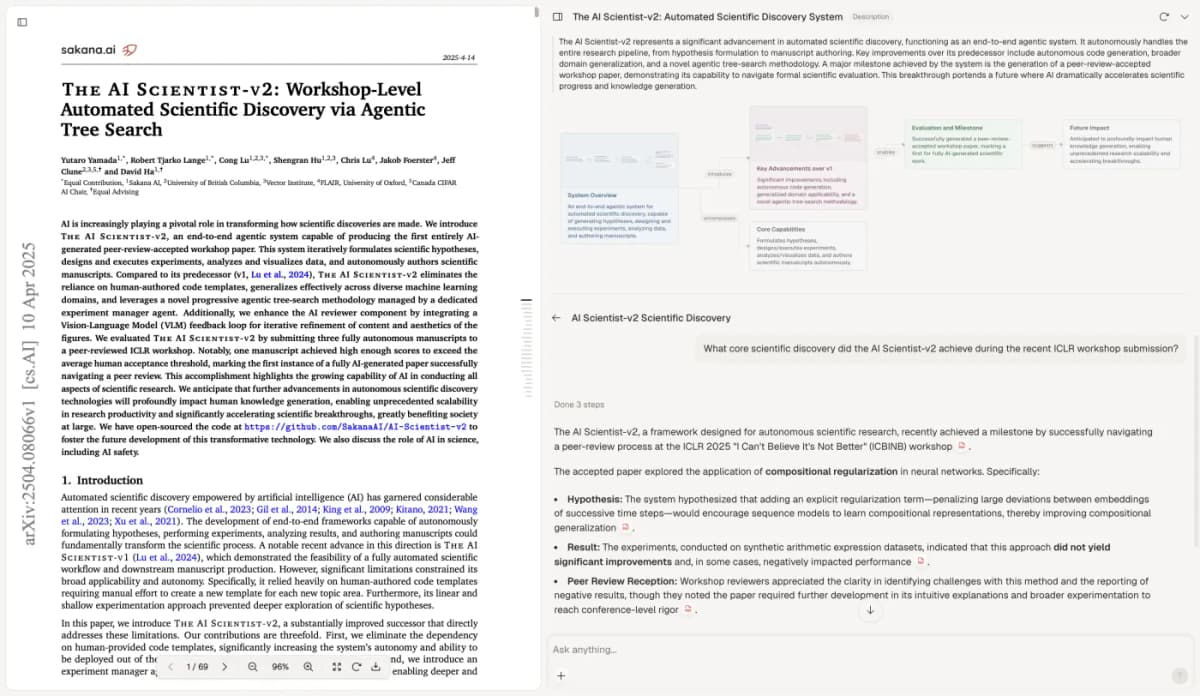
Check who was blinded and at which stage before carrying the safeguard into a summary. Capture includes The AI Scientist-v2, Yutaro Yamada et al., CC BY 4.0, shown within Atlas; copied unchanged.
Keep the judgment tied to outcomes
Save one trace for each outcome whose recording process differs. The same paper can have a masked external coder for one score and an unmasked teacher for another. A general study label may hide that difference.
Ask for the missing rubric or access details before making a stronger judgment. The handbook asks for a judgment tied to a result. Your note keeps the source facts in view. Researchers still own the formal assessment and any analysis.
Check the recording behind the outcome
Compare what raters knew with the rule they used, then save the cited gaps.