
Demand characteristics are cues that may tell people what response a study expects. A person may use those cues to guess the aim and change how they act. A cue alone does not prove that this happened.
Read a paper by tracing three things: the cue, the response it might suggest, and evidence of what people did. Keep a possible belief apart from a belief that the study actually asked people to report.

Trace study cues in Atlas
Compare instructions and debriefing passages, then check each cited claim.
What demand characteristics mean
People do more than follow a task rule. They may try to work out why a task exists and how to do it well. Their view of the study can become part of the setting that the research team hopes to measure.
Orne's original paper made this point central. It challenged the view that people simply respond to the exact task that a researcher has designed. What the person thinks is happening also matters.
A cue need not be a direct request for a result. A study title, an earlier task, or a comment from a researcher may suggest a preferred answer. Yet the person's reading of that cue may differ from the team's aim.
Orne's discussion of perceived cues separates the task as planned from how the person sees it. Do not treat this as proof that people lied. They may try to help, miss the cue, or misunderstand the aim. You need evidence about their response before choosing which account fits the result.
Where participants encounter study cues
The search for cues starts before the main task. The first invitation, consent form, practice task, and spoken comments may give people clues. Extract only words or events reported in the sources you have; do not make up an unseen script.
The research-participation framework follows first contact, consent, baseline tests, group assignment, and follow-up. Its diagram helps you find places where study information may reach people.
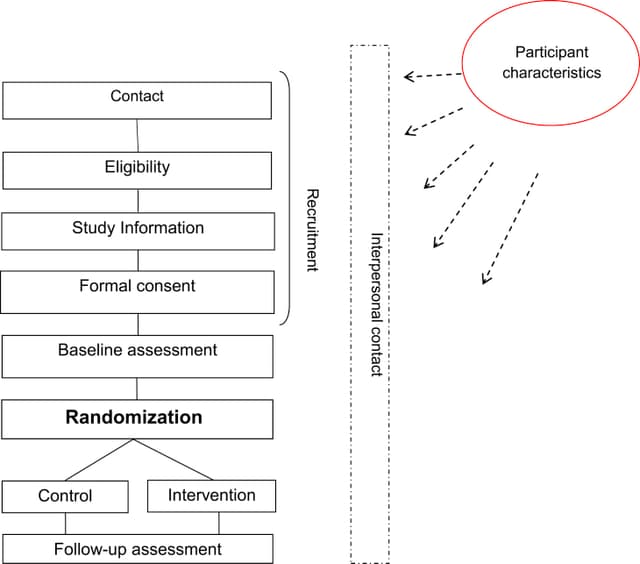
Study information appears at several stages, so check more than the final task script when looking for cues about the expected response. Figure 1 comes from McCambridge, Kypri and Elbourne and is reproduced unchanged under CC BY 3.0.
The boxes map contacts, not measured demand effects. A consent form is not proof of bias. You still need its words, what people understood, and the outcome that could have changed because of that understanding.
Read any quoted script closely. “Answer as accurately as you can” gives a task rule. “This exercise should improve your memory” also suggests a result. The difference tells you what evidence about beliefs to seek next.
If the script is missing, mark that gap. Do not use the paper's title or introduction as a substitute: those parts speak to the reader and may not be what the people in the study saw.
Distinguish cues from nearby bias concepts
The Hawthorne effect concerns knowing that one is being studied. Demand characteristics concern guessing what response is wanted. Someone can know they are watched without knowing the answer a researcher hopes to see.
Social desirability bias concerns answers that make a person look good. The wish to seem helpful or healthy may differ from the wish to confirm a study's predicted result. Record which concern the source raises.
Observer bias concerns how a researcher records or judges events. In a cue audit, ask whether the issue is a cue sent to people or a judgment made about their response. These paths need different checks.
Practice effects concern gains from doing a task before. Order effects concern sequence or position. A better score on a later task does not prove that someone tried to confirm the study's aim.
The review of demand effects outside the lab found a limited and varied evidence base. Use that caution to name the precise concern in a paper, rather than treating the label as a complete account of bias.
Audit a hypothetical experiment
Consider a hypothetical study with a memory task. People read about a “recall-enhancing exercise,” do the exercise, then rate their memory. These invented details show how to audit a cue. They are not facts from an actual experiment.
First, record the cue: the description names an expected benefit. Copy its exact words and source location. Do not strengthen “could help recall” into “will certainly help recall” when writing the note.
Second, name the belief the cue might suggest. People might think better recall is the desired response. That is your possible account unless the paper asked what they believed and reports their answers.
Third, separate a higher self-rating from a better recall score. These are different outcomes, each with its own measure. A change in one does not prove a change in the other, or show why either changed.
Fourth, look for a useful comparison. Did the study vary the description while keeping other parts alike? A group that skips the exercise may not answer a question about the effect of the words used to describe it.
Finally, state the gap: “The description suggested better recall. The paper does not report what people believed, so the cue's role in later ratings remains open.” This is a limit on the claim, not proof the study failed.
For a literature review, keep the reported result next to this limit. That lets you compare findings while retaining the exact reason to be cautious, instead of putting the whole paper in a generic “biased” pile.
Check what precautions actually address
When a study says it was blinded, ask who did not know what. Hiding group assignment, the study aim, or an assessor's knowledge addresses different paths. The label alone leaves an important reading question open.
A shared script can reduce differences between researchers. Check whether the same words were used and whether those words suggested an outcome. Using one script does not make that script neutral.
Questions asked at the end may give evidence of what people thought. Record when they were asked, the wording, and the reported answers. A later account does not prove every belief held during an earlier task.
A reported lack of awareness is also bounded evidence. Check what the question tested before treating it as proof that no cues mattered. Keep the authors' caveat if the measure captures only one part of the concern.
Some studies withhold parts of their aim. Choices about consent, deception, and the final explanation belong to the team and its ethics review. A source audit does not give a reader permission to copy such methods.
Write a precise limitation
A useful limit names the cue, the response it could affect, and what the paper leaves open. It gives the next reader a clear fact to check instead of an unsupported claim that people guessed the aim.
Use this pattern: “People saw [reported cue]. It may have suggested [possible response]. The paper reports [measured outcome], but does not establish [missing belief or comparison].” Fill each part from a source passage.
Mark your own inference as an inference. If the authors raise the concern, keep their account separate from a test that measures it. A discussion of possible cues is not a result from a study of those cues.
Check confounding variables when the cue changes alongside training or task content. Such linked changes may make it harder to assign the result to the cue alone. Trace what differed before making a causal claim.
Across papers, retain the kind of cue and the kind of outcome. Study instructions, knowing one is watched, and wanting to look good can overlap. They should not become one undifferentiated count of problems in the review.
Trace source passages in Atlas
Add study instructions, methods text, and end-of-study reports you may use to an Atlas project. Name the sources in your question so the task is tied to the supplied text rather than a guess about a study you have not read.
Ask: “From these sources, list the words that may suggest an expected response. Separate what people saw, what they said they believed, and what was measured. Cite each point and mark missing facts.”
Use the citation-checking workflow to open each cited passage and read nearby text. Check whether the source reports a belief or whether the answer inferred it from a cue. Correct the note if those levels were merged.
Save the cue's location, the possible response, the measure, the reported safeguard, and the remaining gap. Keep a possible expectation qualified so a later draft cannot turn it into a measured fact.
Atlas supports cited reading and comparison of supplied text. The research team still decides what the design supports. When the paper does not report what people understood, a clear evidence gap is a useful result.
Trace study cues in Atlas
Compare instructions and debriefing passages, then check each cited claim.