
Order effects occur when the sequence or position of study conditions affects a response. A later task may benefit from practice, suffer from tiredness, or be influenced by the task that came before it.
To read a study, trace what each person did first and next. Then ask whether the result follows the condition itself or its place in that sequence. The word “counterbalanced” is a starting point for this check, not its conclusion.

Review study sequences in Atlas
Compare methods and results, open citations, and save a checked sequence note.
What order effects mean
In a study where each person takes part in more than one condition, the first task may change how the next one is done. A score for condition B can therefore reflect both B and the experience of doing A first.
The experimental-design textbook explains this through practice, tiredness, and context. The key reading question is whether a difference follows the condition or the condition's place in the study.
Suppose all people try A before B. A faster response in B does not on its own tell you how B would compare if it came first. The two conditions differ in both their content and their place in the sequence.
Do not use “order effect” as a synonym for every change over time. Record what was ordered, what changed, and how the paper connects the two. When you read an experimental research design, check the actual schedule. The design's name does not give every detail of its task order, breaks, or rules for assigning people to sequences.
Separate the possible sequence mechanisms
Practice effects concern gains from prior task use. If a later condition uses a familiar task, people may already know the rules or response pattern. That differs from a change caused by the condition's content.
Tiredness may work in the other direction. A long earlier task can make a later task harder to complete. The fact that scores fall does not identify tiredness as the cause; check how the paper tests or discusses that account.
A carryover effect involves an earlier condition influencing a later response. Terms overlap across sources. Record each author's definition before treating papers with different labels as evidence about the same pathway.
A sequence may also hint at the study's aim. That belongs to demand characteristics, where cues may suggest a preferred response. Order and guessed expectations can coexist, but they require different evidence.
Knowing one is studied, as in the Hawthorne effect, raises another question. A person may change through being watched even without a change in task order. Keep the proposed cause tied to what the source actually reports.
What counterbalancing does and leaves open
Counterbalancing spreads tasks across orders. With two tasks, some people do A then B and others B then A. This gives a way to check task differences without making A the first task for everyone. It does not undo all effects of having done an earlier task.
The repeated-measures chapter distinguishes all possible orders from a selected set. Check the exact scheme and assignment rules rather than treating the word “counterbalanced” as a full description.
Position balance and transition balance are different. A task can come first or second equally often without following every other task equally often. Check both where it sits and what came before it. Which feature matters depends on what the study asks.
Brooks's methods paper addresses serial carryover through the time relationships between conditions. It shows why the links between tasks matter as well as the position of each task in the session.
Changing order cannot undo every lasting change. If an early task teaches a skill, people still have that skill when they start the next task. The reverse order gives them a different path through the study, not a fresh start free of all earlier learning.
The research team still chooses the model and its assumptions. As a reader, record the scheme and ask whether the claimed result fits its limits. A label tells you what to look for; it does not tell you which model to use.
Audit a two-condition example
Consider a hypothetical usability study. Every person searches for a file with interface A, then does a similar search with B. The invented report says B was faster, but gives no separate order comparison. These are not real study results.
Record A → B and the measure as search time. Check whether file difficulty, instructions, and breaks were alike. The second search may benefit from knowing the task, even if the interfaces themselves differ.
That possibility does not show that A and B are equally good. It identifies a gap in the causal claim. Task experience is a confounding variable when it changes with the interface being tested.
Now suppose another report uses both A → B and B → A. Ask how people were assigned, whether exclusions changed the balance, and whether the results give enough detail to assess a difference by order.
Your note might say: “Both orders were used. The paper describes assignment, but gives no separate comparison by order.” That records a limit in the report without claiming that the precaution failed.
If results differ across orders, read the pattern before repeating the overall result. The meaning depends on the task and design. A sequence-dependent pattern is not an automatic reason to erase the effect of the interface.
Inspect a published sequence figure
A real methods figure may contain more than one order. In Regterschot and colleagues' study, Figure 2 shows sample session sequences and the tests given after them.
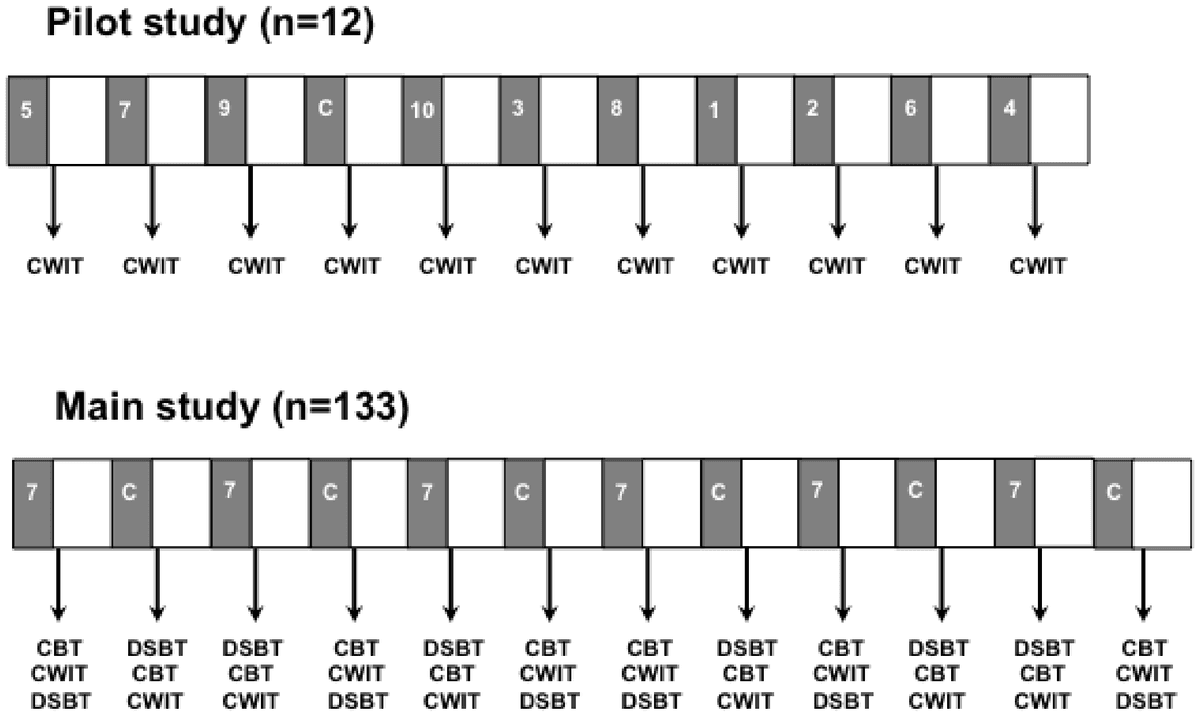
Read the session blocks and test labels separately: the order of treatment sessions differs from the order of tests used to measure their outcomes. Figure 2 comes from Regterschot and colleagues and is reproduced unchanged under CC BY 4.0.
Grey blocks show vibration or control conditions; white blocks show rest. Arrows point to later cognitive tests. The upper panel describes the pilot, while the lower panel shows a sample sequence from the main study.
The methods text explains how session orders and test sequences were handled. One pictured example does not show every person's assignment. Read that text before making a claim about the full scheme.
Use the figure to practice tracing two levels. First locate the treatment or control session, then the tests within its assessment. This is an example of reading a protocol; it is not advice to use the treatment.
Record the unresolved order question
Keep the planned schedule apart from what took place. Missed sessions, exclusions, and deviations may change which sequences were used. Record these details if the paper supplies them, and mark them missing if it does not.
Record any rest or washout period and its stated purpose. A break's existence does not prove all earlier influences ended. Look for the authors' reason for the interval and any evidence about how long the influence lasts.
Keep three evidence levels distinct: an effect that was tested, a concern raised by the authors, and a concern you inferred while reading. A sentence in the discussion is not a result from a test of order effects.
For a literature review, keep the sequence, assignment method, prior-task concern, and outcome timing in a note. This lets you compare papers without assuming that every sequence issue has the same cause.
When details are missing, state the exact question. “Was B always measured after A?” points to a useful next search in the source. “Order effects may exist” gives the next reader much less to check.
Compare sequence passages in Atlas
Add methods text and schedules you may use to an Atlas project. Name the sources in your question so that the answer compares the reported sequences, rather than offering general advice about a design it has not seen.
Ask: “From these sources, list condition order, group assignment, rest periods, and test order. Cite each fact. Separate the planned schedule from what took place, and mark any missing details.”
Use the citation-checking workflow to open each cited passage. Check that claims about the sequence come from methods and that claims about results come from the relevant results text.
Save the checked schedule with source locations and the question that remains open. If the paper says only “counterbalanced,” preserve that reporting gap. Do not let a plausible scheme supplied by an answer become a fact in the note.
Atlas supports reading and comparing supplied text. Researchers still choose the design, model, and causal interpretation. A clear account of what is known and missing helps the review without pretending to solve those choices.
Review study sequences in Atlas
Compare methods and results, open citations, and save a checked sequence note.