

A carryover effect occurs when an earlier condition still affects a result measured at a later stage of a study. The later result can reflect both what happens now and what stayed from the earlier stage. As a reader, trace that link rather than label all change over time as carryover.
A study may report a pause, a washout, or a change in the order of the tasks. Those details matter, but they do not settle the question on their own. Build a note that shows the earlier task, later measure, what might last, and how the authors describe the risk.

Trace the earlier condition in sources
Compare earlier exposure with later measures and reported limits.
What carries into the later period
In a crossover study, the same person takes part in each condition. A period is the stage when one is given. The sequence is their order. GOV.UK's crossover guidance explains why a lasting effect from one stage can matter at the next.
Carryover concerns that earlier effect. A period effect is change with time that does not depend on which condition was given.
A later measure alone cannot identify which explanation fits. The Cochrane handbook's crossover section treats these as distinct concerns.
The term also has a broader use in behavioral research. Statology's authored explanation shows how a prior task can lead to more practice or leave someone tired. This guide traces what one earlier condition may leave behind. Getting used to a task, time passing, and a lasting effect need not have the same cause.
Read 4 parts of the explanation
Start with the methods and discussion, then use any protocol or appendix to fill gaps. The four checks below help you keep the time sequence visible. Look for a route from the earlier task to a later measure it could affect.
| Part | Evidence to find | Question to keep open |
|---|---|---|
| Earlier condition | What was given or learned, and when | What part of its effect could remain? |
| Later measure | What was measured after the next condition began | Could the earlier effect change this measure? |
| Separation | Length and purpose of a pause or washout | Why should this gap be enough for the relevant effect? |
| Limits | What the authors assumed, checked, or noted | Do the sources show that the effect ended? |
Table 1: Four evidence checks connect the reported sequence to its interpretation; they do not calculate a carryover effect.
The original CONSORT crossover extension asks authors to explain the design and the rationale for features such as washout. Record that rationale, not just the name of a phase. A method name can help you find a passage, but cannot replace its reasoning.
For reporting scope, the current EQUATOR resource lists the 2019 crossover extension alongside the generic CONSORT 2025 statement.
These are reporting resources. A clear account still needs a judgment about what the later result can mean. For a report-wide item-to-passage map, use the CONSORT checklist guide.
Worked example with a learned rule
Consider a fictional study of two interfaces for sorting archive items. Interface A teaches a special category rule through feedback. Interface B displays the same categories without that feedback.
People use A then B, or B then A. They take a short break between stages. The task and the following report excerpts are invented; they are not findings from a real study.
In the A-then-B sequence, a person may remember A's category rule while using B. Their work in B could draw on what A taught them. The concern is that this rule stayed with them. That differs from simply getting quicker at clicking through a screen. A fresh set of archive items would not necessarily make the learned rule disappear.
Suppose the report says, “A break between stages removed all influence from the earlier interface.” The methods support the fact that a break occurred. They do not show whether people forgot the rule or stopped using it. The claimed reset goes beyond what the report shows.
A corrected note reads: “The study reports a break between interfaces. A teaches a rule that could still guide work in B. The report gives no reason why the break would remove that learned rule. Carryover is a risk to consider. The supplied passages do not show whether it occurred or how much it changed the result.”
Keep other explanations visible. A later stage might be harder, people might be tired, or the item sets might differ. The fictional sequence raises a question to check. It does not prove that carryover caused a change.
In a wider research paper analysis workflow, retain the authors' explanation and your alternative reading as separate statements.
A pause does not prove recovery
A washout gives an earlier effect time to fade before a later measure. Whether it helps depends on what lasts and when the outcome is measured.
GOV.UK explains its purpose without supplying one duration for all studies. A gap used in an unrelated study is not a rule for the archive task.
Changing the order also does not erase a lasting effect. It may help researchers check some effects of order. An effect from A can still be present when B follows it.
The CONSORT extension's discussion of carryover explains why the authors need to justify their design. A balanced order answers an order question. It does not show that people returned to their earlier state.
Be careful with “no carryover was found.” Ask what was checked and what that check could detect. The Cochrane handbook warns against using an initial test to decide whether to discard data from later periods.
This reading guide does not supply a substitute statistical recipe. Record the stated approach and its limits for review by a methods expert.
A missing explanation does not show that the researchers did nothing. If only the main paper is available, keep “not reported in the supplied sources” in the note. Comparing several studies through research paper synthesis works better when you keep these gaps visible. Do not turn an unknown into a verdict.
Compare the period sources in Atlas
Add the paper, any washout or timing description, and the relevant methods guidance to one project. Include source material you have permission to use. You need the authors' account of the design and its limits. You can compare those statements without data from each person.
- Use @ to select the paper and supporting descriptions. Ask: “What earlier condition could still affect the later measure? State the sequence, timing, washout rationale, and reported limits. Separate the authors' claims from what the passages show.”
- Open each cited passage. Check whether it concerns the right stage and outcome. Read the surrounding text for assumptions, a later qualification, or an appendix reference.
- Correct any claim that “a washout proves no carryover.” Ask which passage supports that claim. Compare it with the CONSORT guidance on explaining the design, then preserve the narrower statement about what was reported.
- Create a note with New → Note. Save the prior condition, later measure, possible lasting effect, rationale, corrected claim, and open question with their citations. Check Saved before leaving.
Atlas can help compare these sources. You judge what a method supports. A cited answer can miss a relevant qualification. These steps do not test for carryover, measure its size, or prove a cause for the study's results.
The existing capture below shows a cited answer beside an unrelated AI research paper. It illustrates opening source context during review. It does not depict the fictional archive experiment or evidence that a washout worked.
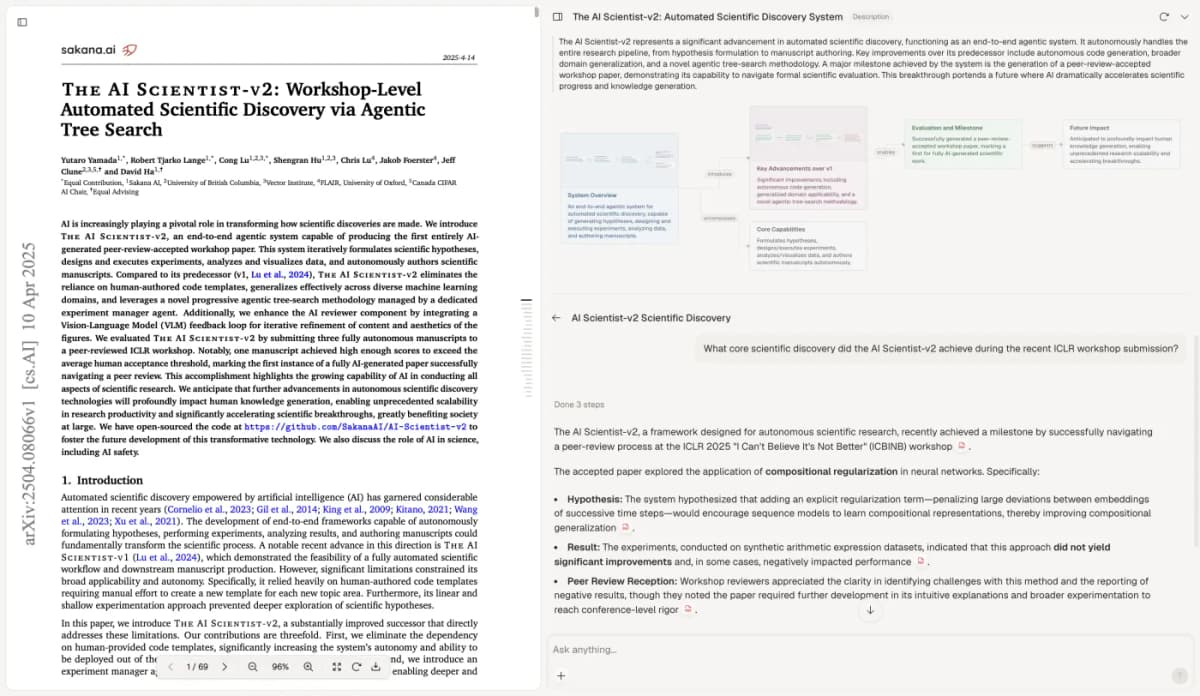
Inspect the cited passage and its surrounding limits before accepting the answer's wording. The embedded paper is Yutaro Yamada and colleagues' The AI Scientist-v2, licensed under CC BY 4.0. The screenshot is reused unchanged.
Save the claim with its limits
A useful final note keeps the report details and your inference separate. “A break occurred” is one statement. “The earlier rule no longer affected later work” is another, and needs its own support. If the sources do not settle that question, preserve it as unresolved.
Revisit the note when a study plan, appendix, or review comment gives you a reason to change it. The note helps you keep different timings and assumptions visible in a literature review process. It remains a reading decision with limits, rather than a new study result.
Trace the earlier condition in sources
Compare earlier exposure with later measures and reported limits.