
Practice effects are changes in test or task performance due to prior exposure. A person may learn the rules, recall items, or find a faster way to respond. A higher retest score alone does not show how much of the gain came from practice.
When reading a paper, trace the first exposure, later attempts, and the time between them. Then ask what comparison helps separate task familiarity from the other changes the study hopes to measure.

Check repeated-test evidence in Atlas
Compare protocols and interpretations, open citations, and keep a checked note.
What practice effects mean
The key concern is that a later attempt is no longer a first attempt. People may know where to look, how to use the controls, or what kind of response counts. Those gains can change a score without the change the test was meant to track.
The ETS review of test practice separates prior test use from coaching. A retest gain need not involve a lesson, study materials, or a teacher showing someone a new strategy.
Keep the scope of a gain clear. Better work on one familiar task does not by itself show a gain in a broad skill. Record the task and measured outcome before using words such as “improved memory” for a change in a specific score.
A working-memory retest meta-analysis examines intervals, test forms, response types, and repeated use. Extract those details before comparing studies. Practice is one possible cause, not a fixed amount to subtract from every score. This article gives a reading method rather than a rule for adjusting individual test results.
Distinguish repetition from other sources of change
Improvement on a repeated test is a finding. A practice effect is an account of that finding tied to prior task use. Treatment, change over time, and differences between test occasions may also contribute to the score.
The account of cognitive trajectories explains why a change score alone cannot identify a person's practice effect. We do not observe how that person would have scored at the same later time without the earlier test.
Order effects concern sequence or position. Practice may help people in later conditions, but the sequence can also involve tiredness or contrast with an earlier task. Trace the proposed pathway rather than merging all later-task changes.
A carryover effect asks how an earlier condition affects a later response. Prior treatment and test familiarity are different things to trace, even when both can last into the next part of the study.
The Hawthorne effect concerns knowing one is studied. Someone can get faster through practice without a new observation arrangement. A demand cue may suggest an expected result, which raises a separate question about beliefs.
Check whether gains were measured on the practiced task or another outcome. A better score on the same items does not establish broader transfer. Record what was tested before using the result to support a wider claim.
Reconstruct the exposure schedule
Start with the first encounter. Was it a demonstration, a practice block without a score, or the first scored test? Count the encounters described in the paper. Keep any unclear or unreported attempts visible rather than silently leaving them out.
Record whether later tests reused items, used alternate forms, or changed the rules. “Same test” can hide different item sets. “Different test” can still share familiar controls or task rules. Note both item exposure and procedural experience.
Record the time between attempts and any feedback. A second try minutes later differs from a test months later. Coaching or feedback may add a chance to learn beyond the experience of taking the test itself.
Use this checklist for each source:
- First exposure and whether it was scored.
- Number and dates of later attempts.
- Item reuse, test form, and response rules.
- Feedback, coaching, or practice blocks.
- Outcome measure and comparison group.
Attach a page or passage to each entry. If feedback is not described, write “not reported.” That is different from saying there was none. A checked schedule should preserve the gap rather than make the study appear more complete.
If you also need to assess test-retest reliability, keep that question distinct. Stable rankings or agreement across occasions concern consistency. They do not on their own show whether prior exposure changed the level of performance.
Read a repeated-performance chart
Van Raalten and colleagues' experiment reports performance for a novel task and six practiced runs. Figure 2 presents reaction time and error rate as separate outcomes.
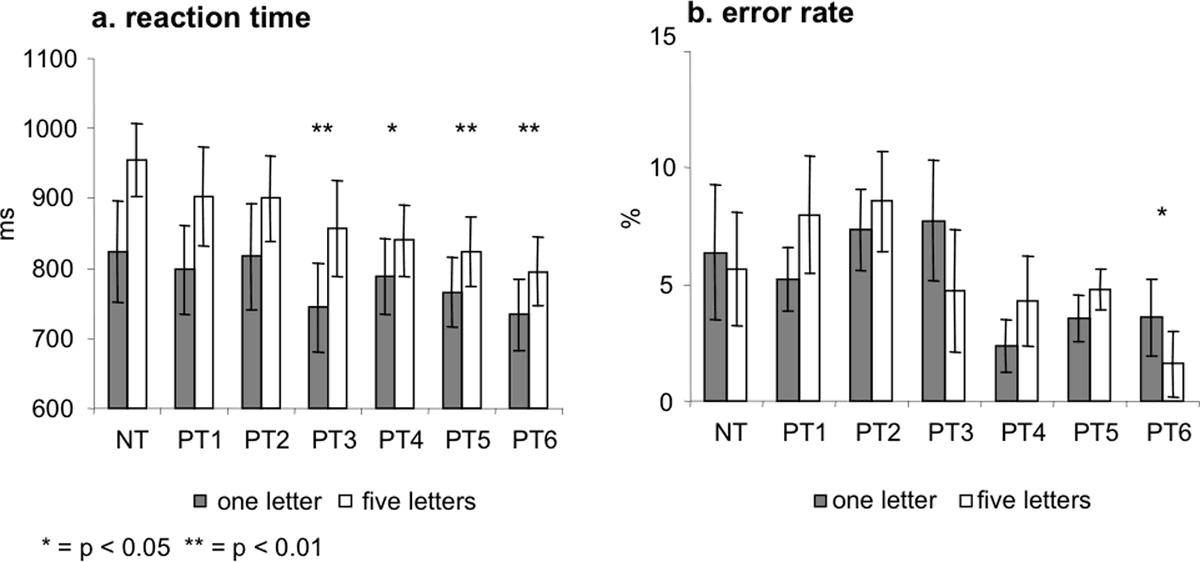
Reaction time is measured in milliseconds and error rate as a percentage. Lower bars mean faster responses on the left and fewer errors on the right; read the two outcomes separately. Figure 2 comes from van Raalten and colleagues and is reproduced unchanged under Creative Commons Attribution, with reuse permitted by PLOS’s license policy.
Grey bars represent one-letter memory sets and white bars five-letter sets. NT marks the novel task; PT1 through PT6 mark practiced runs. These labels locate measured conditions rather than show a score for general ability.
The authors report gains across practice runs, with different comparisons for time and error rate. Read the results and methods together. Do not estimate exact gains or infer the meaning of error bars from the image alone.
This chart is evidence from one task and sample. It shows how repeated performance can be displayed. It is not a correction factor for another test, or proof that everyday functioning improved by the same amount.
Work through a retest example
Imagine a hypothetical study of an attention exercise. People take a timed task before and after the exercise, with similar items. This invented case shows how to read a claim about change; it contains no real scores.
First, state the reported result without assigning a cause: the score differed from the first to the later test. Then ask what the first encounter taught people about the rules, time limit, or response options.
Suppose both the exercise group and a comparison group repeat the test. That is a more useful contrast than looking only at change in the exercise group. Its value still depends on assignment and whether the groups had comparable task experiences.
If one group had more feedback or a different schedule, record that. A “control group” label does not prove equal exposure. Linked changes may act as confounding variables when you try to attribute the gain to the exercise alone.
If all people receive the exercise and no useful comparison is given, write: “The repeated-task score improved after the exercise. The report does not separate the exercise from familiarity with the test.” Keep both the finding and the limit.
This wording does not claim that practice caused all the gain. It identifies the question the design leaves open. A review can preserve the measured result without upgrading it into proof of the exercise's effect.
Assess precautions and remaining uncertainty
Alternate forms may use new items while keeping familiar rules or ways to respond. Check what changed and how the authors show that the forms test the same thing. New items do not remove everything a person learned from taking the earlier test.
A practice block may help people learn the task rules. It does not prove that their scores stay stable on later attempts. Read why the block was used and whether later results match the team's stated aims for that step.
Counterbalancing distributes conditions across positions, but it cannot make earlier task experience disappear. Read whether the study addresses order and repetition as separate concerns, rather than assuming one design step solves both.
Longer gaps change the schedule; they do not prove that all retest gains have gone. Record the time between tests and what the source says about it. A gap of weeks or months needs to be read in the context of that task, rather than treated as a fixed rule for every test.
In a literature review, name the precaution, what it targets, and what remains uncertain. Researchers retain choices about tests, comparisons, and models. This reading method does not supply clinical score corrections.
Save a checked exposure note
Add methods text and results you may use to an Atlas project. Name the sources in your question so the answer can compare their reported exposure schedules. Keep the task bounded to facts in those sources.
Ask: “For each source, list first exposure, later attempts, intervals, item reuse, feedback, and comparison groups. Cite each fact. Keep reported gains apart from proposed causes and mark details the paper does not give.”
Use the citation-checking workflow to open cited passages and read the nearby text. Check that the response has not turned “may reflect practice” into “was caused by practice.” Correct the note if the claim grew stronger.
Save the schedule, score change, source locations, and missing comparison in one checked note. When you write the review, retain the task's name and the scope of the result so a gain on one test does not become a broader claim.
Atlas supports cited reading and comparison of supplied text. The research team still chooses the analysis and causal interpretation. If the source cannot separate practice from other changes, keeping that gap clear is the appropriate result.
Check repeated-test evidence in Atlas
Compare protocols and interpretations, open citations, and keep a checked note.