

A dissertation conclusion gives the final answer to your research question from the work you have done. Bring the main findings together, state what they add, and keep the limits that control your claim. The ending should help a reader see what the study shows and which questions remain open.
This guide uses a made-up study to show how each final claim links to a finding and its limits. Atlas can help you check source text and keep notes. You own the final claims and must follow your school's rules on AI use.

Check conclusion sources in Atlas
Compare a draft claim with named findings and limitations.
What a dissertation conclusion must answer
Start with the question the study set out to explore. A clear final answer states what the work supports. Finishing a project does not mean that you met each aim or proved the claim you hoped to test. A question may have a mixed answer or no firm answer at all.
Bath's chapter guide treats the research question as the link between chapters. Return to that same question at the end. If your study changed course, make sure the opening and methods explain the change before the ending relies on it. Use the dissertation methodology guide to check those methods against the study records.
The discussion explains what the findings mean for the question and prior work. The ending brings that reasoning to a final answer. UNSW's thesis guide gives these sections distinct roles and notes that forms vary by field. Your course may join some chapters or use a different layout.
The study may add a clearer account of a local practice or challenge a prior view. It may also narrow what can be claimed about a problem. Manchester's guide covers both what a study adds and its limits, so keep them together when the limit changes your answer's meaning.
Collect the findings before drafting
Gather the final research question, results chapter, discussion, and the parts that explain the study's limits. Use the files you plan to submit.
Mixing an old results file with a new draft of the discussion can lead to an ending that no longer matches either one.
For each main finding, note where it appears and what kind of support it has. A table of scores, an interview theme, and a close reading of texts can support different claims.
Copy enough text to keep the finding's scope clear, then write a plain-language account beside it.
Keep findings apart from the meaning you gave them. Bath's chapter guide draws a line between results and what they mean. In your working note, keep the result page and the page that explains it as distinct links.
You can then see which part of the final claim draws on each one.
Next, attach the limit that matters to each claim. A study at one site may describe that setting well without supporting a claim about all schools. What people said does not, by itself, measure the effect of what they did. Our external validity guide looks at where findings may apply beyond the group or site studied.
Keep doubt visible at this stage. If two findings point in different ways, note both before you decide how they fit. A neat final paragraph should not hide a result that changes your answer. Return to the earlier work if that tension has not yet been explained in the main text.
Trace findings into a fictional conclusion
Take a made-up study of how students use checklists to plan posters for a research event. In this example, the writer spoke with students from one department. All findings and section numbers below are invented to teach the writing process. They do not come from a real study.
The writer has discussed the findings and their limits in prior chapters.
The table links each part of the final answer to that work. In your own table, use checked findings and real page, table, or section numbers in place of these made-up details.
| Question or claim | Fictional finding and location | Limit that controls the claim | Defensible conclusion wording |
|---|---|---|---|
| How were checklists used? | Interview theme in section 4.2 describes planning tasks before drafting. | Accounts of use, not direct observation. | Participants described checklists as a way to plan poster tasks. |
| What did users value? | Section 4.3 records accounts of noticing unfinished source checks. | No independent measure of citation errors. | Participants valued reminders to check sources; fewer errors were not established. |
| Where does the answer apply? | Methods section 3.1 describes recruitment in one department. | Other departments and nonparticipants were not studied. | The account concerns the interviewed group in this setting. |
| What remains unanswered? | Discussion section 5.4 identifies no poster-quality comparison. | Effects on quality were not tested. | Further work could compare poster quality under defined conditions. |
Table 1: Fictional teaching example: each final claim retains the type of evidence and the limit attached to it.
A weak draft might say that checklists led to better posters. Nothing in this made-up study tests that effect. Change the claim to say that the students found checklists useful for planning and source checks.
This keeps the finding and removes a cause-and-effect claim that the work did not prove.
The final paragraph can then state what the work adds: an account of how this group used checklists and a question for further research. Lucerne's writing chapter treats gains, limits, and future work as distinct parts.
Keep a proposed next study from sounding like a result you have found.
Check scope against programme requirements
Use three criteria to check the draft: fit with the question, support from the work, and fit with your course rules. This is a way to review prose, not a scoring scale that has been tested for research use. It helps you find a weak claim before you polish its wording.
First, check the form and length in your handbook or marking guide. UNSW advises writers to check local guidance because the field shapes the layout. Do not use a word count or share of the whole text from a web guide unless it matches your course rules.
Second, decide which limits belong in the ending. Keep those that change the final answer, while leaving the full account in its own chapter. The Lucerne chapter covers both gains and limits in a review of the work. Give the reader an answer whose scope fits what you found.
Third, check how your course treats advice for practice, source links, and reflection. Manchester's Phrasebank offers wording for several roles an ending can serve. It is a language guide, not a rule that all work must include each role. Use the parts that your claims and course call for.
Write the answer without adding evidence
Draft the answer in plain language before turning it into a polished chapter. State what the study found, explain what it adds, and keep the limits that matter. Build on the points you have made in the discussion. Avoid packing broad claims into one sentence that is hard to trace back to the work.
A fresh synthesis can show how findings fit together without adding new data or a new test. UNC's handout asks writers to connect points from the work rather than just repeat them. Our research synthesis guide covers that task when your claims also draw on several papers.
New evidence needs its own place in the text. A score, interview passage, or source that the reader needs to judge your claim belongs where you can explain and assess it. Bath's guidance says the ending should use points you have discussed.
If a late finding matters, revise that earlier section before using it at the end.
Match the reach of each claim to its support. A local account can raise a question or suggest a practice worth testing without proving that it works at all sites. The UNC handout warns against new topics and evidence that do not belong at the end. Each idea needs a clear path from the main text.
Tie future work to the question it would address. In the made-up poster study, a test of quality would address an effect that was not tested. A vague call for a larger study would leave the reason unclear. Lucerne's guide treats further research and advice for practice as distinct roles, so make clear which one you mean.
Check final claims in Atlas
Use only text you are allowed to upload or share. Before bringing files into a tool, check your school's rules and the terms that cover data from people in the study. Remove names or restricted text when the rules call for it.
This reading workflow does not replace consent or the research process you were cleared to use.
Open the project with the question, findings, discussion, and limits you can use. Mention the right items with @ so the request points to those files. Choose Project only to prevent new web or literature searches.
Earlier chat context remains available, so check what the chat already contains before relying on this scope.
Ask Atlas to check a proposed ending against those named files. For example: "For each final claim, show the finding and where it appears. Keep the stated limit and flag claims these files do not support." Treat the response as a draft check.
A missing source link may mean the tool did not find a passage, rather than prove that no support exists.
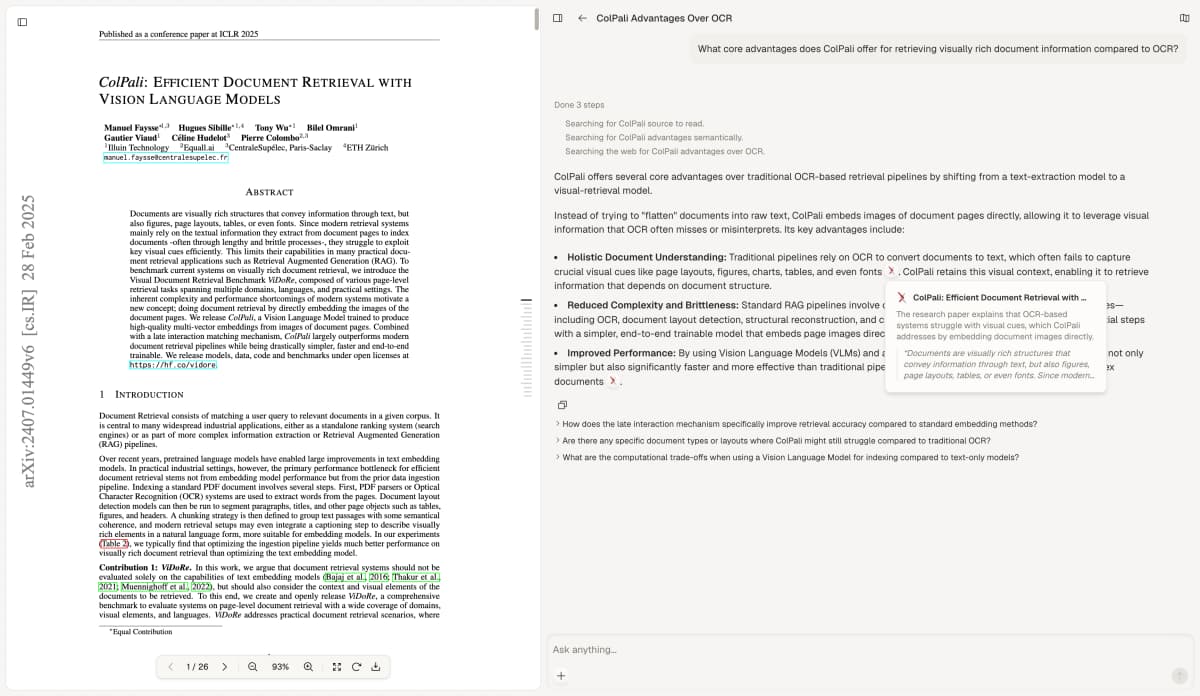
Atlas citation preview beside ColPali by Faysse and colleagues, released under CC0 1.0. The screenshot was converted losslessly without content changes. It illustrates source inspection, not the fictional poster study or a test of dissertation accuracy.
Open citations and read the passage and nearby text yourself. Check what kind of support it gives, who or what it covers, and the limits on the claim. Our citation tracking guide explains why a source link still needs a check.
In the made-up study, reject a claim about better posters when the text reports only what students said.
Save the checked trace and draft reasoning in a note. Select New, then Note, enter the checked trace, and wait for Saved before closing it. Keep the full dissertation in the writing tool your course calls for. Atlas helps keep a checked working note; you and your supervisor judge the final claims.
Read the opening and ending together
Read the dissertation introduction and ending side by side. Check that they address the same question and that the ending gives an answer at the strength the work allows. If a term, group, or outcome changes meaning between the two, fix the right chapter rather than hiding the mismatch in the last paragraph.
Then trace each main final claim to earlier work. Use the dissertation abstract guide to carry the checked answer and limits into the final summary. Keep open questions clear, check the required form, and ask your supervisor about rules you are unsure of. A sound ending gives the reader a clear answer and a clear boundary around that answer.
Check conclusion sources in Atlas
Compare a draft claim with named findings and limitations.