

Dissertation methodology explains how you studied your research question and why you chose that approach. A strong chapter links the question, methods, work you did, and limits of the claims that follow.
For example, reading campus policies can show how written rules define support for students who commute. Those texts alone cannot explain why students miss classes. To answer that second question, you need more kinds of data or a narrower question.
Build a method-choice evidence map before drafting. Give each major choice a row with its reason, method source, and record of what you did. The worked case turns that map into a short rationale whose claims stay within the data.

Build your method rationale in Atlas
Compare study records with cited methods and save your reviewed chapter plan.
What the methodology chapter must explain
Methods are the tools and steps you used to gather and analyze data. Methodology explains the reasoning and assumptions behind those choices.
A dissertation chapter usually needs both, although its name and place vary by field. The Lucerne writing guide joins what you did, how you did it, and why.
Readers need to follow the work and judge whether it fits the question. A list of famous methods does not explain your choices or promise the same findings. The setting, people, and way you read the data can change what a later study finds, even with similar steps.
Check your department's current handbook and your supervisor's guidance first. There is no fixed chapter number, set of headings, or word share for all fields. The Northampton quick guide offers a starting point that you can adapt to local rules.
Gather the records before drafting
Fix the question and study status
Put the final question beside the current aims. If you changed it after access problems or early analysis, keep the reason and date.
A clear research objective helps you decide which steps need more detail. Do not rewrite the earlier plan as though you had always meant to use the final design.
A proposal describes planned work, while a final dissertation reports work you did. Mark each note as planned, done, changed, or unresolved before turning it into prose. A sentence from a proposal cannot show that you later carried out that step.
Collect the study evidence
Gather the study plan and any required approval, source list, sampling log, tool versions, field notes, analysis files, and notes on choices.
For document research, keep each file's title, author, date, version, and download link. Record why you included it. A file list alone will not explain why you kept one item and left another out.
The Northampton research diary advice supports keeping choices and reasons as you work. An audit trail links that history to sources. It helps a reader trace your choices, but cannot recover a choice no one wrote down.
Separate two kinds of support
A method paper can explain why a set of steps suits a task, while your own log shows whether you used those steps and how.
Keep both in view: citing a coding guide cannot show that you checked all six files, while a spreadsheet cannot by itself justify how you read the data.
Connect each choice to the question
Ask what evidence would answer it
Write the question in plain words, then name the data needed to answer it. Counts may suit a question about frequency, while interviews may suit a question about people's understanding of an event. An experiment needs a design that supports its effect claim. These are starting points for thought, rather than rules pairing a question word with a method.
Scribbr's methodology guide connects the approach to the question and the data needed. If a study combines numeric and qualitative work, explain how the parts meet. Two separate sets of results do not form a mixed methods design simply by being in the same chapter.
Explain the reason and tradeoff
For each major choice, finish the sentence: “We chose this because the question needs...” Then state what the choice leaves unanswered. Explain why a plausible alternative did not fit; one well-chosen contrast may explain your choice better than a list of textbook methods.
The Manchester Academic Phrasebank shows ways to explain why you chose one method and rejected another. Use it to state a reason you can support. A claim about reliability cannot stand in for a check your study never ran.
Use philosophy where it changes the work
If your program asks for a philosophical position, show how it shaped your choice of evidence and how you read it. A policy can state the campus's formal view yet leave out much of what staff and students do each day.
Do not choose a paradigm label just because you used numbers or interviews. The Lucerne guide to methodology and tools helps keep your reasons tied to the work. Describe the assumptions you used, with the depth your field expects.
Build a chapter readers can follow
Introduce the design and setting
Open with the question, approach, setting, and reason the design fits. Then guide the reader through choosing the sample, gathering data, preparing it, analysis, checks, and limits.
The university structure guide starts with the reasons for the approach, then turns to the steps. Your headings can follow a different order if the study needs it.
Keep background reading in its proper role. A short reference can support a method choice, while a long survey of all approaches may hide what you did. Editage's chapter guide flags textbook padding and weak links to the question as common writing problems.
Define the sample or source set
State who or what could enter, where you searched or recruited, which rules you used, and how many records entered the analysis. Explain what was left out and why rules changed.
For an existing dataset, describe the original source and the part you used. For documents, keep the final policy distinct from an older draft even if they have the same title.
The READ methods paper lists types of text used to study health policy. Its seven groups cover official, implementation, legal, working, scholarly, media, and other materials. A policy may state a formal view, a work tool may show a planned process, and a draft memo may show a choice still in progress. Choose the types that fit your question. A study does not need all seven groups just because the table lists them.
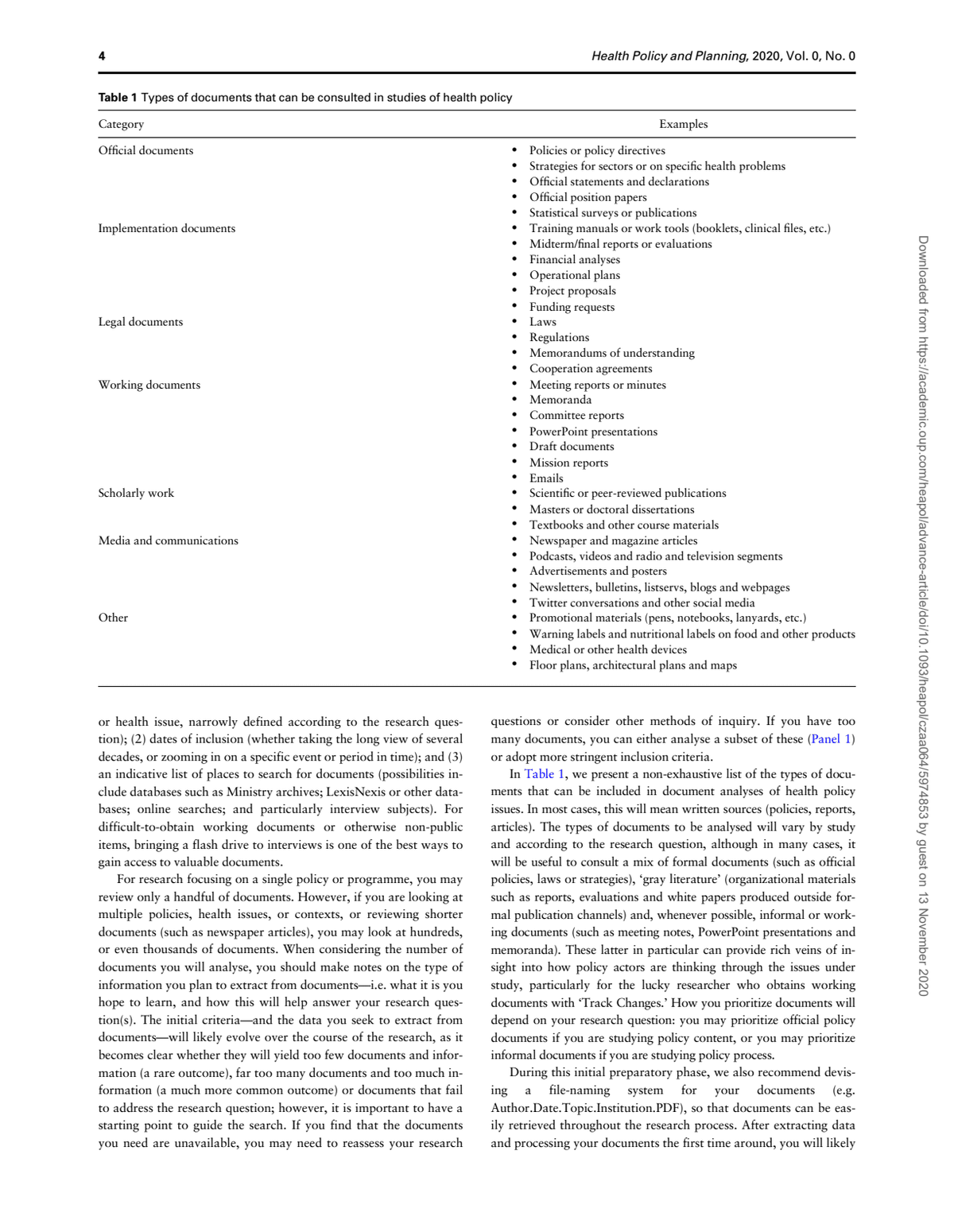
Dalglish, Khalid and McMahon, READ approach, Table 1, CC BY 4.0. Full advance-article PDF page 4 rendered as PNG without cropping or content changes.
Document types offer different kinds of evidence. Select and justify the types your question needs, and keep their status clear in the methods account.
Describe gathering and analysis
Explain enough of the steps for someone to follow their logic, including key dates, wording, tools, versions, and how you dealt with missing data.
Place long survey forms or coding guides in appendices when allowed, then point to the parts that matter. Scribbr's methods guidance includes choosing sources and preparing data as well as gathering it.
Name the analysis method and show how you used it. “The files were analyzed in software” leaves the key step unclear. State how you coded text, grouped codes, compared cases, or ran tests. The Northampton analysis guidance warns that a software name does not explain what you did with the data.
Reconcile the plan with execution
If a tool changed after a pilot, a site refused access, or a source was withdrawn, report the change and its effect. The Northampton final-writing advice calls for the chapter to reflect the work you did. Keep the reasons in the log so the final prose stays precise.
A worked method-choice evidence map
This is an original fictional teaching case. No campus files were collected, no students were studied, and no real findings or ethical approvals are claimed. Its sample and records show how to write from a clear study account. They are not facts from someone else's dissertation.
Define the bounded case
The question is: “How do published 2024 policies at three campuses describe the process for commuting students to request attendance support?” The study concerns written rules and routes for requests. It does not assess whether staff followed the rules or whether students found them useful.
The teaching log has nine candidate files. Two older versions and one unrelated housing policy were excluded. Six files remain: one attendance policy and one student handbook from each campus. The same date and topic rules apply throughout. This source set cannot stand for all universities.
Map choices to records
The table connects each choice to its reason and the record needed to support the methods sentence. For your own study, fill these cells with checked sources and records of the work you did.
| Method choice | Reason linked to the question | Study record to check | Claim limit |
|---|---|---|---|
| Qualitative document analysis | The question asks how written rules describe a process | Final question and source-type notes | Cannot establish students' lived experience |
| Three named campuses | Keep a bounded comparison of institutional texts | Scope note and campus list | No claim about all universities |
| Six 2024 policy and handbook files | Apply the same date and topic rules across cases | Nine-file selection log with three exclusions | Public files may omit informal practice |
| Page-linked extraction | Retain evidence for eligibility, request route, and deadlines | Extraction sheet with file IDs and pages | A summary must not strengthen the source |
| Codes revised during reading | Allow the categories to fit relevant text | Dated codebook versions and revision reasons | Changes require checks of earlier coding |
| Cross-document comparison | Compare stated processes while preserving source context | Checked matrix and interpretation notes | Similar wording does not prove similar delivery |
Table 1: Use the record column to verify what happened before turning each choice into past-tense chapter prose.
The READ paper links four stages: prepare the texts, extract data, analyze it, and bring the findings together. We adapted that sequence for this teaching case. We have not tested it as a campus-study protocol. In a real chapter, the fields you took from each text and changes to codes must come from your own work.
Turn the map into prose
A short methodology extract could read:
This study used qualitative document analysis to compare how three campuses described support requests for commuting students in their published 2024 texts. Of nine candidate files, six were retained. Two old versions and one out-of-scope policy were excluded. Passages were logged with file IDs and pages. The analysis compared who could apply, request routes, and deadlines across the texts, with notes on wording and context. The study addresses stated rules. It does not establish students' experiences or how staff delivered the service.
This extract gives the approach, reason, sample, choice rules, analysis focus, and claim limit. A real chapter also needs search, code changes, checks, data handling, and ethics details. Manchester's methods-writing examples offer sentence forms. The annotated methodology section example shows how to build a paragraph. Supply your own checked facts for both.
Correct the stronger claim
“The policies reveal why commuters missed classes” goes beyond the source set in this case. Change it to “The analysis compared how the texts described support requests.” If the real question concerns missed classes, seek data on what people do or experience and revise the design. A longer rationale cannot fill that gap.
Keep quality and ethics claims specific
Describe the checks you performed
Explain what you did to check the work and why it fits the approach. In the teaching case, that could mean checking extracts against source pages and logging why a code changed. Only report a second-coder review, member checking, pilot, or reliability test when you did it and it suited the study.
Editage's quality discussion offers common examples, but they are not a set of steps that all studies must take. Naming a check cannot establish quality by itself. State its role, what you checked, and any open problem rather than claim it “eliminated bias.”
State position and source limits
Document authors write for a purpose and an audience, while your own aims also shape how you read their work. A note on reflexivity can show how your assumptions affected a reading and what you checked next.
For instance, expecting all campus texts to have the same request route might lead you to miss a key difference.
The READ paper's source-context discussion asks how texts were produced and what is missing. Explain why a missing public file limits the account.
A file you did not find may still exist, and staff may have internal guidance that your study cannot access.
Report the actual ethics status
Use your institution's current ruling and your study records; using public texts does not settle all ethics or permission issues.
State the review or exemption status, access terms, and data safeguards that apply. Do not guess an approval number or copy a claim of review from a model chapter.
The Northampton ethics prompts ask about harm, consent, and data protection. Adapt the relevant questions to your study and follow local rules. Only add personal or restricted data to a drafting tool when you have permission to use it there.
Draft the rationale in Atlas
Keep sources and records distinct
Open a project with the question, allowed study records, and chosen references. Keep proposal notes apart from final logs and label the teaching case fictional if you use it.
A method reference, a policy used as data, and your own choice log serve different roles even when all are project files.
Start a chat and type @ to select the sources and records you mean. Choose Project only to keep new retrieval within the project and supplied text. Earlier chat context stays available, so start a fresh chat if old outside sources could blur the scope.
Request a source-linked rationale
Ask a focused question:
Compare my final question and study log with the named methods sources. Build a table of method choice, reason, supporting passage, record of work done, and claim limit. Mark missing records as unknown. Draft a short rationale from checked facts. Do not invent sampling steps, quality checks, approvals, or findings.
Check whether the answer keeps published guidance apart from your study log. If it uses a method citation to claim you performed a step, correct the row. A rationale can sound plausible and still describe work you did not do.
Inspect and save the reviewed draft
Open each numbered citation beside a method claim and read the text around it. A PDF citation can open an exact page when it has an anchor. Otherwise, find the passage yourself. Check that the source supports how you used the method, rather than just names it.
Check each claimed step against your log. In the teaching case, check nine candidate files, three exclusions, six kept files, and the limit to written rules. Remove claims about who attended class, whether students liked the service, or ethics approval. Keep open cells visible and ask for a new paragraph based on your corrections.
Select New, then Note, to save the checked map and rationale in the project. Keep source passages, log names, open questions, and chapter headings together, waiting for Saved before closing.
Atlas helps compare sources and draft from them. You check the final account and follow your program's authorship and AI-use rules.
Review the chapter against the records
Read the chapter with the final question and logs open, checking counts, dates, versions, choice rules, analysis steps, changes, and claims.
Use past tense for work done and mark planned work clearly. Use the dissertation abstract guide to condense the checked methods and their limits for the final synopsis. Scribbr's final writing advice keeps the focus on how and why methods served the question.
Ask whether each main paragraph gives the reader a fact, reason, step, or useful limit. Remove textbook text that does not explain your choices. Check appendix links and department rules. Ask your supervisor or a methods reviewer to inspect gaps you cannot resolve alone.
The final chapter should make it clear why you chose each method and what you did. If a claim needs data you never gathered, narrow it or revisit the design with your supervisor. Clear writing shows that limit. It cannot replace the missing work.
Build your method rationale in Atlas
Compare study records with cited methods and save your reviewed chapter plan.