
A useful methodology section example links the study's question to the work done. It gives a reader enough detail to follow the choices, data, and steps. You can learn that structure from a model, but your own section must describe your own study.
Below is an original fictional document-study example, with notes on what each paragraph does. Use it to plan your account, then check each factual statement against your real records. Do not carry the model's dates, counts, or procedures into your paper.

Build an outline from your method notes
Compare useful model sections with records of what your study actually did.
What the section needs to explain
A methods section reports how you carried out the research. A methodology chapter may also explain in more depth why the approach fits the question. Titles and scope vary by field. Oxford's reporting-methods guide describes what writers need to explain. Fields may order these parts in different ways.
The reader needs to know what material you used, how you chose it, what you did with it, and why.
San José State's annotated handout shows how the account changes with the kind of data used. Start with your assignment or journal rules, then choose headings that fit the work.
For a finished study, describe the steps you took. A proposal describes work you plan to do. Manchester's methods resource shows that past tense is common for work already done. A change of tense must not turn a plan into a claim that the work took place.
Annotated methodology section example
This teaching example is entirely fictional. The library, texts, dates, counts, and records do not refer to a real study. No actual people, approval, data, or results are claimed. It models a small document study. It is not an interview study, an experiment, or a systematic review.
Purpose and choice of material
This study asked how North Quay Library's public notices described access to its evening services. We compared texts issued in one calendar year. We used written notices because the question concerned what the library said in writing. It did not ask how people felt about the services.
This part names the question's focus and gives a reason for using documents. That reason also limits the claim. A written notice cannot show how a visitor felt.
The link between question and choice matters more than a label such as “qualitative.” WPI's methodology handout asks writers to explain the reasons behind their steps and choices.
Selection and recording
We included dated notices issued from January to December 2025 that mentioned evening opening hours or entry rules. We left out undated texts and copies with the same wording. Of the 18 texts in the archive, 12 met these rules. A log kept each text's ID, date, and the reason it was included or left out. For each passage used, we kept the source text and page number.
This part makes the choice of texts visible. It states the period, rules, counts, and record kept. In a real study, use counts from your records and name how you accessed the archive. SJSU's handout covers where existing data came from and why they were chosen. These 12 texts do not stand for every notice the library has ever issued.
Analysis and traceability
One researcher read the 12 texts and recorded passages about opening times, entry rules, and exceptions. A coding sheet defined these three groups and kept each passage beside its source ID. When a passage fit more than one group, both labels were kept. The researcher checked the sheet against the source texts and logged changes before comparing the groups across texts.
The text explains what “analysis” meant here. It names who did the work, the coding groups, how overlap was handled, and the checking step. It does not claim that a second coder took part or that agreement was measured. In your account, describe the checks that took place. Manchester's methods guidance helps writers explain their steps and limits. Good wording cannot prove that a step occurred.
Scope and limitations
The study covered only the chosen year's texts in the archive. It did not check whether services ran as described or whether visitors understood the notices. One researcher coded the texts, so the labels depended on that person's judgments. The source passages and change log allowed others to review those judgments.
This part tells readers what the method can and cannot show. The audit trail helps someone inspect the judgments. It does not remove every source of bias. The example puts key limits beside the steps used. A thesis or journal may require a fuller discussion of limits elsewhere. George Mason's IMRaD guide separates what was done from what was found and what it means.
Adapt the structure to your study
Copy the paragraph's job, then write the facts from your own project. The example's selection paragraph answers “What was included, how, and why?” It does not tell you to use 12 records or a one-year window.
Those choices need to come from your study and its reasons.
When your study uses interviews
An interview account needs details this model cannot supply. Describe who could take part, how people were approached, what they were asked, and how recordings or notes were handled.
Explain how you studied the data and report the actual consent and review steps that apply. SJSU's qualitative guidance helps identify these needs. Do not add a consent or approval claim unless it is true and supported.
When your study uses numerical data
Report what you measured, how you prepared the data, and which analysis steps you used. Include the details your field requires. This model cannot choose a test or justify a sample size for you.
Use guidance that fits your design and the choices made with your supervisor or team. Oxford's guide stresses both how and why. Explain your choice with support rather than simply calling it correct.
When your work is still a proposal
Keep proposed steps distinct from completed work. State the intended data source and access plan without claiming you already collected data. Mark decisions that remain unresolved.
If a pilot has been completed, identify it separately from the main study. Readers should be able to tell what is known, planned, and still awaiting a decision.
Turn real records into an outline
Before writing prose, gather the records behind your methods. These may include the study plan, selection log, tools, notes on steps taken, analysis files, and review records. Use only material you have permission to handle.
Match each heading to evidence of the work. Keep gaps as questions for the person who can answer them.
For the fictional document example, the map would look like this. In a real project, replace each record name with its actual file and location.
| Proposed heading | Record to check | Detail the record should support |
|---|---|---|
| Purpose and approach | Research question and design notes | Why documents fit the question and what they cannot show. |
| Document selection | Archive record and selection log | Source, date range, rules, included counts, and exclusions. |
| Analysis procedure | Coding sheet and procedure notes | Who coded, definitions, overlap rules, and checks performed. |
| Scope and limits | Review notes and correction log | Constraints, changes, and the limits of the resulting account. |
Table 1: This map helps you write. It does not certify the design.
WPI's handout offers a useful structure of steps and reasons. If a record conflicts with your planned sentence, check the difference before polishing it. For example, a note that only ten texts were coded cannot support “all 12 were analyzed.”
Keep findings out of the procedural account unless your field's format requires otherwise. George Mason's guide distinguishes methods from results. Explain how categories were compared here; report what that comparison found in the appropriate results section.
Compare examples and notes in Atlas
Atlas can compare model sections with your permitted method notes and propose an outline. Check the draft against records of the steps you performed, and judge whether the design fits your question.
Name the two kinds of source
Add the examples and your actual notes to a project, then wait for processing to finish. Start a fresh chat if earlier messages contain unrelated evidence. Choose Project only beside + to keep new web and literature searches out of this comparison. Earlier chat context remains available, which is why a fresh chat can help keep the task focused.
In Ask a question, type @ and select the example sources and actual study notes. Ask for a distinction such as:
Compare the named methodology examples with my method notes. Propose an outline with each heading's purpose, the model passage that illustrates that purpose, and the actual-study note that supports my content. Keep missing facts as questions. Do not transfer the example's sample, dates, procedures, approvals, or results into my study.
The approach used in research synthesis also helps here. Check each source's role. A model can show how to structure the text. A project note can support a fact about your study. Keep those roles separate when the answer combines them.
Check and correct the outline
Open the numbered citations for both sources. Check whether the model shows the claimed writing task. Then read the study note for the fact proposed under that heading. Include the nearby context. A source can mention coding without showing who coded or which checks took place.
If the answer proposes “two researchers coded independently” but your notes name one researcher, remove that claim. Keep a question about any missing detail instead.
If the wrong source was used, mention the intended note and ask again. The source-checking workflow explains why a citation marker is only a route to inspect the text.
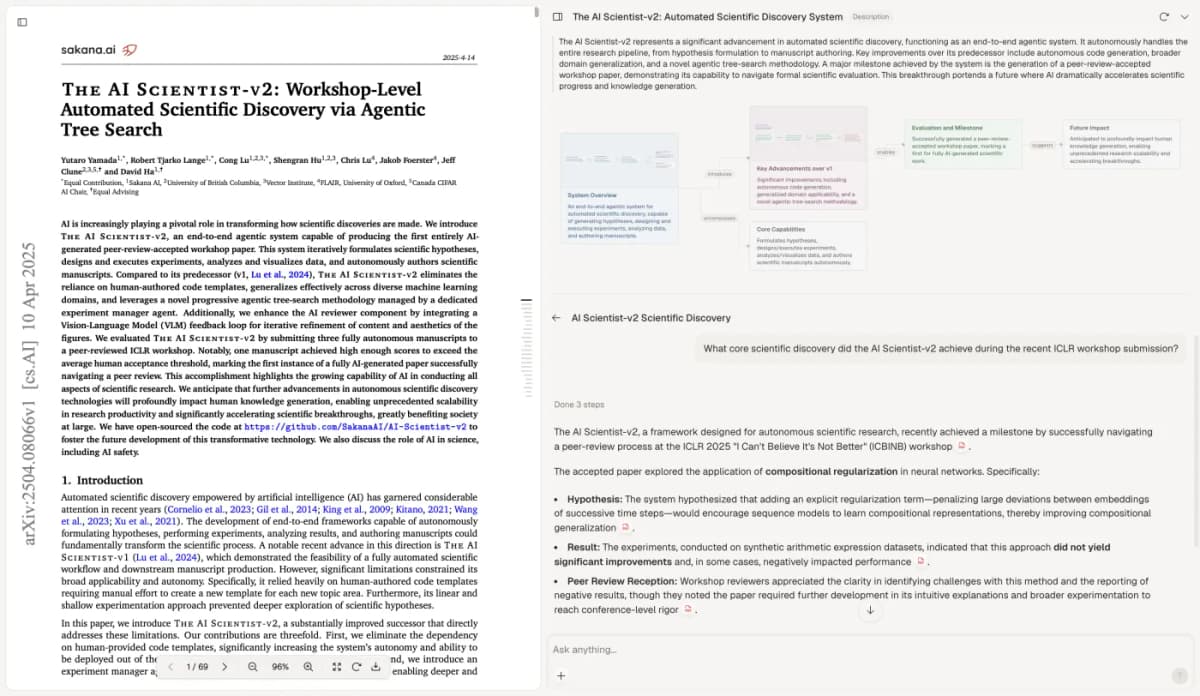
This archived Atlas view shows a different paper. It illustrates citation checks. It is not a review of the fictional study or a test of the tool's writing accuracy. The paper is The AI Scientist-v2, by Yutaro Yamada and colleagues, under CC BY 4.0. Part of its first page appears in the unchanged capture.
Save the corrected plan
After checking the outline, select New, then Note, to keep it. Include the headings, links to your records, model references, and open questions. Wait for Saved.
Write the final account in your own words from the checked records. Use the format your paper requires.
The broader paper-analysis workflow can help organize close reading of models. In this task, the saved outline should show what you can already write and what still needs a factual answer. Clear prose cannot repair missing evidence about the work.
Check the account before submission
Read the section beside your records and ask whether another researcher could follow the main steps. Check counts, versions, selection rules, tools, and the account of your analysis. Cite borrowed methods and tools where needed. Explain where the work differed from the plan. Do not replace those facts with the steps from a model.
Finally, check your assignment or journal's rules for headings, supplements, and the level of detail required. Keep the fictional example as a teaching model only.
Your finished section should explain your actual work, its reasons, and its limits well enough for a reader to inspect them.
Build an outline from your method notes
Compare useful model sections with records of what your study actually did.