

A methods paper makes a research technique its main contribution. It explains what the method does, how to use it, and what evidence supports claims about its value. A clear set of steps helps readers follow the work, but they also need to see how the claims were tested.
Before drafting, build an outline that connects each method claim to the relevant step, test, result and limit. That gives the paper a purpose beyond listing what the research team did.

Map method claims to evidence in Atlas
Connect your method steps with tests, results and limits in your sources.
Define what the method contributes
Start with the problem the method addresses and who could use it. Explain what your paper contributes: a new procedure, an improvement, a new application or a detailed account of an established technique. Frontiers’ Methods category accepts new or established methods, protocols and techniques. Other journals may require a new advance, so check the target category before describing the contribution.
The Springer Nature author guide describes methods papers as new or improved techniques that show an advance. The Taylor and Francis author guide includes changed methods and new uses too. State what your work adds and how the evidence backs it.
A methods section explains how one study was done. A methods paper focuses on the technique itself. Its own methods section can explain how the team built or tested that technique.
A study protocol sets out a study plan. Labels can overlap across journals. The Taylor and Francis taxonomy links Method with Laboratory Protocol and Study Protocol, but gives each a separate description. Read those rules with your work's purpose in mind. If the category is still unclear, start with the broader research article types guide. Do not change the scientific claim just to fit a label that sounds more impressive.
Describe the procedure and its conditions
Describe the input, steps, settings and output. Explain which choices are fixed and which the user must set. Give readers enough detail to follow the method under the conditions you describe.
The source figure below comes from Priya Choudhry's published colony-counting study. Its central column shows how the method finds, separates and measures objects in an image. The other columns show different ways to process the image.
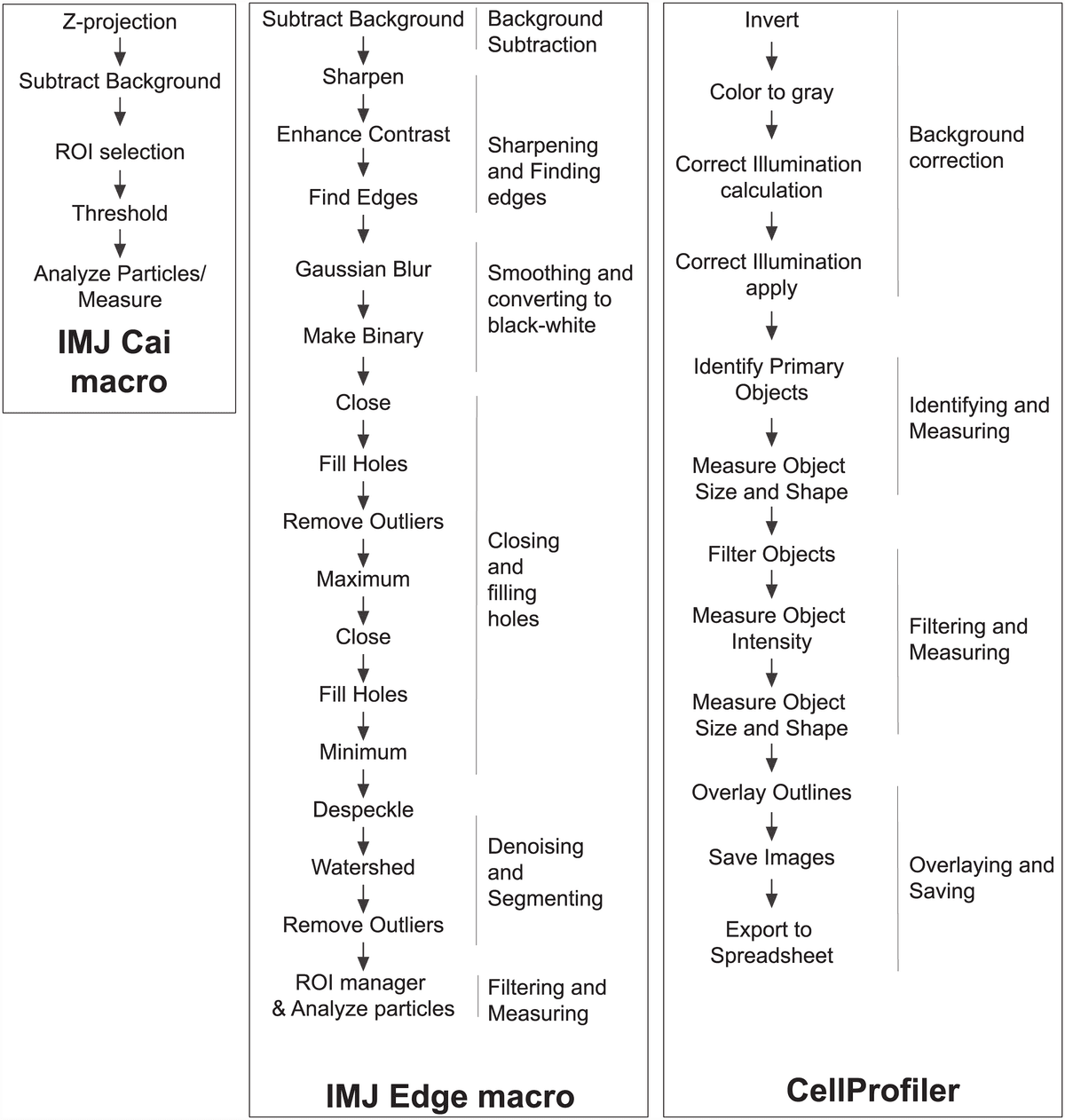
Choudhry's 2016 method paper supplies this original processing figure under CC BY 4.0.
The figure explains what happens to an image. It shows steps that correct the background, find objects, process them and take measurements. To judge how well each method works, read the paper's separate tests and results.
A flowchart helps readers see the order of steps and where choices are made. It cannot prove speed or accuracy on its own. Pair the chart with settings and test evidence for each claim. Keep this older paper's figure as a reporting example.
Connect each claim to the right test
Validation tests a stated claim under stated conditions. A claim about speed needs timing evidence. A claim about agreement needs a clear reference to compare with. If you claim the method works on more kinds of input, show tests of those kinds.
Keep the test conditions close to the result. Record which inputs and settings were used, what the team compared, and what it measured. Were the conditions the same for each method? If they differed, explain how so readers can judge the test.
A successful example can show that a procedure works in that example. It does not establish that it works for every input or user. Leave untested conditions visible so the discussion does not turn a narrow result into a broad claim.
Frontiers' Methods guidance includes procedure steps, validation, applications, limits and troubleshooting. Treat those as related reporting tasks. The exact evidence your paper needs depends on its claim, field and journal.
For writing, collect the evidence that exists before requesting stronger wording. If a needed test is absent, return that question to the research team. Text comparison cannot fill an experimental gap.
Build a method-step-validation-limit outline
Imagine a fictional image-counting method for isolated objects on plain backgrounds. The team has a written procedure, a small test set, reference counts and timing logs. It has not tested images where objects touch or overlap.
The outline below is a writing example with fictional source locations. It contains no measured performance values.
| Proposed point | Method detail | Evidence location | Limit to keep |
|---|---|---|---|
| The procedure detects isolated objects | Input rules and object detection steps | Methods paragraphs 2–4 | Tested images have plain backgrounds |
| Counts can be compared with a reference | Definition of the reference count | Validation section 1 | Reference method has its own error sources |
| Processing time was recorded | Hardware, settings and timing rule | Timing log and Results paragraph 3 | No claim about different hardware |
| Touching objects remain untested | Current input exclusions | Limitations paragraph 2 | Do not claim success on overlapping objects |
Table 1: Now read a draft claim: “The method counts objects accurately and quickly in all images.” The outline does not support that scope. It points to a limited image set, a reference comparison and timing under specific conditions.
Rewrite the claim to reflect the tests actually reported. Keep the input conditions in the same passage. If the draft lacks enough detail to state the result, flag it for the team rather than inventing a percentage or calling the method validated.
Check the reporting outline in Atlas
Add permitted method text, relevant prior method papers and the team's validation descriptions to an Atlas project. Use the finished versions you intend to cite. Keep restricted data or code in the systems approved for the research.
Open a chat and use @ to name the sources. Choose Project only to keep new search within the project and supplied material. Ask a question that connects writing claims to the tests already described:
From the named method draft and validation descriptions, map each proposed claim to its method steps, supporting test and reported limit. Cite the source passages. Mark untested conditions and missing evidence. Do not infer that a process diagram proves performance.
Open each numbered citation and compare the answer with its source context. For the fictional method, correct any claim that touching objects were tested. Check that the timing claim still includes its hardware and settings.
If the result passage is missing, keep the claim unresolved and ask the study team for the relevant output. Atlas can help read and compare the text you supply. It does not run the experiment or validate the technique.
Create a note with New and Note to retain the checked outline and open questions. Wait for Saved before closing it. Accept a row only when its claim matches the source and its limits remain visible.
Review the manuscript against the journal's rules
Choose the journal's paper type before making a research paper outline. Check its sections, data and code statements, reporting rules and extra files. The same method may fit different formats at different journals.
Read the draft from claim to procedure to result. Can a reader find the steps and conditions behind each test? Does the discussion stay within those results? Reporting study limitations means explaining where the evidence stops and why that matters for use.
Ask an expert in the method to check the steps and the tests behind your claims. Resolve missing tests with the research team.
The team must make those scientific decisions before editing can give the paper a clear, supported account of the method.
Map method claims to evidence in Atlas
Connect your method steps with tests, results and limits in your sources.