

The STROBE checklist helps authors give a clear account of observational studies. Its 22 items cover what was planned, done, found, and concluded in cohort, case-control, and cross-sectional research. Choose the form that fits your study from the official checklist downloads.
To complete the form, check the paper against each item that applies. A sentence on page 6 may answer one part of an item but leave another open. A filled page-number column alone does not prove that the full item is covered.

Review manuscript reporting in Atlas
Compare your manuscript and checklist, then inspect each cited passage.
What the STROBE checklist covers
STROBE stands for Strengthening the Reporting of Observational Studies in Epidemiology. It guides what authors report so readers can see what was done and judge the study's strengths and limits.
The STROBE initiative says the checklist does not tell you how to design or run a study. It also does not judge research quality. Finding the methods text and judging whether the method is sound are separate tasks.
For example, a paper might state which confounders it adjusted for and how. Readers may still doubt whether those choices were sound. STROBE helps make the choices clear enough to review. A completed box does not make them correct.
Keep this reporting check separate from a risk-of-bias or statistical review. If a coauthor asks for a quality score, ask which tool they need. Adding up STROBE items does not supply that score.
Choose the correct checklist
For a randomized-trial report, use the CONSORT checklist guide to map trial reporting items to manuscript passages. STROBE's observational-study forms and CONSORT's trial checklist address different study designs. Choose the applicable guidance before reviewing the text.
The study design in the protocol and paper guides the choice of form. The official site provides these versions:
- Cohort checklist: covers how people were selected and followed, the length of follow-up, and results over time.
- Case-control checklist: covers how cases were defined, how controls were chosen, and matching where it applies.
- Cross-sectional checklist: has its own wording for who took part and methods that account for the sampling plan.
The combined form shows the designs side by side. A cohort follow-up item may not apply to a cross-sectional paper, so use the wording for your design. Keep phrases such as "if applicable" when they affect what the item asks.
Use these steps to finish selecting the form:
- Check that the paper's design label fits how people joined the study and when they were assessed. Ask the team to resolve a conflict before choosing the checklist.
- Look for a relevant extension through the EQUATOR STROBE entry. Some fields need extra detail. For example, STROBE-Nut covers nutrition research and advises reading the explanation resources too.
- Check the journal's rules for the file you need to submit. The official menu offers PDF and Word files and a fillable combined form. Save the form's name and download source in your notes.
Read the items and subparts
The original explanation paper describes 22 numbered items. Eighteen are shared across the three main designs, and four have design-specific wording. Some items have lettered subparts, so there are more than 22 questions to check.
The checklist follows the paper from title and abstract to methods, results, discussion, and funding. Methods items cover who took part, where the study happened, what was measured, bias, study size, and analysis. Results items cover group counts, characteristics, outcomes, estimates, and other analyses, so readers can see who was studied and judge what each finding means.
The source table below shows those parts together. The wording changes by design under participants, statistical methods, and outcome data. Its rows prompt authors to report facts. They do not set the order of every paragraph in the paper.
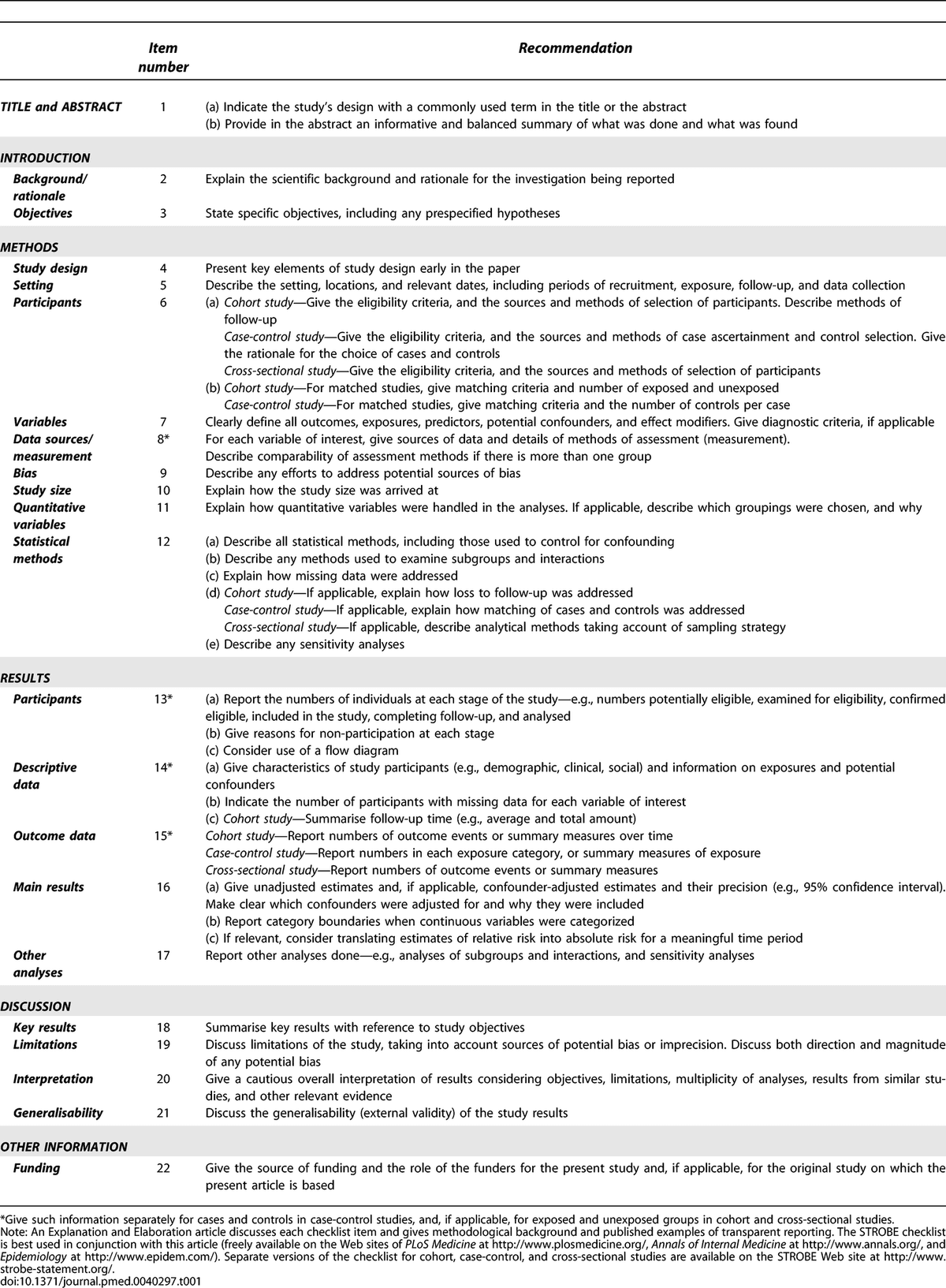
Vandenbroucke and colleagues' PLOS Medicine explanation paper, Table 1, shown unchanged under the paper's Creative Commons Attribution notice. Use the current official downloads for the form you submit.
Read each subpart that applies before adding a page number. Item 12(c) asks how the analysis dealt with missing data. Item 14(b) asks how many people have missing data for each relevant variable. Reporting one does not answer the other.
A final sample count also differs from how the study size was chosen. Saying that 240 people were analyzed gives a count. It may leave open the reason for the size, which item 10 asks authors to explain.
Worked manuscript passage map
This made-up cohort paper is about work schedules and sleep. It has one extra methods file. Save a copy named Manuscript v3 before review so that each page reference points to a known version.
The example maps five reporting questions. It does not represent a real study review or an Atlas accuracy test, and it leaves most of the checklist for the author to review.
Each row pairs an item or subpart with source text and an open author check. The statuses belong to this review and are not official STROBE categories. "Present for author review" means a passage was found, but the author still needs to check that it answers the item. Keeping that check beside the passage shows where a page reference is only a starting point.
| Item or subpart | Fictional location | What the passage supplies | Review status |
|---|---|---|---|
| 6(a), selection and follow-up | Methods, p. 4, paragraph 2 | Eligibility and recruitment route, with follow-up schedule | Present for author review |
| 8, data sources and measurement | Methods, p. 5, paragraph 1 | Sleep questionnaire named, scoring procedure absent | Partial |
| 10, study-size rationale | Results, p. 7, participant count | Final analyzed sample only | Rationale not located |
| 12(c), missing-data handling | Supplement, p. 2, analysis paragraph | Mentions complete-case analysis, without identifying affected variables | Needs author clarification |
| 22, funding and funder role | End matter, p. 11 | Grant source named, funder role not stated | Partial |
Table 1: The map leads to three author checks:
- For the measurement row, ask where the test and scoring method are described. Add a reference to the supplement if it holds the answer.
- If the detail is absent, ask the team for an accurate account from study records. Do not infer the scoring method from the test's name.
- For study size, ask how the number was chosen. Moving the final count to a new column does not answer that question.
The Duke cohort form has an MS page column for these references. The page number is useful because it helps a reader find text to inspect, rather than settling whether the text is adequate.
Resolve gaps without inventing study details
"Not located in the supplied manuscript" says what you found in the paper. "The study did not collect this information" says what the team did. Ask the author or check study records before moving from the first claim to the second.
If the text answers only part of an item, state what is still missing. In the made-up funding row, the gap is the funder's role. A grant number does not tell readers whether the funder shaped the design, analysis, or report.
Some items may not apply. For example, a study may not have used matching. The author should explain why the item does not apply and follow the journal's rules for the form. Missing text alone does not prove that a method was not used.
Some gaps need more than a writing edit. If the paper does not explain how it adjusted for a confounding variable, the author may need to ask the analyst. A writing assistant should not invent a method to fill the row.
The same care applies to external validity. The author needs to explain how the sample and setting affect where the results may apply. A broad claim that the findings fit all groups does not give that reasoning.
The people who ran the study should approve added details. Claims that go too far need revision, while open methods questions need a qualified reviewer. Clear reporting exposes those questions so readers can judge them.
Map selected items in Atlas
Atlas can help compare your paper with the selected checklist. This source-reading step fits within a broader academic writing workflow. The author still decides what to report and checks the accuracy of each addition.
- Add the paper, chosen checklist, and needed supplements to one project. Upload only files you have permission to use. Wait until each source finishes processing.
- Open a chat, type @ in Ask a question, and select the files. Choose Project only to keep new retrieval within the supplied project material.
- Ask about one item or a small group of related subparts. Use the prompt below as a starting point, then select Send.
- Open each numbered citation and read the source passage and nearby text. Check that it answers the item, rather than just mentioning a related topic.
- Choose New, then Note. Save the checked map with its source, paper version, page references, and open author questions. Wait for Saved before closing it.
For the made-up paper, a focused prompt would be:
Compare item 12(c) in the selected STROBE checklist with Manuscript v3 and its supplement. Find passages about how the analysis dealt with missing data. Give a source citation for each passage. Keep reported facts separate from your reading of them, and mark facts you cannot find. Do not infer an unstated method.
In this example, an answer might treat a table of missing counts as the missing-data method. The count table may answer item 14(b), while the analysis text is needed for item 12(c). Fix the row and ask for an answer that keeps those questions separate.
If a citation lacks an exact page or passage link, inspect the named source and note where you found the text. Do not accept a page number you have not checked. This leaves a clear trail for the next reader without making the map a claim of compliance.
Check the final submission version
Check each page reference against the final paper and supplements after edits. Page numbers can change even when the text stays the same. Items affected by changes to the study report need a fresh review too.
Follow the journal's rules for the checklist and other files. The BMJ author checklist treats reporting guidance as one part of preparing a paper, along with figures, references, and required statements.
Keep the final form in line with the files you submit. Retain the author's reasons for items that are partial or do not apply. That record helps coauthors and editors inspect the report while keeping the question of study quality separate.
Review manuscript reporting in Atlas
Compare your manuscript and checklist, then inspect each cited passage.