

The ARRIVE guidelines describe what an animal-study report should include so others can check the work. A review asks where the paper supplies each detail. Finding that text is a first step, with no verdict that the methods are sound.
An item-to-manuscript-passage note keeps the guidance beside the text that may address it. Record the item, where you found it, what it says, and any gap. These fields make a claim about the report easier to check and revise.
The worked note below covers four items in a paper from 2014. We wrote it as a teaching example from the main text. It is a partial source map, with no new animal work or verdict on full ARRIVE adherence.

Trace reporting items to manuscript passages
Compare the manuscript and guidance before marking an item as reported.
What the ARRIVE guidelines cover
ARRIVE stands for Animal Research: Reporting of In Vivo Experiments. The official ARRIVE 2.0 guidance divides its 21 items into two sets. The Essential 10 are the minimum reporting set. The Recommended Set adds context, and reporting both sets is best practice.
The Essential 10 cover design, sample size, inclusion and exclusion rules, randomisation, blinding, outcome measures, statistical methods, animals, procedures, and results. Use the official subitems to see what each field needs. A broad heading may hide several questions about the report.
The official author checklists let authors name the parts of the paper that address those items. A section name points a reader toward evidence. It does not prove that the text answers every part of the item.
The guideline authors' explanation paper gives reasons, details, and examples behind the items. It also discusses study design. Our task here is to find text in the report. Experts retain the separate judgments about methods and the soundness of the study.
Prepare a versioned reporting review
Start with the exact draft or paper version and the guidance you will use. Add a list of the extra files you can inspect. Keep a missing file on that list as a gap in your source set. This defines the scope of the evidence you can review.
Fix the source scope first
The EQUATOR resource record points readers to official ARRIVE sources. Check the guidance itself and the target journal's current rules. Journals may request a specific checklist or a set form for authors to use.
For a reading note, record the title, version or date, guidance version, checked files, and review date. Page numbers may change between versions. Keep a section heading and a few words about the passage beside the page or line number so you can find it again.
Break the item into its questions
Some items need several passages. Item 5 on blinding asks who knew the group assignment at four stages. These are when groups were assigned, when the study was done, when outcomes were assessed, and when data were analyzed. A statement about one stage cannot stand in for all four.
Other items ask for related numbers or choices. Item 2a on sample size asks for units assigned to groups and total animals used. Those numbers may differ from the numbers in an analysis. Keep the stage and study part beside each count.
The NIEHS training module uses examples of missing details to teach this review. Use such guides to learn the task, then return to the official wording. Your note should answer each relevant subpart with text or an open question.
Worked ARRIVE item-to-passage note
The Miranda and colleagues paper reports a rat assay with two separate experiments. The article was published in 2014, before ARRIVE 2.0. Its own ARRIVE statement refers to the earlier guidelines.
The official checklist page links this paper as an example using the 2010 checklist. We apply a few current item questions to its main text for teaching. We could not inspect its linked checklist file, so it remains outside this exercise's source scope.
Our four-row note records reported methods, where to find them and open questions, with no claim to check every item or validate the study.
| Current item | Reporting found in main text | Passage location | Limit or next check |
|---|---|---|---|
| 8a, animal details | Adult male Sprague Dawley rats and starting weight are described. | Methods, Experimental animals. | Review other animal details separately rather than marking all of item 8 complete. |
| 4a, randomisation | Excel RAND generated a drug-and-control schedule in two blocks. | Methods, Study conduct. | Preserve the per-experiment context and inspect other allocation details. |
| 5, blinding | Coded vials and blinded data processing and exclusion decisions are reported. | Methods, Study conduct and Experimental animals. | Retain block unblinding and the later stated difficulty keeping one experiment blinded. |
| 3a, exclusion rules | A recording-related exclusion and cell-selection rules are described. | Methods, Experimental animals and Electrophysiology recording. | The checked passages do not explicitly settle when these rules were set. |
Table 1: These are our paraphrases of the main article's methods. The last column holds questions about the report. It does not diagnose bias or replace an expert review of the methods.
Read beyond the first matching phrase
The study-conduct passage says data were unblinded after the first block before work went on. The discussion also notes that visible effects made it hard to keep the person doing the oxycodone experiment blinded. Keep those limits with the methods statement.
The current item 5 guidance helps you ask which stages and people a statement covers. It supplies the review question. The paper supplies what its authors say about that question.
For item 3a, the official explanation asks whether the rules were set before the experiment. A report of what was left out does not itself settle that timing. Keep the timing field open rather than filling it from a guess about usual practice.
You can extend this note with the full checked source set. Tie each extra row to the study part and passage it concerns. The research synthesis guide helps you keep source roles and limits clear when you compare several reports.
Keep reporting gaps and limits visible
A status label should describe the support you found. Useful choices include a statement found, partial support, a clear statement of non-use, and text not found within the checked scope. Explain the label in the note so another reader can repeat the check.
For example, a passage saying randomisation was not used is a report of non-use. Silence about the method is a different state. Neither should become a claim that the study used randomisation.
Correct the all-stage blinding claim
Suppose a draft note says the paper proves all stages were blinded. The text about coded vials and data processing does not support such a broad claim. The block unblinding and later limit also belong in the note.
A corrected entry would say that the paper reports several blinding measures and describes limits. It would keep the named passages and leave any stage without clear support open for review.
We propose this change to the reading note. We made no new finding about how the study was done.
If the main text and an extra file seem to disagree, keep both statements with their versions and locations. Seek a fuller account before deciding which describes the work. A neat summary should not erase a conflict that a reviewer needs to examine.
The original 2.0 update treats reporting as a basis for close review. An item map helps readers check the source. Keep this partial source check within its purpose rather than giving the study a quality score.
Describe missing evidence within its scope
For the exclusion-timing row, use a bounded statement such as "Timing not explicit in the checked main-text passages." Add the passages you inspected and the next source you need. This tells a reviewer what remains to be checked.
It would be unsupported to say that no rules were set before the experiment just because those passages do not state the timing. The missing file could contain relevant text. Its absence from our source set limits our review.
Do the same for text that cannot be read in an uploaded file. A poor scan, cut-off table, or missing page is a source-access problem. Record it and get a readable source before marking the item's status.
The literature review process guide helps you track which source you searched and what comes next.
For this job, you may need an extra file, a fuller methods section, or an author response. Keep a clear reason tied to the gap.
Check manuscript passages in Atlas
Add suitable draft files, available supplements, and official ARRIVE guidance to a project. Check that the files are readable and give versions clear names. List missing sources before asking for a comparison. A file outside the source set cannot support the answer.
Start a fresh chat and mention the named sources. Project only limits new retrieval while earlier chat context can remain. Ask Atlas to find passages for a few item subparts, with each study part kept separate. Request where the text appears, what it says, and where support is missing.
Open each citation and read the text around it. Atlas opens the related source and goes to the cited passage when available. Otherwise, find it yourself. Check the version, study part, people or stage described, and nearby limits before keeping the entry.
Correct claims that exceed the source. For the worked example, keep the blinding limits and open question about when rules were set. Use New → Note to save the checked rows, source list, date, and next questions, then wait for Saved. The research-note organization guide helps you trace later changes.
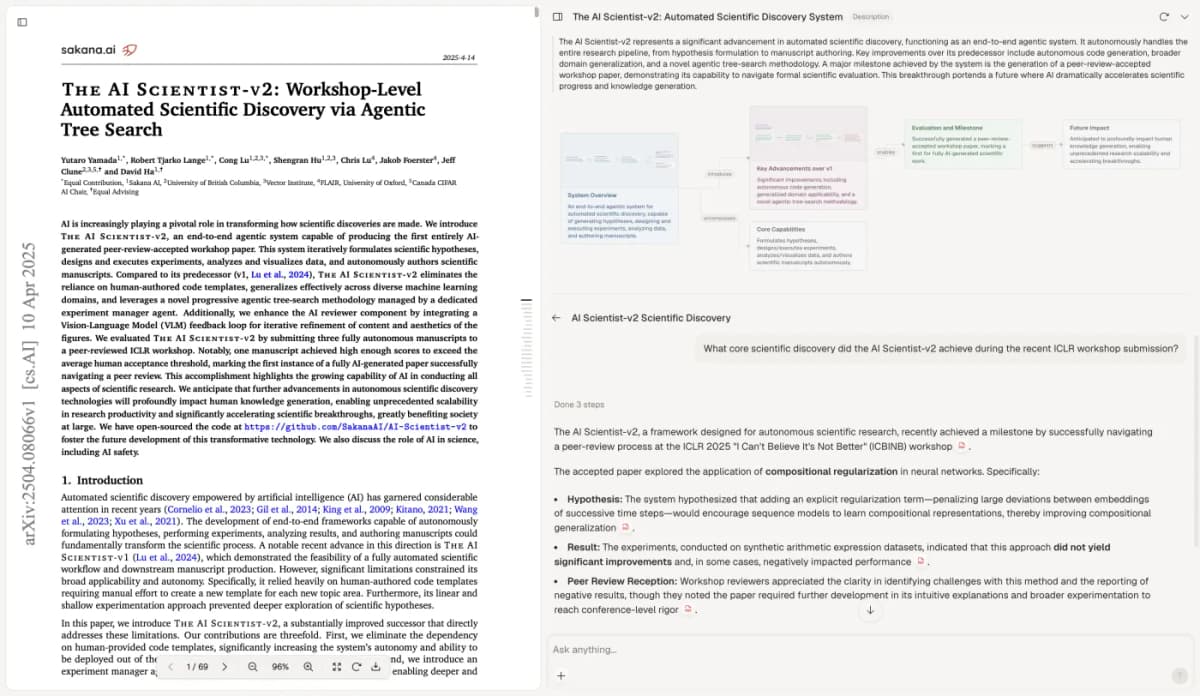
This unchanged Atlas capture shows The AI Scientist-v2, by Yutaro Yamada and colleagues, under CC BY 4.0, beside a cited answer. It illustrates source inspection, without showing the animal-study paper, an ARRIVE review, or a test of this source check.
Review the note before submission
Read each status against the full item wording before using the note in a draft or sending it to a journal. Check all subparts rather than relying on a broad heading. A passage may address one question and leave another open.
Keep both sets in view as you extend the note. Our four rows are a partial exercise, so they cannot establish adherence to either set. Authors need to check the scope and form the journal requires.
Keep reporting and research judgments separate
The note can show that a paper reports an ethics approval statement. It cannot prove that the study followed every rule or that the approval applies to each step described. Those checks belong to the research team and relevant reviewers.
Finding a reason for the sample size does not settle whether it was sound. Finding text about statistical methods does not verify the analysis. Keep questions about design, analysis, welfare, and validity for expert review rather than turning found text into a positive verdict.
Choose the guidance that fits the research. The STROBE checklist guide covers observational clinical reporting, while this page covers the animal-study report. Related tools do not do the same job just because some item names overlap.
For a case-control paper, the case-control study guide helps you check who became a case, where controls came from, and which selection details remain open.
Before closing the review, name who will answer each open question and which source they need. Keep a date beside that action. The next note version should show whether the gap was closed, still open, or changed by a new draft.
Keep the source map as a reading aid that others can check. Authors and reviewers remain responsible for the item choices and report they submit.
Atlas supports the source check and saved note. This workflow supplies no animal work, ethics approval, statistical analysis, or validity verdict.
Trace reporting items to manuscript passages
Compare the manuscript and guidance before marking an item as reported.