
How to Present Qualitative Data With Themes and Quotes
Present qualitative findings with clear theme claims, checked quotes, and qualifying cases. Build an evidence table without implying population frequency.
- Byline

Summary
Present qualitative data by explaining each researcher-approved finding, showing relevant source material, and interpreting what the example does and does not support.
A useful findings display pairs a theme claim with an illustrative quotation, a qualifying or contradictory passage, case context, and a checked source locator.
Selected quotations do not establish how common a view is; confidentiality, quotation editing, and publication permission remain the researcher's responsibility.
To present qualitative data, lead with a finding, show the source material that helps explain it, and tell the reader what that material means. A set of vivid quotes without a claim or context leaves the reader to do the analysis.
Choose quotes and cases after the research team has checked its themes. One selected quote shows an example; it does not show how common a view is. Keep a qualifying case nearby when it changes the claim.
Atlas can help you compare the passages you have permission to use. Open each cited source before you put a quote into a table or report. The team still approves the finding, checks consent, and decides what can be shared.

Atlas

Check theme evidence in Atlas
Compare selected passages before writing a findings display.
What a qualitative presentation shows
A good findings section joins three things: a clear claim, the source material behind it, and the team's reading of that material. It also shows the cases that limit the claim. The SRQR reporting guideline covers reporting a qualitative study as a whole; it is a guide for transparent reporting, not a seal of quality.
For example, “students found support hard to reach” is too broad on its own. A stronger account names which barrier the team found, shows a checked excerpt, and notes a case that differs. That gives the reader a path from the data to the finding.
The Social Data Analysis teaching chapter asks writers to consider audience and voice when sharing results. A journal reader may need more method detail than a service team. Both need enough context to judge the claim.
Choose a format for your audience
Use prose when the sequence or meaning of a case matters. Use a table when readers need to compare several claims, cases, or sources at once. Use a figure only when it makes a pattern easier to see than prose or a table would.
The format serves the finding. A chart of code counts may look precise, but it can hide the meaning of a passage or the way the sample was chosen. The qualitative findings chapter discusses how to make data vivid without leaving analysis behind.
| Format | Best use | Check before sharing |
|---|---|---|
| Short prose and quotes | Explain a theme in context | Does each quote support the sentence beside it? |
| Theme-and-evidence table | Compare a few claims and cases | Can a reader reach the source and see a limit? |
| Case narrative | Show how an account changes over time | Have you kept the order and context intact? |
| Diagram or figure | Show a relationship that text obscures | Does the visual imply a count or certainty you do not have? |
Table 1: If a table repeats the prose word for word, choose one form. The BCcampus chapter on sharing qualitative work also treats audience and purpose as choices the writer must make.
Write a bounded theme claim
Start with what the team concluded from its chosen material. Make the claim narrow enough that a reader can test it against the shown cases. “In these interviews, an unclear referral route delayed first contact” says more than “access was a problem.”
Then ask three questions:
- Which checked excerpt best shows the point, and what case context must travel with it?
- Which case does not fit, or changes how strong the claim can be?
- What could a reader wrongly infer about the sample or wider group?
The inductive thematic analysis guide shows how a team moves from codes to a theme it can defend. The negative case analysis guide shows how to test that theme against a case that resists it. Presentation comes after those choices, not in place of them.
Do not let a memorable quote do all the work. A quote is a piece of evidence from one source. The sentence around it should explain why it matters and what it cannot show.
Example theme-and-quotation display
This fictional example uses three invented interviews about a campus support service. The short excerpts are invented for teaching. They are not real participants, findings, or evidence about any service.
| Theme claim | Illustrative excerpt and case | Qualifying excerpt and case | Checked locator | Interpretation to review |
|---|---|---|---|---|
| An unclear referral route could delay first contact | P04: “I was sent to two offices before I knew where to ask.” The student sought help after a tutor's suggestion. | P07: “I knew the desk, but the next slot was weeks away.” The route was clear; wait time was the barrier. | P04 lines 88–94; P07 lines 41–47 in this fictional set | Split “hard to reach” into referral clarity and wait time. Do not claim either barrier was typical. |
| A direct introduction could make the route clearer | P02: “My tutor walked me to the desk.” The student had a tutor who could help. | No matching account from students without a tutor has been checked. | P02 lines 19–23; comparison pending | Present this as one route in this case, not a solution shown for all students. |
Table 2: The table makes the limit visible. P07 does not disprove P04's account. It shows that one broad “access” claim hides two types of delay.
The P02 row marks a gap rather than filling it with a guess.
A report could turn the first row into prose: In this small set, one student described being passed between offices before first contact. Another knew the route but could not get a quick slot. The team therefore treated referral clarity and wait time as separate barriers. That reading is narrower than a claim that most students faced either one.
The audit trail guide shows how to keep the decision to split a theme, its reason, and the old version. The report can point to that record without printing private transcripts.
Check quotes and qualifying cases
Open the original passage before copying a quote. Read the words around it. A speaker may be describing a past view, quoting someone else, or changing their mind in the next sentence.
A source locator makes the check possible. It does not make the quote accurate by itself.
Keep the original wording. Mark any cut with an ellipsis and put supplied words in brackets only when your field's style allows it. Do not remove words that reverse the meaning. If the edit needs too much repair, choose a different excerpt or explain the point in prose.
Protect the person behind the quote. Check consent, any promise of anonymity, and whether a detail could identify someone when combined with other facts. The research team decides what can be published. The SRQR record helps frame transparent reporting, but it does not grant permission to use a quote.
Look for a case that narrows the claim. The negative case analysis guide gives a way to record what the team sought and how it revised a working finding. A case that differs can be part of the result, rather than a flaw to hide.
Inspect passages in Atlas
Add only source files that the project may use. Put the team-approved theme note next to the selected files in an Atlas project. Mention the sources with @ and ask for a short table of passages that support, qualify, or leave the theme unresolved.
Ask for the case ID, excerpt, source link, and any missing context. Open each citation in the source view. If the answer overstates a passage, correct it. Save a checked note with the team's final wording and the open questions.
The research paper synthesis guide shows the same source-check habit across documents. Here the check is about qualitative findings and permissioned excerpts. Atlas can help locate and compare selected text; it cannot approve a theme or decide whether a participant can be quoted.
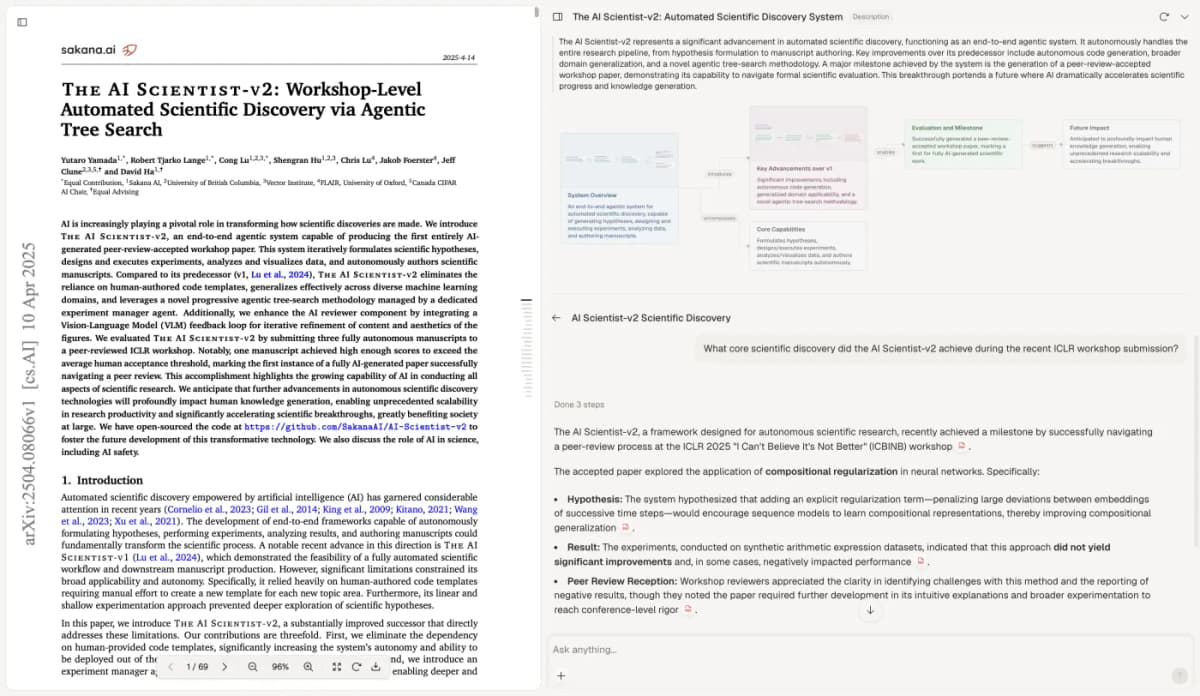
The screenshot shows a cited-source review surface with a research paper. It does not depict these fictional interviews or a finished qualitative results table. Use the cited passage check as one step in the team's own review.
Disclose limits and permissions
Selected quotes show meaning and contrast. They do not tell you how many people in a wider population share a view. If your design supports a count, name the sample, the denominator, and the rule used to count. Do not turn a purposive sample into a population estimate.
Explain how the material was chosen and what was left out. Name a qualifying case when it matters. If a quote was edited, say how. Keep the link to the source in a protected record even when the public report must hide the person's identity.
The SRQR guideline supports a full account of the method and findings. The Social Data Analysis chapter reminds writers that sharing results is part of the research, not a last-minute layout task.
Before you publish, ask a team member to read the claim, the selected quote, and the case that limits it. Then check the source, privacy rules, and local reporting instructions once more.
Atlas
Check theme evidence in Atlas
Compare selected passages before writing a findings display.
Frequently Asked Questions
Organize researcher-approved findings for the intended audience. For each claim, give enough context, a checked quotation or other evidence, an interpretation, and any meaningful qualifying case or limit.