

A mixed methods research design is a plan for using words and numbers together to answer a research question. Choose the design from what the two parts need to do: bring findings together, explain a numerical result, or build a measure from people's accounts. Then name where and how the parts will connect.
The three core options are convergent, explanatory sequential, and exploratory sequential. Their names describe different study plans. The order of a survey and an interview is only part of that plan. You also need to show what each part contributes to the final claim.

Compare the guides behind your design
Compare design guides, check citations, and save your rationale.
Start with the combined research question
NIH's mixed methods guidance puts the research problem ahead of the choice of methods. A mixed study needs a reason to use both. Collecting interview text alongside a spreadsheet does not, by itself, explain why the extra work will answer your question.
Suppose you want to study access to appointments at a local service. A survey could ask how long people wait. Interviews could ask what makes it hard to attend. The combined question might ask how the pattern of waits relates to people's accounts of barriers. That question gives the two parts a shared job.
Write down the gap that one method leaves. If your question asks only how many people waited more than a week, a sound survey may be enough. If it asks how people experience a long wait, interviews may be the right starting point. Use both when their connection adds something your question needs.
Harvard Catalyst's starter questions ask what you want to know, what data you will use, and how you will integrate them. Here, integration means bringing the two parts into a shared line of reasoning. Decide what that connection should achieve before choosing a name.
Compare the three core designs
The Creswell and Plano Clark design chapter treats core designs as choices to fit a problem. This table compares their usual purpose and order. Read the point of connection as well as the timeline before deciding which plan fits your own study.
| Core design | What the study needs | Usual sequence | Point to specify |
|---|---|---|---|
| Convergent | Compare or combine two views of the same problem | Collect and study words and numbers in a similar period | How the two sets of findings will be brought together |
| Explanatory sequential | Help explain a numerical pattern | Study numbers, then follow with qualitative inquiry | How the first findings guide the next sample or questions |
| Exploratory sequential | Develop something to measure or test | Study accounts, then build a quantitative phase | How the early findings shape the later measure or test |
Table 1: These are starting points for planning the connection, not a complete list of every possible mixed methods study.
Convergent: bring findings together
For the fictional appointment project, a convergent plan could collect a waiting-time survey and interviews during the same study period. You would study each set of data, then compare their findings on agreed access questions.
For instance, does a short reported wait sit alongside difficulty finding a slot that fits work hours?
The methods guide by Fetters and colleagues describes bringing findings together to study them. Say which results belong together and why.
Two separate results sections need a reasoned link before they support a joint claim. Use the detailed convergent mixed methods design guide when you have chosen this route and need to work through that connection.
Explanatory sequential: follow a pattern
In an explanatory plan, you would study the survey first. A pattern in those results would then shape the interview phase. Perhaps users with short waits still give low access ratings.
Interviews could explore what those ratings mean and which barriers the wait measure misses.
Kajamaa and colleagues' methods guide describes this numbers-first logic. The interview phase needs a link to the earlier result.
Asking some people general questions after a survey closes does not, on its own, show what the second phase is meant to explain.
Exploratory sequential: build from accounts
An exploratory plan could start with interviews because the service lacks a useful measure of access. People might describe issues with booking, travel, or fitting care around work. The team could use those findings to develop survey items, check their wording, and plan a later test of the measure.
Harvard's exploratory example shows interview themes shaping later survey questions. That is the connection to look for. In your own plan, keep a record of which theme led to which item and why. Moving a phrase into a survey is a development step; it does not make the new measure valid without further work.
Specify where the parts connect
A design label leaves practical decisions open. Write the link as an action you can carry out and check. The Fetters integration framework describes links through choosing a sample, building a method from earlier findings, bringing results together, or joining data at several points within a larger study.
A study may use more than one of these actions.
Name the handoff between phases
For a numbers-first study, identify what leaves the survey phase and what it changes in the interview phase. A result might guide whom you invite, what you ask, or both. Save that decision with its source in the survey analysis.
Later, you should be able to trace an interview question back to the result that made the question worth asking.
For a words-first study, the handoff might be a set of candidate survey items. Keep the link to the accounts that informed them and record any changes made during review or testing. For a convergent study, specify which findings will be compared and how you will handle differences in what the methods capture.
Plan the combined account
Schoonenboom and Johnson stress deciding the point of integration. One useful planning question is: what will I be able to say after bringing the parts together that I could not say from either part alone?
A joint display can place related findings side by side with an account of what their combination means. The scholarly integration guide describes displays as a means to develop insights across the findings. The layout does not do the reasoning for you.
A row still needs to explain why the items belong together and what the evidence leaves open.
Work through an explanatory sequential plan
This plan is fictional. The patterns and questions are invented to show how design choices work. No survey or interviews were run. The job is to learn why a wait measure might miss the barriers people face when they book and attend an appointment.
Choose the pattern to follow
Start by defining the survey measures and how the team will study them. The team proposes to compare reported waits with access ratings. If short waits and poor ratings occur together, that contrast will guide the next phase. Keep this rule in the plan before seeing the results, while stating how any new patterns will be handled.
The proposed interview sample would include people whose responses show that contrast and people whose ratings and waits align. The second group gives the team another way to examine what might explain the contrast. Record how these groups are defined, how people will be invited, and what happens if few agree.
This is an illustration of linking phases through sampling. It is not a fixed sample rule for all sequential studies. The team still needs to judge which cases and range of experience fit this question.
Turn the pattern into a question
A candidate prompt is: “Tell me about the last time you tried to book an appointment. What made it possible or hard to attend?” A follow-up could ask what the person meant by their access rating. This lets the team examine the rating without telling the person that work hours must be the cause.
Keep a note of the survey finding behind each follow-up. If the team adds a question after an early interview, record why. The core design chapter allows for planned and emerging elements. Report a change as a change instead of rewriting the history to make the study look fixed from the start.
Bound the joint claim
If later interviews describe clashes with work hours, the team could examine whether that account helps explain the survey contrast. They would need to check other possible accounts, such as what users understood by “access” or whether the interview group differs from those who declined.
The result would need careful wording. An interview account might help explain how some users experience the service. It would not prove that work hours caused the survey pattern across all users.
The design and validity discussion is a reminder to judge the strength of each part and the connection between them. Keep the proposed explanation separate from the evidence needed to test it.
Check the sample and practical limits
Give each sample its own purpose
The survey and interviews need not use equal samples. The core design guide discusses different sampling needs across designs. Explain the population or cases each part aims to describe, how people are chosen, and how the samples relate.
Do not use the size of the survey to lend population reach to every interview theme.
The quantitative research design guide compares options and assumptions for the part using numbers. Use it to check that phase on its own, then explain how it connects with the work using words.
In the fictional plan, interviews target a contrast rather than estimate how common each barrier is. Keep that purpose visible in the final report. If the sample misses people who cannot book at all, the combined study may still leave their experience unknown.
Budget for the dependency
NIH's teamwork guidance calls for relevant skills, defined roles, and time for joint work. In a sequential study, phase two depends on work in phase one. Leave time to study the first results, choose the next sample, and revise questions before the next invitations go out.
The design construction paper distinguishes timing from dependence. If your phases overlap, describe what was available at each decision point. Calendar order alone may not fit a standard label. Review the actual connection with your methods team.
For a larger trial or several linked stages, the integration framework also covers more complex designs. Use a plan that fits the whole project instead of forcing it into a two-phase template.
If results disagree, keep the difference available for further examination. The construction paper treats divergent findings as something to work through. Check whether the parts ask the same question and cover comparable people and periods. Do not discard one result simply because it complicates the combined account.
Compare design guidance in Atlas
Use Atlas to compare the passages in your selected design guides, then check the answer against those sources. The reading task is to find support for the connection you propose. The researcher and methods team still choose the design and assess its sampling, analysis, and ethics requirements.
-
Add the guides you have permission to use to the same project and wait until they finish processing. Keep titles and editions easy to distinguish.
-
Open a chat and use @ to select the guides you want to compare.
-
Ask: “Compare how these sources describe explanatory sequential design. Find passages on when the first analysis guides the later sample or questions. Give a citation for each source's contribution. Mark what the sources leave open for the researcher.”
-
Open each numbered citation and read the text around the passage. Check whether it supports the claim about timing, sampling, or integration.
-
Correct your comparison. If an answer calls any survey followed by an interview explanatory sequential, return to the passages on dependence and record what your proposed study would need to show.
-
Select New, then Note. Save the checked passages, source details, and your own reason for the proposed design. Wait for Saved before closing the note.
The citation view below lets you read a source beside an answer and check its support. It shows a ColPali paper, which is unrelated to the fictional study.
Use this view to read the text behind a claim. The image shows no results from a test of the design-guide workflow.
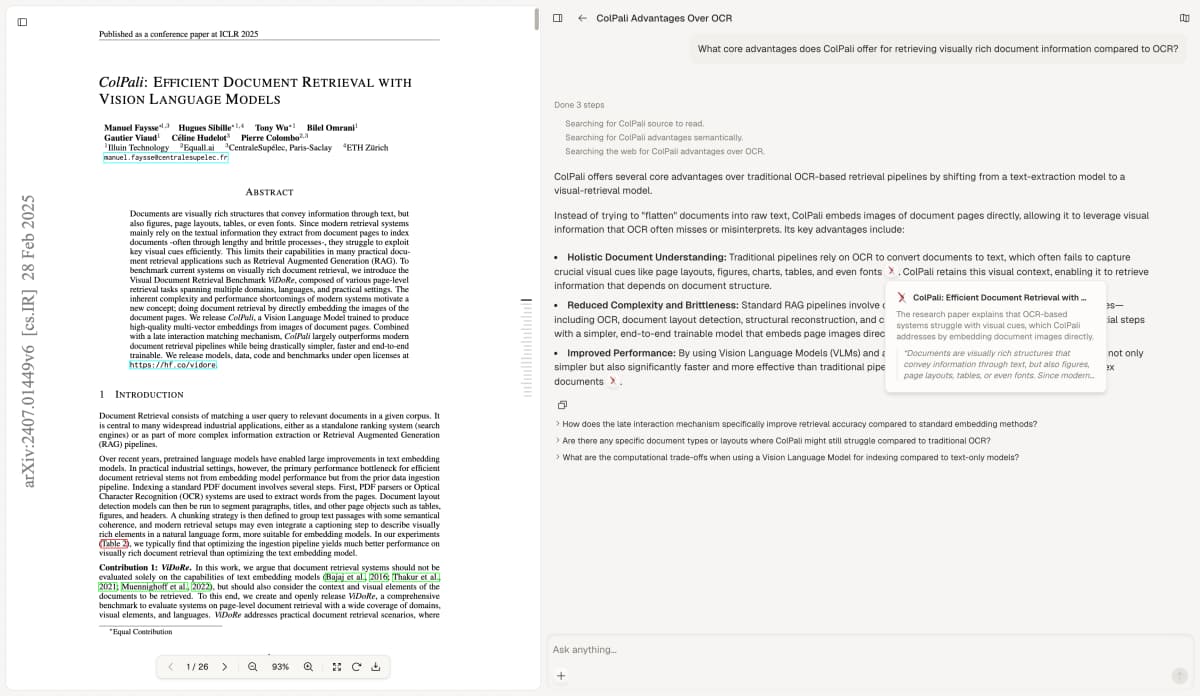
Read the passage and nearby text before keeping it in your design rationale.
If a citation is missing or points to the wrong place, find the source by name and read it directly. The AI citation checker workflow shows how to test the link between a claim and its cited text. A source about a design's name may not support a claim about how to select your sample.
Write a rationale you can defend
For the fictional project, a draft rationale could read:
We propose an explanatory sequential study to explore why wait times may not explain access ratings. We will study survey patterns first. Selected contrasts will guide whom we invite to interviews and what we ask. We will use those accounts to help explain the patterns, while keeping other possible causes and the limits of each sample in view.
That paragraph gives the design a job and names the connection. It still needs the actual measures, sample rules, analysis plan, and review procedure in the full protocol. The practical mixed methods guide asks researchers to describe why, how, and when they bring methods together. Use those questions to check what your rationale leaves out.
If you are reading published mixed-methods studies as sources for the plan, the Mixed Methods Appraisal Tool guide helps record which quality criteria the paper addresses. An appraisal of another study does not validate your proposed design.
Keep the chosen guides and corrected rationale with the work from your literature review process. When the study changes, update the rationale to show what changed and why. That record lets the team assess the plan from its actual decisions rather than from a label that no longer matches the work.
Compare the guides behind your design
Compare design guides, check citations, and save your rationale.