

Narrative inquiry studies experience through stories. To explain this choice, link your question to how people live and tell stories over time. Read the story in its social setting and place. Include your own role in how the account was made and read.
Start with a note that links your question to the story and its context. Link each claim to the supplied account or method source. Keep your reading and missing context visible. The example below reviews a published study. It adds no new field data.

Connect your question to story context
Compare permitted accounts and method sources, then save a cited rationale.
What does narrative inquiry help you understand?
Narrative inquiry asks how people make sense of their lives through stories. It can suit a study about a change in who someone feels they are, a turning point, or a move to a new role. The question needs a story of how someone lived through it. A count of how often an event occurs would answer a different question.
There are different narrative traditions. This guide uses the Clandinin and Connelly approach to time, social context, and place. Pino Gavidia and Adu's methods paper explains these three dimensions and who studies the story.
Name the approach you choose and why it fits; “we used stories” leaves too much unstated.
A story summary is one part of the work. Narrative analysis can focus on content, form, or how a story is told. The broader Narrative Inquiry journal scope includes work across disciplines and approaches. Check which tradition each method source uses before you borrow its terms. The qualitative research design guide helps place this choice beside other designs. For a submission decision, use a journal aims and scope check to compare your manuscript's topic and contribution with the journal's criteria.
Connect the question to time and context
Write what you want to learn about and whose account can help you do that. A hypothetical question might ask how a teacher makes sense of moving from classroom teaching to remote teaching. That asks how a teacher lived through change.
It does not ask whether remote teaching caused a measured outcome.
Follow time through the account
Temporality means reading past, present, and future together. Check both when an event happened and when it was told. A later account can give an earlier event a different meaning. Do not turn that change into an error just because the two tellings differ.
The methodological paper's description of temporality treats people, events, and places as changing over time. Find passages about what came before, what the teller faces now, and what they expect next. Explain how those connections help answer your question.
If the supplied account contains only one short episode, state the limit. Check whether other sources you may use give earlier or later context. A document comparison can keep versions and dates side by side. It cannot supply an experience that was never recorded.
Read social conditions and place together
Sociality brings together the personal and the social. Read feelings and hopes alongside social ties, roles, and rules. Place concerns where the events unfold. A location matters when it shapes the story, not simply because a city name appears.
The methodological paper's three-commonplace discussion links these dimensions. Read the passage within that wider setting. Who is present? What role or rule matters? Where does the event unfold? What does the narrator say it means to them?
Add who tells the story to whom. An account told to a colleague may differ from one told to a stranger. Ask what that means for the account. Keep both stories in view.
Record what the source actually says about the teller, listener, and setting.
Trace context in a published education study
The 2021 education study by Ciuffetelli Parker and Conversano reads teachers' pandemic stories within a longer school research project. Its stated framework uses time, sociality, and place. It also uses the author's 3R framework and an ethic of care.
Those choices belong to this study. Other studies need their own reasons for choosing a framework.
Build a source-linked rationale record
The following review draws on the paper's Theoretical Frameworks and Method sections. It shows how this study links its question to context. The final column shows what a reviewer should preserve in a rationale note.
| Context to trace | What this paper documents | What to keep in the note |
|---|---|---|
| Time | Earlier teaching, pandemic teaching, and imagined post-pandemic practice | Event period and the perspective of the later telling |
| Sociality | Educators' values, student relationships, and school barriers | Personal meaning alongside institutional conditions |
| Place | A high school site and changed teaching settings | The setting that gives the account its meaning |
| Researcher relationship | An ongoing project, remote interview, and follow-up contact | Who elicited the account and how it was produced |
Table 1: These rows review the published record. They add no new interview findings.
For a different study, replace them with its own question, sources, and settings. Keep each supporting section or passage so another reader can check the connection.
Distinguish the source framework from the commonplaces
The original figure shows the study's 3R narrative framework. Reveal brings forward lived and told stories. Revelation reads them against the way things are. Reformation concerns new ways of seeing and reform. These terms describe the authors' framework.
These three terms differ from time, sociality, and place. Do not substitute one set for the other.
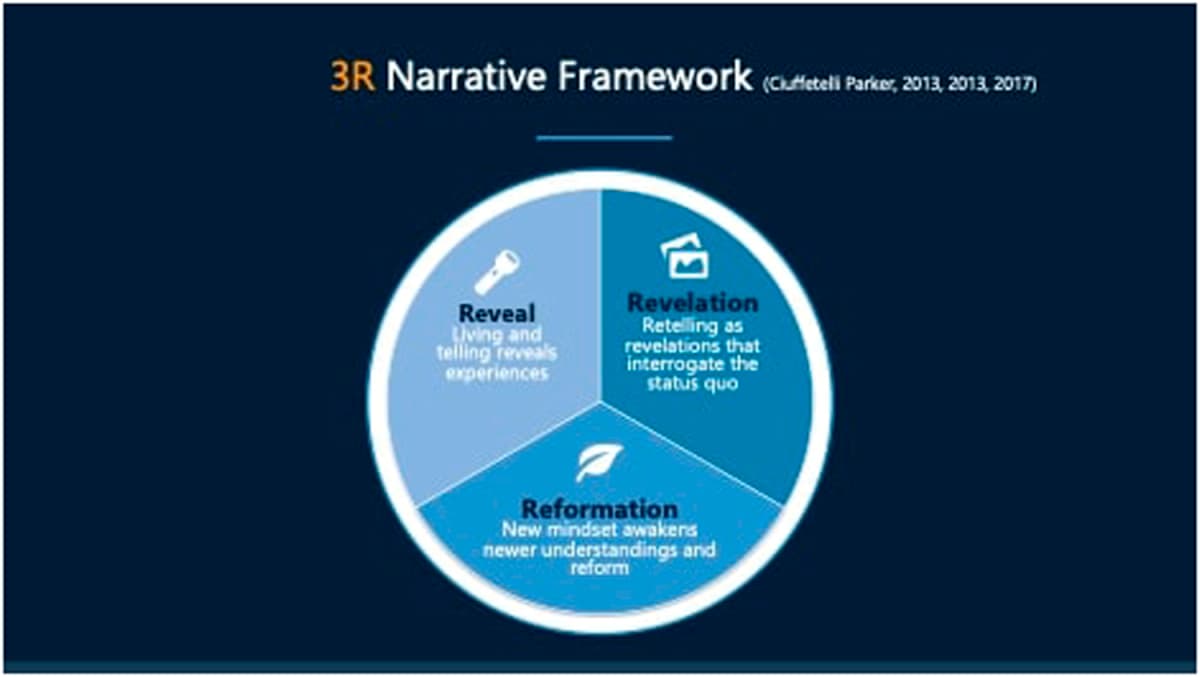
Original Ciuffetelli Parker and Conversano, Figure 1, Frontiers in Education, 2021. CC BY 4.0; unchanged source image.
The study's Method and Limitations sections describe a small set of educator accounts within the larger project. The authors used interviews and other written contact, then read and coded sources. This records their choices.
It cannot show how common those stories are or prove that a proposed school reform caused an outcome.
Keep accounts distinct from your interpretation
Your note should show the route from source to the claim you make. Label the teller's account, your reading, and the open question. A neat theme can hide a change of view, a gap in time, or a relationship that matters to the question.
Keep field texts and research texts traceable
Field texts are records made or gathered through the study. They may be chat records, transcripts, journals, or other items you may use. Research texts are the accounts and readings made from them.
State where each item came from and how it was made. A transcript does not give its own full context.
The 2023 Reflexivity and Relational Spaces paper describes moving from field texts to interim and final research texts. Its authors went back to sources as they shaped accounts. They read and wrote more than once. Their work did not end when a theme was assigned.
Keep a passage locator beside each interpretive sentence. When you shorten or reorder an account, record the choice and check what context was lost. A source-checking workflow helps test the sentence against the source; the researcher still decides whether the account is fair.
Explain your role in telling and retelling
Reflexivity means looking at how your role and choices shape the work. Note whom you knew before, what you assumed, what you asked, and what you chose to include. State what you know from the record and what you need to discuss with the teller or team.
The 2023 paper's account of research relationships looks back at the researcher's role and the online study setting. It shows why the person doing the research is part of the story. Keep that context in your note where the sources support it.
Pino Gavidia and Adu's reflexivity discussion also links the reading of a story to duties of care throughout the work. A signed form alone does not settle how a story should be shared later. Keep review and consent questions with the people responsible for the study.
Check what your rationale can support
A useful rationale names the story, question, chosen tradition, time, social context, and place. It also names who took part in telling and hearing the story. It links each point to a source and states where the evidence runs out. Check those items before you use the note to discuss the plan.
Do not make an account prove more than it supports. A memory can show what an event means to a person. It need not prove every detail of the past. A few stories do not show how common something is or what caused it. Choose other evidence and methods if your question needs those claims.
Keep different views across accounts and within one person's tellings. Do not smooth them into a single confident story just to make the prose easier to read. A research synthesis workflow can compare accounts while keeping each source's contribution distinct.
Use only records you may process and share. Even with names removed, details about people, places, or events can reveal who a story concerns.
The research team must check who can see or use the story. It must review consent and how people are shown. A cited note cannot prove those duties were met or show that the study is complete.
Save a cited question-context note in Atlas
Atlas can help compare accounts you may use with your chosen method sources. Use that reading to draft a note on why the method fits. The research team and people taking part retain fieldwork, consent, and the final reading of the story.
- Add the accounts and method sources you may use to one project. Wait for processing to finish.
- In chat, type
@and select the sources relevant to the question. Ask how the question links to time, social context, place, and who took part in telling the story. - Open each citation and read the surrounding passage. Correct claims the passage does not support. Mark context not found in these records.
- Select New, then Note. Save the checked note with source locators and open questions. Confirm the Saved state before closing it.
Try this request: “Using @selected sources, connect my study question to time, personal and social conditions, place, and researcher relationship. Cite the passages. Keep the account, my reading, and missing context distinct. Do not invent motives or smooth different tellings. Do not claim that these records prove consent, show cause and effect, or form a complete study.”
Connect your question to story context
Compare permitted accounts and method sources, then save a cited rationale.