

A report may say people were “randomized” without stating what the chance rule chose. Did it pick people for the study, or put those already enrolled into groups? Find that stage before deciding what the method supports, and keep a separate source passage for each step.

Check the two study stages
Compare selection and allocation passages and save the checked distinction.
The difference is selection versus allocation
Random sampling picks units from a population. Random assignment puts study units into conditions. A study can use either, both, or neither. The shared word “random” does not make the two steps the same.
MacEwan's experiments chapter separates choosing the sample from grouping those in it. The first asks who enters the study. The second asks who receives which condition.
Sampling helps support claims about the wider group from which units were drawn. Assignment supports a treatment comparison through chance-based grouping. Neither step alone resolves every threat to those claims.
What random sampling controls
Start with a target population, meaning the full set of units the study concerns. A chance design chooses units from that set through stated rules. In a simple random sample of a fixed size, every possible sample of that size has the same chance.
The list used for the draw is called a sampling frame. A draw from a student register covers names on that register. It may leave out eligible students whose names are missing. Random choice within the list cannot fix that gap.
Being chosen is also different from taking part. A student may decline or fail to reply. Statistics Canada describes the sampling design. Keep the names drawn apart from the final replies, since respondents may differ from those who do not reply.
Duke's teaching notes distinguish the sample draw from the later group assignment. The probability vs non-probability sampling guide gives more detail on known selection chances.
To check a report, find the target group, frame, draw rule, and response account. A phrase such as “a random group of students” leaves too much unclear. You need to know what made the selection random.
What random assignment controls
Random assignment uses a chance rule to put enrolled units into conditions. A generated sequence could assign each student to a new teaching method or the usual method. The draw concerns which method each person receives.
If students choose their own method, their preferences may also relate to their scores. A chance rule prevents that choice from determining the groups. It changes how the treatment comparison is set up.
It does not ensure the actual groups are identical. The MacEwan experiments chapter explains that chance can still leave groups with different traits. Judge the rule as well as the result.
The teaching methods must also be used as planned, and outcomes must be measured and handled well. Missing scores or changes from the assigned method can affect a treatment claim. A randomization label does not finish those checks.
Finally, assigning volunteers at random does not turn them into a random sample. A study can have a sound rule for grouping people while needing caution about applying the result to those who never joined.
Read all four design combinations
Random sampling and random assignment
A made-up college study draws names from a full eligible-student register with a stated chance rule. Students who join are then assigned at random to two teaching methods. The report needs a separate account of each step.
Both questions have a chance rule, but the reader still checks the list, response, teaching steps, and score measures. An unexplained phrase such as “randomized sample” should not stand in for those details.
Random sampling without random assignment
A college draws students at random for a survey of study habits. It observes habits students already have rather than giving them a method to use. The draw can support claims about the wider group under the sampling design.
If one habit is linked to higher scores, other traits may help explain the link. The study did not assign the habit. Choosing people at random does not create that missing treatment step.
Random assignment without random sampling
A college invites volunteers, then assigns those who join at random to two teaching methods. Joining was a choice. Which method each volunteer receives was decided by chance. The Norton textbook unit also distinguishes these stages.
Scribbr's guide explains this distinction. Assess the method comparison and wider use of the result separately. Volunteers may differ from people who never replied to the invitation.
Neither procedure
A college surveys students at a drop-in session and compares two methods they already use. Attendance and existing choices define the groups. Neither stage is stated to use a chance rule. Use non-experimental research to check whether researchers observed existing choices or introduced a change before naming the design.
The study may still help describe views or explore a question. A treatment claim or estimate for all students needs a further basis. Do not invent random selection or assignment to make the result seem stronger.
Check a study in two stages
A volunteer teaching study
In this invented example, forty students respond to an ad and agree to join. A computer-generated sequence then puts them into two teaching groups. The report describes two different steps with different purposes.
It does not state whether recruiters could see the next group assignment. Keep that detail open in the table below. Its source labels are teaching aids, not passages from a real study.
| Stated passage | Stage and purpose | Checked reading |
|---|---|---|
| R1 describes replies to an ad | Joining the study | Volunteers joined; no random population draw is stated |
| A2 gives a generated group sequence | Assignment to conditions | A chance grouping rule is stated |
| M3 names two teaching methods | Use of the intervention | Methods are named; their use still needs review |
| No concealment passage found | Carrying out assignment | The detail is unreported, rather than proven absent |
Table 1: Each claim keeps the passage that supports its own stage.
Interpret each procedure separately
A checked sentence could say: “Students volunteered after an ad, then were randomly assigned to teaching methods.” It keeps the supported chance rule without treating the volunteers as a random sample.
If a summary applies the result to all students because the group sequence was random, return to R1. Wider use needs a reason beyond the chance rule used after enrollment. The sampling claim and treatment claim need their own support.
Statology's comparison helps with the terms. In a real study, keep the exact rules and any departures alongside those labels. Missing concealment detail is a reporting gap, not proof that concealment failed.
A study may use quota targets for who joins, or snowball referrals to reach peers. Those recruitment details do not erase a separately documented random rule for teaching groups.
Save the checked methods distinction
Request separate source support
Add the report and protocol to one Atlas project, using the research assistant workflow. Once they have processed, use @ in a chat to select them. Ask for separate passages on joining the sample and receiving a condition.
For example: “Compare recruitment and group assignment in these sources. Give each rule, its purpose, source citation, and missing detail. Do not infer a random sample from random assignment.”
Check each stage against the paper
Open the citation beside each stated rule. Does it point to recruitment, the group sequence, or a summary with no detail? Read nearby text before accepting the label. A citation to one stage does not support both.
If Atlas calls the ad respondents a random sample, correct that row to volunteer recruitment. Keep the generated group sequence in its own row. A mistake about the sample should not erase a supported chance rule for assignment.
The Atlas view below shows where to read a cited answer beside the original source. The visible AI paper is unrelated to the made-up teaching study and provides no design evidence for it.
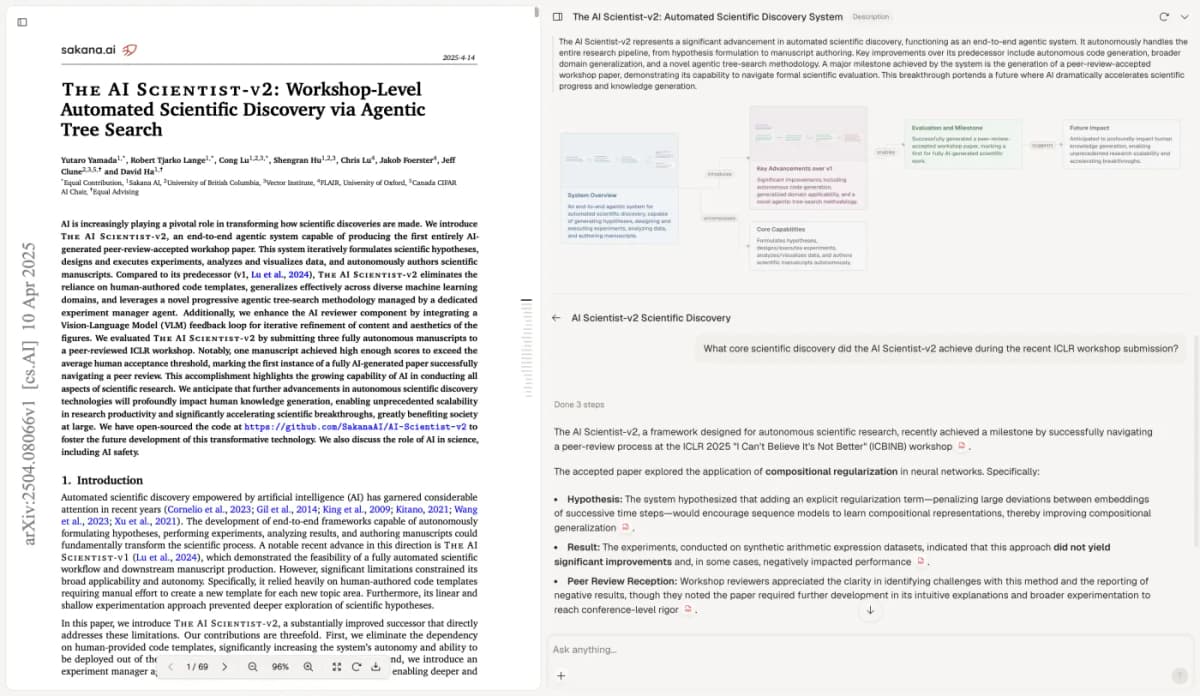
Match the cited passage to the stage the answer describes before keeping the claim. The visible paper is Yamada et al.'s The AI Scientist-v2 (2025), licensed under CC BY 4.0. This Atlas capture is unchanged.
Keep separate claims for each stage
For a methods note, keep the two stage claims separate. Choose New, then Note, and save the selection-versus-allocation purpose evidence table with the corrected sentence and missing detail.
Wait for Saved and update the note when a new appendix resolves the gap. Use the recruitment passage for the sampling claim and the group sequence for the assignment claim.
Atlas supports reading, comparison, and notes from supplied sources. Researchers check participant selection, group assignment, analysis and design limits before deciding which claims the study supports.
Check the two study stages
Compare selection and allocation passages and save the checked distinction.