
A person you interview may know peers whom a contact list would miss. Their help can make a study possible, but it also shapes whose accounts you hear. With snowball sampling, keep track of the referral route and the people it may leave out, including those with no ties to the first contacts.

Trace recruitment passages in Atlas
Compare seed and referral descriptions, check citations, and save the limits.
What snowball sampling means
Snowball sampling reaches new people through referrals from those already reached. The first people form starting points for later contacts. New recruits may pass the invitation to others, so one chain can become several branches.
Ordinary snowball recruitment is non-probability sampling. The referral process does not give known selection chances for all members of the target group. Statistics Canada notes that some people may have no chance of being reached.
The method can help when a useful list is missing or access depends on trusted peers. The probability vs non-probability sampling guide explains why reaching relevant people and making claims about a whole group need separate checks.
Follow seeds and referral waves
A seed is an initial person or starting contact. This is part of the method evidence. Find how the seeds were reached: a service group, personal ties, an event, or outreach. That starting route shapes the networks through which later invitations can travel.
A referral wave is a stage in which earlier recruits lead to later ones. Seeds form the starting stage, followed by their referrals. Use the report's numbering rule, since authors may count the starting stage in different ways.
MacEwan's sampling chapter separates finding available first contacts from asking them to reach peers. A team might choose seeds for their experience, then use snowball recruitment after that.
Scribbr's guide describes linear and branching forms. A linear chain moves from one person to one next contact. A branching chain allows several referrals, sometimes with further screening by the team.
These labels describe growth. They do not tell you who passed screening, who declined, or how repeats were handled. Find those rules in the report before treating the branches as a full account of the method.
Trace a snowball sampling example
Start with two access routes
Imagine a made-up study of independent bicycle repair workers who have no central trade list. The team asks how they learn repair skills. It seeks accounts of experience, not an estimate of how common a view is among all workers.
The team finds seeds at a workshop and a community repair event. Those workers can share an invitation with peers. Interested peers contact the team, which checks that they meet the study's entry rules before interviewing them.
The table uses invented document labels. It shows how to keep a stated stage apart from what that stage can tell you about reach.
| Stated stage | Teaching source | Meaning or open question |
|---|---|---|
| Seeds found through two events | Protocol P1 | Event-linked workers provide the starting networks |
| Seeds share invitations with peers | Methods M2 | Later contact depends on peer referrals |
| One chain stops after its first referral | Field note R3 | Chains differ in growth and reach |
| Overlapping referrals are not described | No passage found | Handling of repeat referrals remains unknown |
Table 1: Each row links a recruitment stage to its source and leaves unsupported details open.
Keep location apart from coverage
Suppose the report says it includes workers across the city. That may tell you where they live. It does not prove that each city network had a route into the study. Workers outside the event-linked circles may never have seen an invitation.
A checked note can say the study reached event-linked workers and their referred peers. It can also record the stopped chain and the missing repeat-referral rule. Claims about all city workers would need a further basis.
If an appendix later states how repeats were screened out, add that passage to the note. Do not fill the gap just because avoiding duplicate interviews would seem sensible. The note should show what the sources say.
Check network coverage and inference
People often know peers with similar jobs, interests, or circumstances. A chain may stay close to those circles as it grows. People with few ties, or no links to the seeds, may be absent.
Statistics Canada's network-sampling section names this missing access as a limit. In the repair case, workers who never attend events or know attendees may not receive an invitation.
More seed routes can broaden access, but do not prove full reach. MacEwan's examples show the practical use of referrals. A long chain may still be part of one narrow circle.
Ask what each route adds and what parts of the target group remain unseen.
A study may use these accounts to explore how skills are shared among those interviewed. Whether that insight applies elsewhere needs reasoning about the setting and the question. Sample size does not create a standard sampling margin of error.
The paper On the Concept of Snowball Sampling explains that the term covers different designs. The actual rules matter for any wider claim. A method label alone cannot settle it.
Respondent-driven sampling adds special design and estimation steps with assumptions that need review. The snowball terminology paper discusses the broader design distinction. A report saying people referred friends does not prove those steps were used.
Keep ordinary referrals apart from those specialized methods.
Report the recruitment trail
Identify the stages and counts
Locate who was eligible first, then read how seeds and later recruits joined. Useful reporting details include the seed routes, invitation path, entry checks, wave count, stopping rule, and number of completed interviews.
The Scribbr guide describes checking whether referred people meet the study rules. A referral is a possible contact, not yet an included case. Do not treat those counts as the same.
Where available, keep separate counts for people invited, people found eligible, and people interviewed. A report with only the final interviews may leave refusals and exclusions unknown. Mark that gap in the methods note.
Respect privacy and mixed methods
Do not assume a person may reveal a peer's identity or sensitive status. Follow the approved invitation and consent process. A methods note can use deidentified stages without becoming a public list of contacts.
A study may also use targets for group counts. Quota sampling concerns the desired mix, while snowball sampling concerns the route through peers. The two can be used together without making selection random.
A short methods account should name the seed routes, referral rules, achieved sample, and known gaps in reach. If a rule is not stated, say so. Do not make the account look complete by guessing what the team likely did.
Preserve a checked referral note
Ask about the named sources
Add the report and recruitment protocol to one Atlas project, using the research assistant workflow. Once both have processed, start a chat and use @ to select them. Ask about seed selection and later referrals as two stages.
For example: “Trace the seeds and later peer referrals in these sources. Give each stage, source citation, entry rule, and limit on network reach. Mark missing overlap or stopping rules. Do not infer citywide coverage from where people live.”
Inspect support for each claim
Open each material citation and read the nearby text. Check whether it describes the planned route or what the team did. A protocol can state an intention that changed during the study.
If the answer says the chains reached all repair workers, narrow the note to the networks the documents describe. Keep an open question for workers with no link to the seed routes. The claim's scope must match the passage.
The Atlas view below shows a source beside a cited answer. It illustrates where to inspect support for a claim. The visible AI paper is unrelated to the made-up repair-worker study and gives no referral evidence.
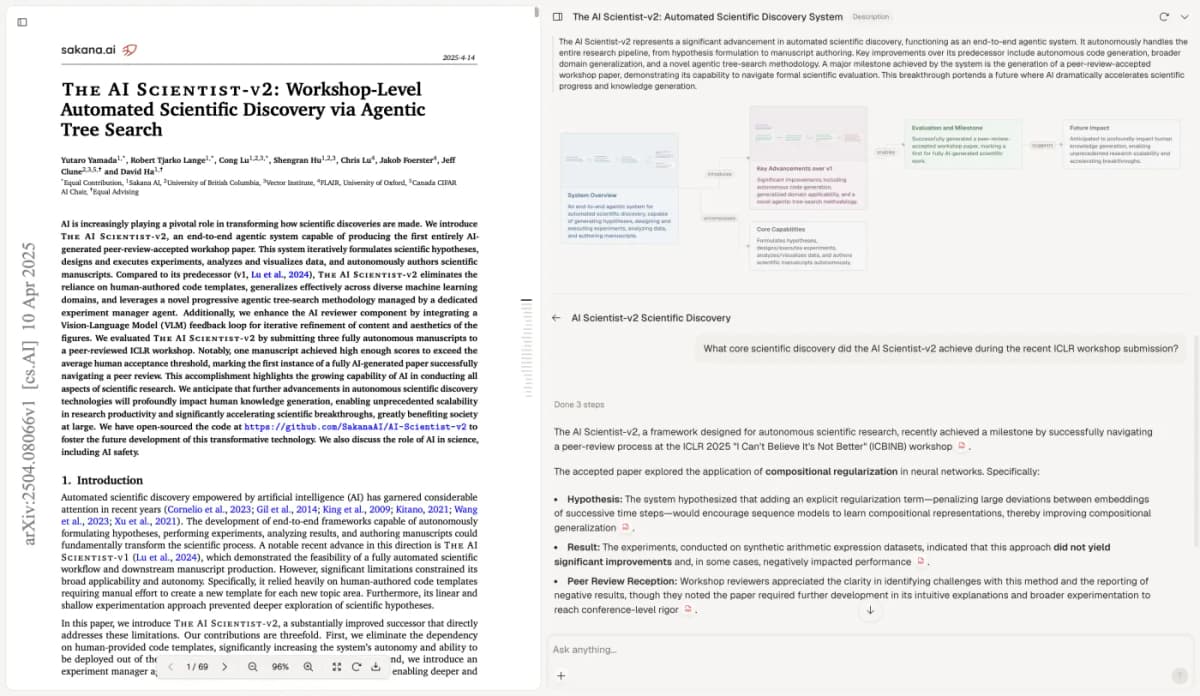
Read the surrounding source passage before keeping a claim about how people joined the study. The visible paper is Yamada et al.'s The AI Scientist-v2 (2025), licensed under CC BY 4.0. This Atlas capture is unchanged.
Save the referral trail and gaps
Select New, then Note, to create the seed-referral-network-limit note. Keep the routes, checked stages, source locations, corrections, and open questions together. Wait for Saved and revise the note if a later appendix fills a gap.
Atlas helps compare supplied sources and retain checked findings. Use the comparison to check reported recruitment routes. The researcher retains the privacy, design, and interpretation decisions.
Trace recruitment passages in Atlas
Compare seed and referral descriptions, check citations, and save the limits.