

A survey can match its planned age or travel-mode mix and still miss people with different views. With quota sampling, check the targets and how people joined each group. The final counts tell you who took part, but not who was left out.

Check recruitment evidence in Atlas
Compare quota targets with recruitment passages and save a checked note.
What quota sampling means
Quota sampling fills preset group counts through non-random recruitment. A team might seek 60 bus users and 60 drivers, then find willing people through chosen channels. The targets control the mix on those traits.
Statistics Canada explains the key difference from stratified random sampling: how people are chosen within groups. A quota can be filled with people who are easy to reach. A random draw needs a defined chance rule.
“We planned equal numbers from both groups” states a target. “We drew names at random from each group list” states a rule for choosing them. Find both details in a report before drawing a conclusion about the method.
The broader probability vs non-probability sampling guide covers known selection chances. Here, the focus is what a quota controls and what can remain unknown when it is filled. Use the selection versus allocation guide to keep random assignment to conditions apart from quota recruitment.
Choose what the quotas control
Proportional quotas aim to match chosen group shares. If a sound benchmark says 70% of the target group uses buses, bus users receive 70% of the planned sample. Check that the benchmark covers the same people and period as the study.
Non-proportional quotas can give groups equal counts or a minimum count even when their shares differ. QuestionPro's guide covers this choice. It can help a team hear more from a small group.
The overall mix then serves a comparison goal rather than matching the benchmark.
Two separate targets do not fix every joint group. Equal age-group counts and equal travel-mode counts can still leave very few older drivers. These separate totals are called marginal quotas.
Interlocking quotas set counts for the joint groups: younger drivers, younger bus users, older drivers, and older bus users. Scribbr explains the joint-cell choice. More cells can take more time to fill.
Use them when those joint groups matter to the question. Scribbr's guide covers these choices. A methods note should say which kind was used. Two reports that both mention age and travel mode may control different parts of the sample mix.
Calculate a quota sampling example
Imagine a made-up survey about travel to one campus. The team plans 120 replies. Its teaching benchmark says 60% of eligible commuters use buses and 40% drive. No real campus data is being reported.
The targets are 120 × 0.60 = 72 bus users and 120 × 0.40 = 48 drivers. They add to 120. When a calculation gives fractions, state how the counts were rounded and check the total again.
If the goal is to hear the same number of accounts from each group, the team could instead seek 60 bus users and 60 drivers. That changes the mix from the benchmark. Name the reason for the targets before claiming what they reflect.
Now suppose the team also seeks 60 younger and 60 older commuters. Those totals do not reveal the number of older drivers. Check the joint cell if the question concerns older drivers' travel needs.
The plan and the achieved counts also differ. If only 38 drivers reply, the target of 48 was not filled. Keep both counts in the report so the reader can see the shortfall.
Check recruitment within each quota
Match each count to its source
Read the methods, the fieldwork appendix, and the benchmark together. This table uses invented passage labels to show which parts of the account need their own support.
| Evidence in the teaching documents | What it shows | What remains to check |
|---|---|---|
| Methods M1 sets 72 bus and 48 driver replies | Planned travel-mode counts | Who the benchmark covers |
| Appendix R2 names two student groups | Where people were reached | Who those groups could not reach |
| Appendix R3 keeps replies until cells fill | First-available eligible replies | How early and late replies differ |
| No passage describes replacing partial replies | A reporting gap | Whether replacements changed the mix |
Table 1: Filled targets and the rule for choosing people answer different questions about the sample.
Keep gaps and conflicts visible
A checked note could say: “The plan sets travel-mode targets. The appendix keeps early eligible replies from two groups. It does not state how partial replies were replaced.” A missing rule is not proof that no replacements occurred.
If the plan names three channels but the report names two, keep the conflict. Note the dates and versions, then look for an amendment. Choosing the more detailed account without checking could hide a change in fieldwork.
MacEwan's sampling chapter shows how matching one trait can hide differences in another. In this case, the bus and driver counts could match while course schedules differ sharply between the groups.
A referral route is another part of the account. The snowball sampling guide covers people inviting peers. A quota states the desired counts, while referrals describe how people were reached.
Interpret advantages and limitations
Quotas can help a team hear from groups that would otherwise be swamped by easier-to-reach people. They can also be filled without a full list of everyone eligible. That can suit early work on experiences across groups.
The claim still needs to fit the question. Hearing accounts from bus users and drivers can help explore travel needs. Estimating how common a view is across all campus commuters needs a stronger basis for wider claims.
Statistics Canada's caution concerns who was missed or declined. Replacing an unwilling person with a willing one may fill the cell while leaving response bias intact.
Sample size alone does not justify a standard sampling margin of error. Wider estimates from a non-random sample need added assumptions and a suitable method. Ask what supports the claim beyond matching the quota traits.
For a report, give the target group, benchmark, quota traits, planned and achieved counts, channels, entry rules, stopping rule, and known gaps. QuestionPro's fieldwork guide discusses screeners and fill tracking. Explain how those controls affected who joined.
Keep a checked recruitment note
Ask about named sources
Add the report and fieldwork appendix to one Atlas project, using the research assistant workflow. Once they have processed, open a chat, type @, and select both. Naming the sources helps keep the plan apart from the account of what happened.
Ask: “Compare the quota targets with the rules for choosing people. Give each target, channel, entry rule, achieved count, and source citation. Mark any replacement rule that is not reported. Do not infer a representative sample from filled quotas.”
Read and correct the answer
Open each citation for a claim you will keep. Does the passage describe a plan or a result? A target of 72 bus users does not prove that 72 replied. Read nearby text to check the scope of the claim.
If the answer calls the sample representative because the quotas were filled, revise the note. The chosen traits matched the targets, while people joined through a non-random route. Keep “not reported” for a missing replacement rule.
The Atlas view below shows a source beside a cited answer. It shows where to check the claim against the paper. The visible AI paper is unrelated to the made-up commuter case and provides no sampling evidence.
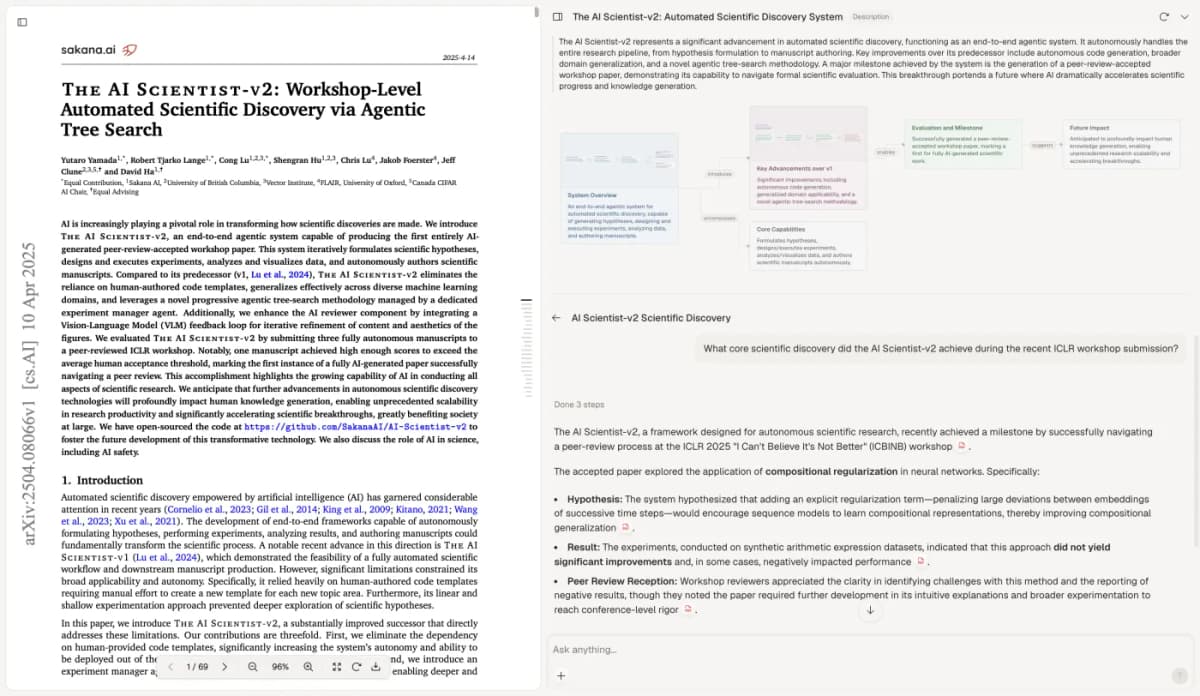
Keep the source open while checking whether the answer preserves its limits. The visible paper is Yamada et al.'s The AI Scientist-v2 (2025), licensed under CC BY 4.0. This Atlas capture is unchanged.
Save the quota evidence and gaps
Choose New, then Note, and keep the quota-recruitment-rule-uncertainty note with source locations, your corrections, and gaps. Wait for Saved. Update it when a revised appendix gives the missing rule.
Atlas helps compare supplied texts and keep checked findings with the sources. It does not recruit people, run sampling statistics, or certify that a sample represents a wider group. The researcher owns that judgment.
Check recruitment evidence in Atlas
Compare quota targets with recruitment passages and save a checked note.