

Non experimental research studies what already exists. The researcher does not assign the exposure or condition being studied. The study can describe people, compare groups, or measure a link between things. To understand the design, ask what the researcher did. Numbers alone do not make an experiment.
Reading records of students who chose tutoring differs from assigning students to it. This guide shows how to check the methods for that detail. You can then save a note of what the paper says and what you still need to know.

Check what the study actually did
Compare methods passages and preserve the limits of the claim.
What makes research non-experimental
The KPU psychology textbook defines this approach by the absence of manipulation of an independent variable. That means the researcher does not change or assign the condition under study. Recording habits does not change them, even if you take the measures in a lab.
Random sampling and random assignment differ. Sampling is about who enters a study. Assignment is about which condition they receive.
NIST's design guide describes randomly assigning treatments. If you choose a random sample and ask about habits people already have, you have not assigned a treatment.
A study can introduce a change without random assignment. That may be a quasi-experiment, rather than a study that only observes. Find out who made the change, how groups formed, and what they were compared with. “No randomization” is not enough to settle the label.
Common designs and overlapping labels
Relationships and data sources
Correlational research measures how things vary together. A researcher can watch behavior as it occurs, or use records made earlier for another purpose. These labels can overlap. For example, you can use old records to check whether two measures are linked.
Crump's methods chapter shows why setting and data source do not settle the design. A survey or interview is a way to get data. You still need to ask what was assigned, if anything, and how the groups answer the study question.
Timing and group formation
Cross-sectional data give a view at one period. Longitudinal data follow change across time. These labels describe timing, not who chose the exposure. A study can follow people for years without assigning what they do.
The JIBC teaching chapter lists common types for learners. Use those lists as aids, then explain the study in your own words. Who took part? What was measured and when? How did people come to have the exposure?
Worked reading of a tutoring study
Consider a fictional paper about tutoring and writing scores. Students chose whether to attend. Staff recorded who came, and researchers linked those records to scores at term end. This example contains no findings or effect estimates.
Use these passage checks to build a design rationale rather than guessing from the title or the presence of a survey.
| Illustrative methods statement | What it supports | What remains to check |
|---|---|---|
| Students chose whether to attend | Attendance was self-selected | Whether another part of the study assigned an offer |
| Staff recorded normal attendance | Existing behavior was measured | How missing visits were handled |
| Scores were linked at term end | A later outcome was available | Earlier scores and other group differences |
| An abstract calls this a comparison | A comparison was reported | Exact exposure, timing and analysis in the full methods |
Table 1: The passages are fictional; the checks show which design details a reader should verify in a real paper.
Narrow the conclusion
A draft summary might say, “Tutoring improved writing.” The methods do not show that. Students who attend may have different past scores, time to spare, or reasons for seeking help. A design note should say the study examines the link between choosing to attend and later scores.
That wording does not say the study found a link. No results were given. If a real paper reports one, use its results to record what was found and how uncertain it is. Keep why you chose the design label apart from the findings. A paper-analysis workflow helps you read those parts separately.
Leave missing details open
Suppose the full methods also say some students were assigned an invitation, but do not explain how. Being invited and turning up are different things. A study of the offer may have a different design from a study of who chose to attend. Check which one the claim is about.
Write “how the invitation was assigned is unclear.” Find the study plan or ask for the missing detail. Handley and colleagues' review explains why a nonrandom study of an intervention needs a sound comparison. Choose the label once you know what was done.
Keep causal claims within the evidence
Time order and rival explanations
If you measure the exposure and outcome at the same time, you may not know which came first. Repeated measures can help with timing. They do not rule out every other cause. Students' drive to learn could affect both whether they seek tutoring and their scores. That shared cause is a possible confounder.
Crump's explanation of correlation covers cause direction and shared causes. Name the concern in your paper rather than adding a stock warning. What was measured before students attended? What was not measured? How could those gaps change the claim?
Selection and the reach of findings
People who join or stay in a study may differ from those missing from it. A finding from one course need not describe every student. Check who could join, who did join, and who had missing records. Keep the group in the claim matched to the group studied.
For recruitment in arrival order, use the consecutive sampling checks to trace eligibility, dates, refusals, and coverage gaps. Asking every eligible arrival during a stated window does not establish that the sample represents everyone outside it.
Do not write that observed data can never help answer a cause question. Strong designs can do so with sound assumptions.
Do not write that an adjusted model proves cause and effect either. The design review explains how the comparison can be flawed. Get expert help to assess the real design and its claim.
Save a design rationale in Atlas
- Add the paper, any available protocol, and the relevant design guidance to one project. Confirm that the files are readable and that the protocol belongs to the same study.
- In Ask a question, use @ to select the sources. Ask: “Compare the methods with this guidance. Identify what was assigned, what was only measured, and how groups formed. Cite passages and leave missing details unresolved.”
- Open each citation and read the surrounding text. Check the subject of the statement: an invitation, actual attendance, and a later score are not interchangeable. If a passage is unclear, ask a narrower follow-up.
- Separate source statements from your design judgment. Use a multi-source synthesis approach to retain disagreements instead of blending different definitions into one verdict.
- Create New → Note, record the passages and rationale, and wait for Saved. Include unresolved assignment details and the scope of any claim you narrowed. Atlas helps with reading and notes; it does not validate the causal design.
The image shows the source beside a cited answer. Read both to check that the answer stays within the passage. Its visible AI research paper is unrelated to the tutoring example and does not demonstrate this prompt or its accuracy.
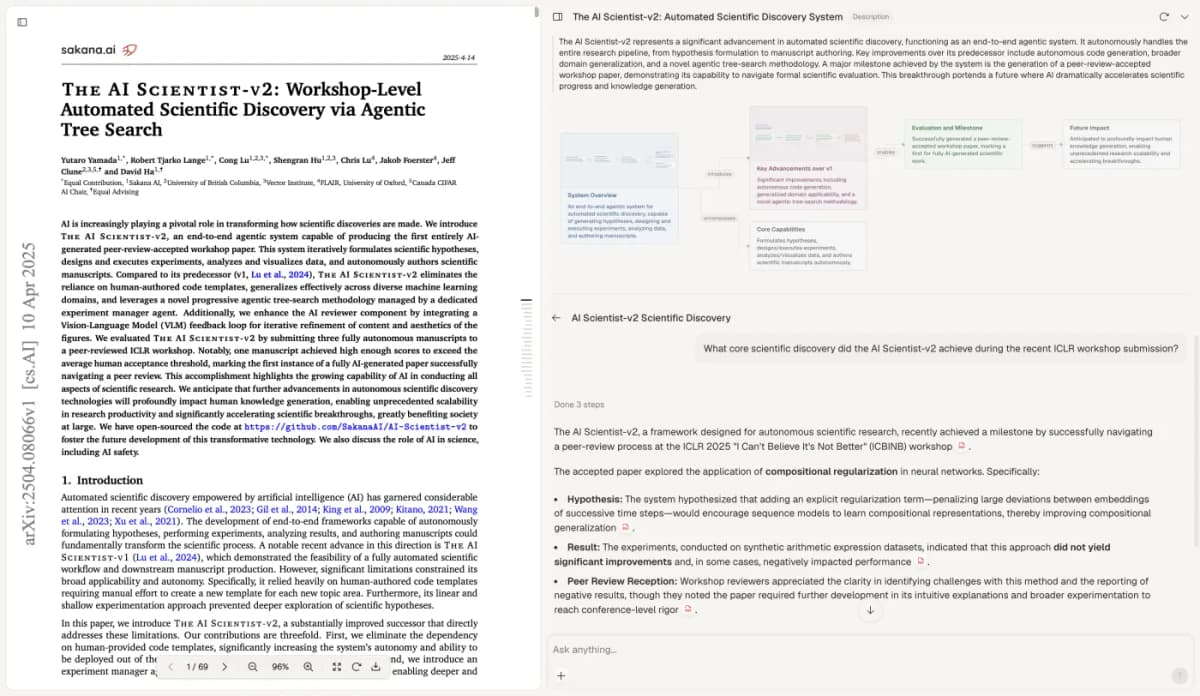
Real Atlas source-check capture. The visible AI Scientist-v2 paper by Yutaro Yamada and colleagues, licensed CC BY 4.0, appears unchanged within the screenshot. It is unrelated to the fictional tutoring example and does not demonstrate design-classification accuracy.
Check the note against the paper
Read the full methods and results before using the note. Check that the label, exposure, group, dates, and finding all refer to the same question. If the title is less precise, use the clearer account from the methods.
If one source is not enough, use a bounded literature review to find relevant methods guidance. Keep the search and causal review separate from the act of summarizing one paper.
The KPU definition is a starting point for that reading, not a substitute for the paper's design details.
Check what the study actually did
Compare methods passages and preserve the limits of the claim.