

Consecutive sampling takes cases in order as they meet the study's rules, until its end date or sample target. To read a study well, check who could join, when staff were there, and who entered the sample.
The word “consecutive” means cases follow one after another. It does not show whether staff worked all shifts or whether each person agreed to join. Keep those limits in a note about the sample.

Check the reported recruitment sequence
Compare eligibility, dates, and included cases across your sources.
What consecutive sampling means
Imagine a service desk where staff ask each person who qualifies to join a study. They follow this rule during the stated hours, rather than asking only those who seem easy to talk to. Cases enter by arrival order, without a random draw.
The patient exit methods study describes taking each case that qualifies until the site's target is met. People seen in that window are only part of those the site may serve over time.
Meeting the rules and giving consent are two things. A person can qualify but decline. The methods tutorial uses the term “consecutive consenting sample” for people who qualify and agree at a clinic.
That tutorial classes the clinic sample as a form of convenience sampling. One paper may stress access to cases; another may stress the rule used to approach them. Check the steps behind the labels before treating them as distinct designs.
Check 4 parts of recruitment
Read the methods alongside any recruitment account or appendix to trace the claims behind the method label. Keep a missing detail marked as “not reported,” since a gap in the text does not prove that staff failed to perform a step.
| Check | Evidence to locate | Question left open |
|---|---|---|
| Eligibility | Inclusion and exclusion rules | Were the same criteria applied throughout? |
| Window | Sites, dates, days, and staffed hours | Which eligible arrivals fell outside coverage? |
| Sequence | Account of screened, invited, consenting, and included cases | Were missed approaches or refusals described? |
| Stopping rule | Time limit, sample target, or both | What determined the final included case? |
Table 1: Four checks for reading a recruitment report without treating its method name as proof of complete coverage.
A log can show who was found, who met the rules, who was asked, and who joined. The practitioner guide raises two useful questions: did staff shifts leave gaps, and did cases arrive at once? Ask these without assuming that staff missed cases.
If a paper gives only the final count, you cannot work out how many people qualified but were never asked. The final count records a result, while the sequence of screened and consenting cases helps explain how that result came about.
The ending rule matters too. Reaching a target before the planned closing date may leave a different time window from the one you first inferred. Record the actual reported endpoint and preserve any gap between the plan and the account.
Worked example with missing coverage
In a fictional study of users' views at an advice service, staff say they asked all adults who met the rules in arrival order. They worked on weekdays from 9 a.m. to 5 p.m. in April, although the service also opens on Saturday mornings.
An extra report says some people declined but gives no account of missed cases. All these details are made up to show how to read a claim; they are not study findings.
Suppose the paper claims, “Consecutive sampling ensured that the sample represented all service users.” The methods support less than that: staff say they asked people who met the rules within weekday hours. Saturday users were outside that window.
Those who declined are absent from the final sample. You cannot tell from these facts how that changed the results or whether staff missed weekday cases. The exit methods study makes time coverage part of the question about the wider group.
A corrected note could read: “Staff say they asked each adult who met the rules during weekday hours in April. Saturday users were outside that window, and some people declined. The report does not say whether staff missed cases. The method name alone does not support the claim about all service users.”
This correction challenges the scope of the conclusion. It does not invent a count of missed cases or declare the findings unusable.
Separate inclusion from broader representativeness
A full sequence at one site still leaves out people who never go there. The MacEwan sampling chapter contrasts samples based on access with designs where each case has a known chance of being chosen.
Ask which group the study reaches and which group its claims describe. A weekday sample may suit a question about weekday users better than one about all users across the year. This is a scope judgment, not proof of a measured bias.
If a trial assigns people to groups at random after they join, that is a separate step. It decides which group they enter. It does not make the first sample a random draw from all users, a distinction worth tracing in the methods tutorial.
Taking cases in order also differs from taking every nth entry. That method needs a step size and a starting rule, as explained in systematic sampling. Asking all cases that qualify does not skip by a fixed step.
When papers use the same label, compare their sites and times before joining their findings. The guide to synthesizing research papers helps keep differences that change the meaning in view.
Compare the recruitment sources in Atlas
Add the study methods, extra recruitment report, and sampling guidance to one project. Use only sources you have the right to share. A methods account may be enough; you do not need named case records to check the stated rule.
For a broader review, the research paper analysis workflow explains how to keep an answer tied to its sources.
- Select sources with @. Ask: “Who could join, when did staff recruit, and how did cases enter the study? What does the report say about consent and when recruitment stopped? Keep missing details separate from known missed cases.”
- Open each citation and read the nearby text. Check whether the dates were planned or worked. Check whether a count means people asked or people who joined.
- If an answer says “all eligible people were included,” check it against refusals. Change it to the supported claim: “Staff say they asked each case that qualified in the stated window.”
- Select New → Note. Save the rule, site, dates, consent account, correction, and open question with citations. Wait for Saved.
The capture below shows a cited answer beside an unrelated paper. It shows the source-checking step, rather than our fictional service study or a case log. Read the passage to check who the source says was asked and who joined.
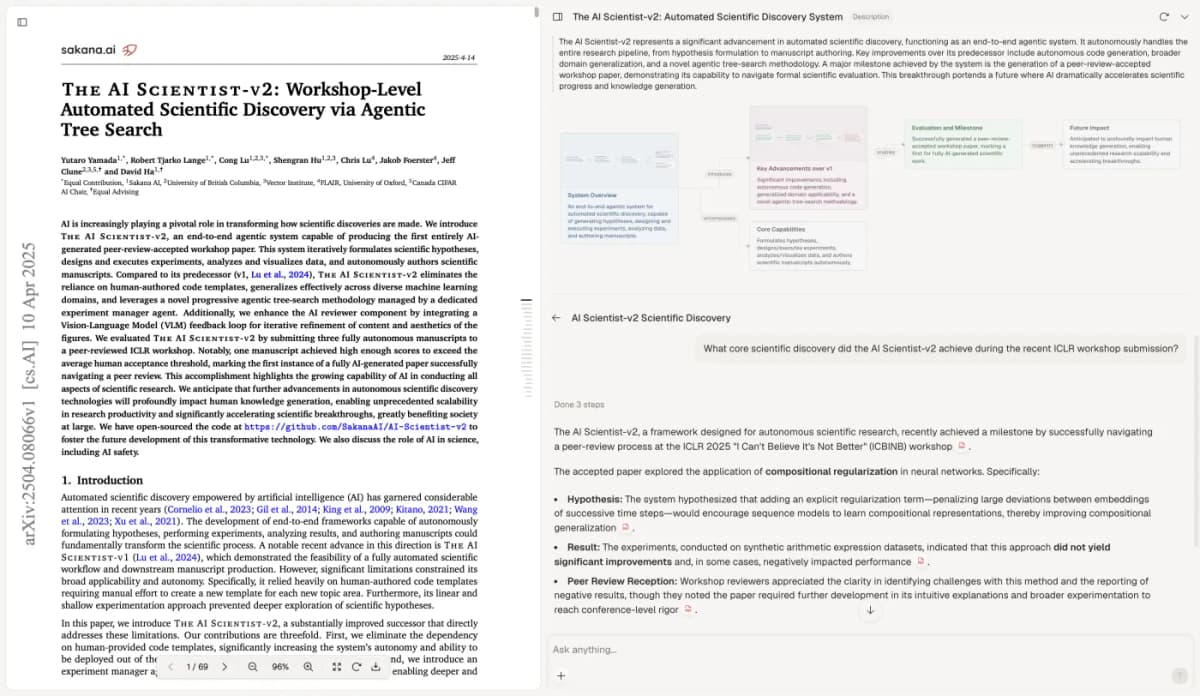
Check the cited wording before turning a recruitment description into a claim about who was included.
Screenshot: Atlas. Embedded paper: Yamada et al., The AI Scientist-v2, CC BY 4.0. Paper content unchanged within the product capture.
Save a bounded recruitment note
Keep the note specific enough to revise when an appendix or clarification arrives. State what the authors report, which visitors the window covers, and what remains unknown. Retain the exact passage supporting each judgment.
If you later find a screening log, use it to revise the affected claim. Do not carry an old reporting gap forward after the new source resolves it. Equally, a citation to the method name alone does not resolve a missing account of cases.
This appraisal of a study's recruitment belongs within your literature review process. Keep it separate from your own rules for finding and selecting papers.
Check the reported recruitment sequence
Compare eligibility, dates, and included cases across your sources.