
Systematic sampling takes units at a fixed interval from an ordered frame. In the basic probability design, a random start chooses where that sequence begins. A report that says “every fourth record” tells you the interval. It does not yet tell you how the first record was chosen or what the list order might hide.
The useful reading task is to connect four things: the frame, the start, the interval, and any repeating pattern. Your result should be a short evidence note with cited facts and open questions. A method name alone does not prove that the sample reflects the whole group.

Check a sampling method against sources
Compare the reported frame, start, interval, and list order.
What systematic sampling selects
A sampling frame is the list or set you draw units from. Suppose a complete list has 40 records and the planned sample has 10. Here, 40 divides by 10 with no remainder, so the step is four.
Choose one of the first four positions at random, then take every fourth record. Statistics Canada explains this basic design.
If the start is two, the selected positions are 2, 6, 10, 14, 18, 22, 26, 30, 34, and 38. Choosing a different start changes the whole sequence. The draw starts at random, then follows a fixed step, as shown in the New Zealand curriculum definition.
That sequence differs from a simple random sample of ten records. Once the start is fixed, the rest of the systematic sample follows from it. In this basic design, each unit can have the same chance to be picked. Yet the choices still depend on each other. Wolfram MathWorld makes that distinction explicit. Equal chances for each unit do not give all groups of ten a chance to be picked.
Read four details in the report
Use the methods section and any frame description to fill the following table. Record what the authors report before judging what it means.
If a detail is missing, write “not reported” and keep the question open. The Scribbr method guide provides a readable sequence from frame choice to start and interval.
| Detail | Evidence to find | Limit to retain |
|---|---|---|
| Frame | Eligible units, exclusions, and the list used | A complete list of one group may exclude another group of interest |
| Start | How the first position was chosen | A convenient first record is not evidence of a random start |
| Interval | The stated step and how it produced the sample size | A rounded step may need a separate rule for the end of the list |
| Order | Sorting rules or repeated blocks of records | An interval can line up with a pattern related to the outcome |
Table 1: Four report checks for a sampling evidence note; these are questions to inspect, not a score for study quality.
Check who belongs on the frame. The group a study wants to describe may be larger than the set it can draw from. Statistics Canada's glossary defines both the target group and the rule used to draw units. Taking every fourth record does not repair a missing group.
The division rule above covers an easy teaching case. If the frame size is not a multiple of the target sample size, inspect the actual procedure. Do not silently round the interval and assume the design is unchanged. When reading a paper, a clear account of what the researchers did matters more than fitting the report into the simplest example.
Worked example with a repeating list
Consider a fictional maintenance study. Its frame contains 40 records from ten weeks. Each week contributes four records in the same order: early inspection, repair request, repair work, and final sign-off. The researchers plan to review ten records, so their interval is four. These records and the following methods statements are invented for this example.
With a random start of two, the sample includes the repair-request record from each week. A start of four would include only final sign-offs. The interval keeps selecting the same position within each weekly cycle.
If the record types differ in the outcome being studied, the resulting samples could tell very different stories. That is the repeating list problem discussed by Statistics Canada.
Now suppose the fictional report says, “Ten records were selected by taking every fourth entry, ensuring a representative mix of work stages.” The stated step supports the first part of that claim. The known frame order challenges the claimed mix: each possible start follows just one work stage. The report also fails to say whether the start was random.
A better appraisal note reads: “The report describes an interval of four. The frame repeats four work stages each week, so this interval selects one stage per week. The starting rule is not reported. The claimed mix of stages is not supported by the described selection rule; the effect on the study's estimate has not been established.”
This preserves the evidence without inventing a measured bias.
Distinguish ordering risk from reporting gaps
A list that repeats does not stop the start from being random. But one drawn sample can look quite unlike the whole list. Results can also change a lot with the start. MathWorld discusses this as a variance and ordering concern.
Avoid replacing that point with the broader claim that systematic sampling is always biased.
Order can also spread selected units through a list in a useful way. The question is how the order relates to the study's variables, rather than whether any order exists. Statistics Canada's comparison of possible samples helps explain why the same interval can behave differently on differently arranged frames.
Keep three things apart: what the report says, what follows from the stated design, and what you still do not know. A missing start rule is a reporting gap. A repeating block is a feature to investigate. Missing eligible units are a coverage concern. Do not use one of these gaps to dismiss all of the study's results.
For several papers, compare the same fields before combining findings. The guide to synthesizing research papers explains how to preserve differences that affect a conclusion. Two papers may name the same method yet use different lists, orders, and rules.
Compare the sampling sources in Atlas
Bring the study methods, the frame description, and relevant guidance into the same project. Include only materials you are permitted to use. A description of the frame with no names may be enough.
You need to check the stated rules; you do not need to upload personal records for a draw. For broader paper reading, see the research paper analysis workflow.
- Use @ to select the methods, frame description, and guidance sources. Ask: “What does the study report about the frame, start, and interval? What does the frame order imply about which positions can be selected? Separate facts from missing details.”
- Open each cited passage. Read the nearby text for exclusions, sorting rules, or a qualification that the answer may have missed. A cited answer still needs your review.
- If the answer says “a random start guarantees a representative sample,” correct it. Ask for the passage supporting that claim and compare it with the Scribbr discussion of periodicity. Keep the more limited question about how this list and interval interact.
- Create a note with New → Note. Save the reported frame, start, interval, order concern, corrected interpretation, and unresolved question with their citations. Check Saved before moving on.
The existing capture below shows a cited answer beside an unrelated AI research paper. It illustrates the source-checking step, not the fictional maintenance records or a sampling calculation. Readable source context belongs in the review even when the answer appears clear.
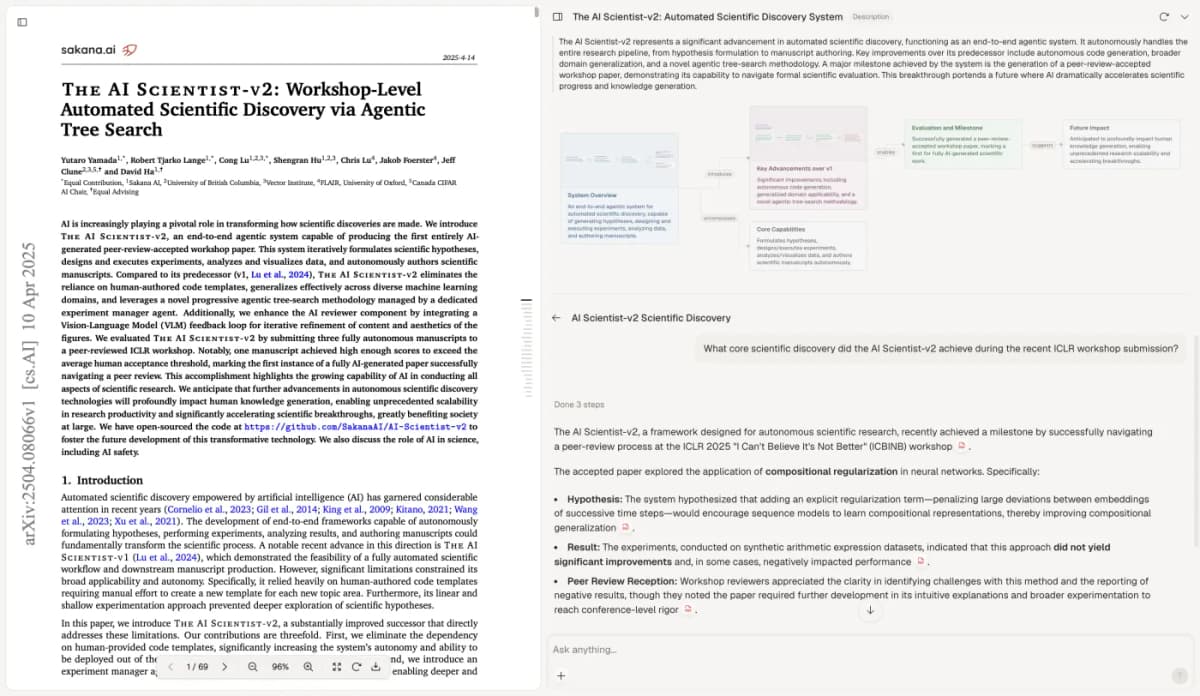
Open the cited source and compare its wording with the answer before saving your interpretation.
The visible paper is The AI Scientist-v2 by Yamada et al., licensed under CC BY 4.0. This Atlas screenshot is reused unchanged.
Save the evidence and unresolved question
End with a note another reader can challenge. State the reported rule, the frame feature that matters, and the limit on your conclusion. If the start rule or order is unclear, show that gap. Do not decide that the design passed or failed.
This note also helps when new material arrives.
An appendix may explain the random start or show a different list order. Revisit the affected judgment rather than carrying the earlier uncertainty into every finding.
Within a literature review process, keep this appraisal of sampled units separate from your own rules for finding and selecting papers.
Check a sampling method against sources
Compare the reported frame, start, interval, and list order.