
Interpretative Phenomenological Analysis: A Case-First Guide
Interpretative phenomenological analysis starts with one person's account. See a worked case trace, cross-case themes, and checks for sound interpretation.
- Byline

Summary
Interpretative phenomenological analysis is a way to study how one person makes sense of a major life event.
First read each transcript in depth. Then compare cases and link themes to cited passages.
A fictional case table traces source words through notes to a tentative claim that the researcher must test.
Interpretative phenomenological analysis (IPA) asks how a person makes sense of a significant lived experience. A researcher reads one account closely, builds a reasoned interpretation of that case, and only then asks where accounts meet or differ.
Imagine an interviewee saying, “I kept the appointment card in my pocket, even after the visit.” A search for appointment may find the line. It cannot settle what the card meant to this person.
The researcher needs the wider account and a note that explains the reading. Atlas can retrieve a supplied passage with a citation. The researcher makes and tests the claim.

Atlas

Check participant passages in Atlas
Compare passages, check citations, and save interpretation notes.
What IPA asks
IPA studies lived experience: what an event is like for someone and how that person understands it. Its roots include phenomenology, which attends to experience, and hermeneutics, which attends to meaning.
It is also idiographic. The researcher stays with one case before making a wider claim. Smith and Osborn's account of IPA sets out these three commitments.
The method has a double hermeneutic. The person tells a story to make sense of an event. The researcher reads that story and asks how the person made sense of it.
An interview offers words the researcher can inspect. Those words support a careful reading of meaning in context. Smith and Osborn stress the need to stay close to what the person said.
When IPA fits a question
The case comes before the group
An IPA result goes beyond a list of topics. “Diagnosis,” “family,” and “work” may name what an interview covers. A theme such as “protecting a familiar self while accepting help” makes a claim about the person's view of life.
That claim needs exact passages and an account of how the researcher reached it. The IPA textbook's publisher description frames the approach around how people make sense of major life events.
An IPA study can compare several people who lived through a similar event. Yet each interview gets its own close reading first. Cross-case patterns grow from those case accounts.
Smith and Osborn call this the idiographic commitment. The CASRAI practitioner guide shows how personal themes can lead to group themes.
This order matters even when software can search all transcripts at once. A pooled hit for “fear” may hide fear of harm in one account and fear of losing a social role in another. The researcher must read each phrase in its own story.
IPA suits a question about a life event and the sense people make of it. For example: How do new nurses understand their first night shift alone?
That question invites a rich account of duty, doubt, and change. A survey could answer how often nurses feel stressed. IPA asks what this shift meant to each nurse.
Rich accounts matter more here than a large set of short answers. People need room to describe a moment in their own words. They may return to it and explain what it came to mean.
Interviews are common. Other material may also work if it supports close study of each person's experience. The Smith, Flowers, and Larkin text includes studies of health, distress, and identity. It does not set one rule for every sample.
Choose people for their link to the event under study. Explain why their accounts can answer the question and how each was read.
A small group alone does not make a study IPA. There is no magic sample size that makes a claim sound. Smith and Osborn explain why close study of a few cases can help with complex experiences.
Choose the method for its aim
Use IPA when each person's account and sense-making are central. Phenomenography maps a group's different views of one topic into related categories. Inductive thematic analysis develops themes across a dataset and can serve many kinds of research question.
Define the claim your project needs to make before choosing a method. The Larkin, Watts, and Clifton paper describes two linked tasks in IPA: giving voice to a person's concerns and making sense of them in context. That pair of tasks shapes the study from its first question through its report.
An IPA design is a good fit when you can:
- Name a lived event that matters to the people in the study.
- Gather rich accounts that let each person explain its meaning.
- Read and write up each case before comparing cases.
- Show the words and notes behind each later theme.
An IPA report should show close attention to each case. A broad codebook alone misses that depth unless the team has also built each person's account. A small, chosen set of cases cannot show how common a view is in a whole population. Its strength lies in depth and a clear evidence trail.
Interpret one case first
Start with one person's full account. Read it more than once. Notice what led up to the event, which ties matter, and where the story changes. Keep the whole account in view as you select phrases.
If a recording exists, check the text against it. A text workspace cannot restore tone, pauses, or gestures absent from the transcript.
The stages below offer a path for close reading. They follow the case-first approach in Smith and Osborn and the steps in the CASRAI guide.
Return to earlier notes when a later passage changes your view.
For each case, keep three linked records:
- The full account with passages marked in context.
- Descriptive, language, and meaning notes beside those passages.
- A case memo that tests each PET against the full account.
Read and annotate the account
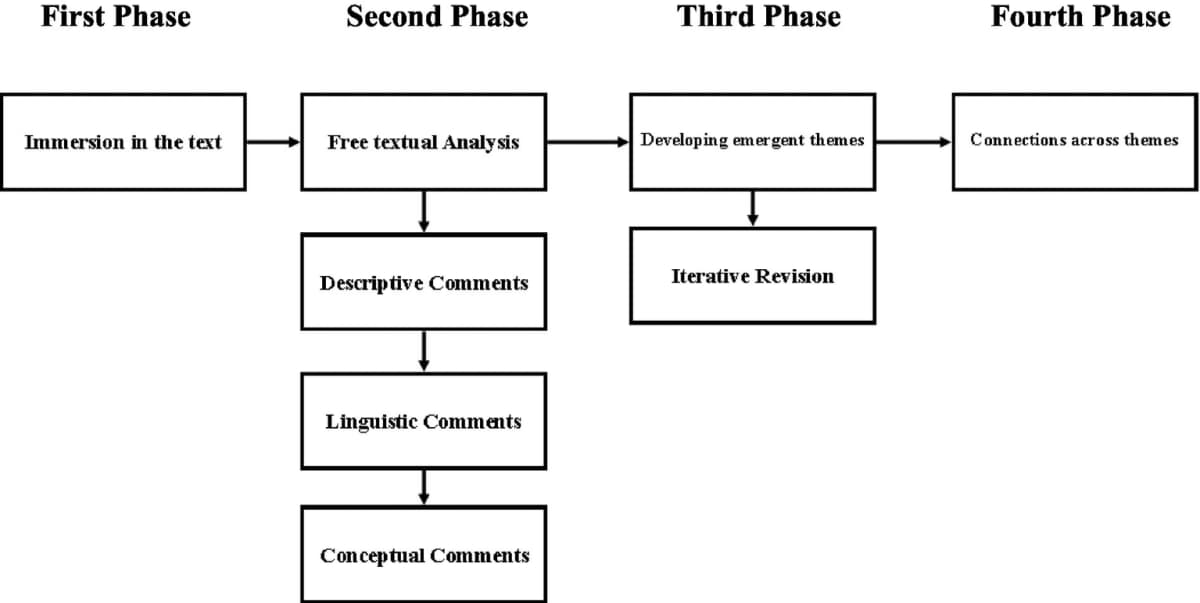
Write descriptive notes about what happened. Add linguistic notes where a phrase, metaphor, or repeated word seems key. Use conceptual notes to ask what a passage may mean.
Keep these notes near the quoted lines so another reader can trace the claim.
For instance, “They handed me the keys” describes an event. A note might ask why the speaker switches from “I” to “they.” Do the keys mark freedom, burden, or a formal handover?
One line cannot settle that question. Read the nearby text and later parts of the account before making a claim.
An open IPA study by von Rieben and colleagues shows one team's path from reading to descriptive, linguistic, and conceptual notes, then revised themes.
The diagram records that study's approach. Other IPA teams may make different choices and should explain them.
Form experiential statements
Turn a group of notes into a short claim about what the event seems to mean for this person. Go beyond a topic label. Keep the claim tied to the words and setting.
“Duty arrives before confidence” may fit an account of sudden work, doubt, and a new role. The word “duty” alone would give it a weak basis.
Keep a path back from each claim to the text and earlier notes. The researcher makes the move from words to meaning.
The Nigbur and Chatfield paper on IPA theme names shows why names should convey a lived meaning. A good label helps readers see the claim. The analysis beneath it still matters.
Build a personal theme account
Look across this one case's statements for links, tensions, and change over time. A personal experiential theme (PET) groups related meanings within the account.
Its name should fit the case and leave room for strain or doubt. The CASRAI guide to PETs explains the term. The researcher decides which statements belong together.
Write a short case memo before opening the next case. State the PET, its strongest lines, a line that may weaken it, and the assumptions you brought to the reading.
This memo helps keep the first case intact when a vivid phrase appears in the next one. Reflexivity in qualitative research helps make the researcher's role and changing views clear.
A worked case interpretation
The excerpts in this section are invented teaching text. They are no one's data. Imagine a project about the first week of care for a parent at home. “Mira” and “Jon” are made-up people.
The example shows how words can lead to a tentative PET and then a cross-case question.
First, read Mira's entire fictional interview. Suppose the account describes a rushed discharge, a notebook of medication times, and a phone call with a sibling. The table isolates three moments only to show how an audit trace might look; no researcher should interpret these lines without the fuller account.
The claim in the last column is deliberately tentative. It should be read against Mira's whole interview and against the alternative readings discussed below.
| Mira's fictional excerpt | Exploratory note | Tentative experiential statement |
|---|---|---|
| “I kept checking the clock, even when she was asleep.” | Repeated checking may signal vigilance; ask what the clock meant to Mira. | Care time may feel like constant readiness rather than a set of tasks. |
| “The notebook made it feel like I had a shift.” | Work metaphor; note how she describes duty and rest elsewhere. | A family role may be experienced as assigned work. |
| “When my brother called, I told him it was fine. Then I checked the clock again.” | Spoken reassurance sits beside continued checking. | Mira may protect others from the strain she feels. |
Table 1: One possible PET is “Always on duty, even in quiet moments.” It draws on the clock, the shift metaphor, and the gap between “fine” and renewed checking.
The last line may also mean that Mira was following a drug schedule. Read those parts of the account. Does Mira speak of worry, duty, or the need to keep time? The table offers a claim to test against the full case.
An audit note could say: I first read the clock as worry because I have cared for a relative. Mira may mean that she followed the care plan. Recheck the discharge story. Did she find the clock scary, helpful, or routine?
This note records a rival reading and what could test it. A bare “anxiety” code would hide that doubt.
The Nizza, Farr, and Smith quality paper names close reading and a strong account of lived meaning among its four markers.
In the table, “shift” and “fine” invite a reading. They cannot prove Mira's private thoughts. The case memo should show how the researcher reached a plausible claim and where doubt remains.
Compare cases without flattening them
The method calls for Jon's own close reading, notes, statements, and PETs first. Then set his account beside Mira's. Suppose Jon also mentions a notebook. In his made-up account he says, “The notebook let me hand things over to my sister. It meant I could go home and sleep.” For Mira, the book may mark duty. For Jon, it may let him rest.
That difference matters more than a shared “notebook” code. Both people may seek a way to manage care. Yet the record may feel like a shift plan to Mira and a path to relief for Jon. This is a test of the evidence behind a cross-case claim.
A tentative group experiential theme (GET) could be “finding a way to govern care time.” The report should still show the two meanings. Revise the GET if it hides Mira's burden or Jon's relief.
The Nizza, Farr, and Smith paper names both sameness and difference as a quality marker. Its other markers are an unfolding story, a strong account of lived meaning, and close reading.
Use those markers to ask what the report lets a reader inspect. The CASRAI guide also notes that older IPA writing may use “superordinate” or “master” themes. Newer accounts often use PETs and GETs. State which terms your study uses.
When writing findings, move between the group claim and named cases. Show enough of each person's words to let a reader test the link. State where a case resists the GET. A count cannot show what a shared meaning is. One vivid quote cannot speak for every person.
Test and report your interpretation
IPA findings need a clear line from account to claim. For each PET or GET, ask:
- Which exact line supports it, and what does that line mean in its setting?
- What other reading might fit? Which line could weaken the claim?
- How did my own role shape the first reading?
Use the answers to revise the theme and keep a trace of why it changed.
Keep the case context when checking an excerpt. If you quote one line, link it to nearby text in your study notes. Describe the sample and its limits in the report.
A small chosen sample does not prove how common a view is. An account cannot reveal private thoughts with certainty. Smith and Osborn ground IPA claims in close study of what people said.
Use Atlas to inspect supplied text
Atlas can support a narrow part of this work. Add text transcripts to a project, select one case with an @ mention, and ask for passages about a researcher-defined concern. Open each citation and compare the answer with the transcript. The cited text gives the researcher material for close reading.
After writing a case memo yourself, you can mention the checked case notes and ask for a comparison of cited passages. Inspect each supporting citation and ask Atlas to separate sources if a combined answer is hard to trace. Save the useful, checked comparison in a note with the source explanation.
For the made-up case, a prompt might ask: In Mira's text, find the clock and notebook lines. Cite each and show nearby words. Do not name themes.
The researcher would read the cited text and write the case memo. A later prompt could set the checked notebook lines from Mira and Jon side by side. The researcher would decide if one GET can cover both while keeping their difference clear.
Atlas cannot know what Mira felt. It cannot perform the double hermeneutic or certify an IPA theme. Text search also cannot supply tone or gesture that no one recorded.
Use Atlas to find and check supplied text. The researcher owns the account.
Next steps for an IPA study
Begin with a research question about a bounded lived experience. Check whether the participant material can support close case reading, then write an analysis plan that keeps each case separate until its own interpretation is recorded.
For the first case, keep the transcript, exploratory notes, experiential statements, PETs, and alternative readings linked. Review the account again before moving on. Do the same for each following case, noting where your earlier interpretations may influence your reading.
Finally, compare completed case memos. Report a GET when you can show what each person adds and where accounts differ.
The four IPA quality markers can guide a final read of the story, its depth, close use of words, and treatment of difference. Keep each claim as narrow as the evidence allows.
Atlas
Check participant passages in Atlas
Compare passages, check citations, and save interpretation notes.
Frequently Asked Questions
It is a qualitative approach that examines how a person makes sense of a lived experience, interpreting each account in depth before looking for patterns across cases.