
Phenomenography: Trace Conceptions to an Outcome Space
Phenomenography maps different ways people understand one phenomenon. Learn to compare interviews, test categories, and show relationships in an outcome space.
- Byline

Summary
Phenomenography is a way to study how a group understands or experiences one phenomenon in different ways.
Researchers compare all the accounts. They name distinct ways of seeing the topic, then show how those ways relate.
Keep excerpts and counterexamples linked to each category while the researcher tests and revises it.
Phenomenography asks how people in a group see the same thing in different ways. The result is a set of categories of description and an outcome space that shows how those ways relate.
Researchers build and test the categories across all the accounts. A category does not label one person for life. This group focus is central to the Stenfors-Hayes method paper.
Suppose a team asks what “feedback” means to students. One student may treat it as a verdict; another may use it to plan a new attempt. Atlas can compare supplied text and cite the lines it uses.
The team must read those lines in context and decide what they mean. The excerpts below are invented to teach the method.

Atlas

Compare interview sources in Atlas
Compare transcripts, inspect citations, and note category questions.
What phenomenography studies
The core question is about variation: how does a group make sense of the same thing in different ways? That thing might be feedback, teaching, a new skill, or a care visit.
Researchers read the accounts as a set and describe the range of views. The Stenfors-Hayes paper also asks how those views relate.
The method takes a second-order perspective: it asks how people see the thing. In the feedback case, the team studies how students talk about feedback's role in learning. It does not rate a teacher's comment as good or bad.
Each category names a way of seeing feedback. The outcome space shows how those ways relate. The researcher builds both through close reading, not from a theme list alone. The method paper calls for repeated reading and a search for cases that challenge early labels.
Phenomenography and neighboring methods
Phenomenography and phenomenology both use accounts of experience. The first maps ways of seeing a thing across a group. The second may study the lived meaning of one kind of experience in depth.
The method paper makes this distinction while noting their shared interest in experience.
Theme coding can group text about “teacher comments.” That tells us the topic. A phenomenographic category must say how feedback is understood: perhaps as a verdict or as a way to improve the next draft. The outcome space links those ways. Choose the method that fits your question. For tools used across methods, see qualitative data analysis with AI.
One student may see a grade as a verdict, then use a tutor's advice to revise. The same person can express more than one way of seeing feedback. The midwifery-method paper also frames the method around group variation. Describe the way of seeing, not a fixed “type” of student.
Gather accounts that reveal variation
Start with a question about one phenomenon and a group for whom it matters. Select people who may bring a range of experiences. The interview evidence should reveal a range of views; it is not a count of how common each view is.
A team studying course feedback might invite students from different course stages or assessment settings. It should explain why those differences could reveal variation.
Use open prompts that let people choose what matters in their account. “Tell me about a time feedback changed what you did next” can open a concrete story. A follow-up such as “What did that comment mean to you then?” probes the way the event was understood. The Stenfors-Hayes paper describes open-ended, semi-structured interviews and follow-up questions for this purpose.
Keep the full account and interview context. A short line may sound like a “verdict” until a later part shows the student used it to plan a revision. Transcribe with enough care for the research question, protect participants' data, and record where any excerpt came from. Text uploaded to Atlas gives the tool the text it can compare; it does not supply tone of voice, pauses, gestures, or unseen video context.
Build categories from the corpus
Read all accounts before settling on category names. Mark passages where a participant explains what the phenomenon is for or how it changes action.
Then compare passages across transcripts: where do two speakers appear to mean the same thing, and where does a similar word hide a different way of seeing it? Return to whole transcripts as your questions change.
The method literature describes a path: read the material, pick key text, compare and group it, name each category's core meaning, and contrast the categories. The medical-education paper says these steps go back and forth as the group revises its reading.
Consider these three invented interview snippets about feedback. They are teaching text, not participant data. T1, T2, and T3 stand in for source and line references. In a real project, use exact locations and read each full exchange before testing the tentative labels.
| Fictional excerpt and source | Tentative way of experiencing feedback | Boundary to check |
|---|---|---|
| T1, lines 12–14: “The mark tells me if I got it right.” | Feedback as a verdict | Does the speaker later describe using the mark to change their work? |
| T2, lines 20–23: “The notes show me which part to redo.” | Feedback as guidance for revision | Does “redo” mean a small correction or a new way to approach the task? |
| T3, lines 8–12: “I ask why the note matters, then try a new plan.” | Feedback as a dialogue about next action | Is the exchange a shared plan, or only a request for a clearer verdict? |
Table 1: This fictional trace names a difference in role: feedback may judge an answer, guide a change, or start a talk about the next attempt. It says nothing about how often each way occurs. A real study needs the full transcripts, more accounts, and a record of why each boundary holds.
Now test a counterexample. T1 might later add: “A low mark makes me check the comments and try another method.” That line weakens a clean “verdict only” reading. The researcher may revise the category, describe more than one way in T1's account, or find that the labels miss a key distinction. Keep the challenge visible while testing the category.
Describe the outcome space
An outcome space brings the categories together and states their relations. In the feedback example, a tentative relation might be the part of learning that feedback brings into focus: judging a past answer, changing the next attempt, or discussing what to do and why. That is one possible way to arrange the invented categories. It is not an empirical finding or a ladder from “bad” to “good” students.
The Stenfors-Hayes method paper notes that some category sets have a nested order, but others do not. Show the relation the data support. Reread accounts that fit two categories or neither. The published research-design paper shows how key dimensions can shape an outcome space.
A useful outcome-space memo can keep five checks together:
- Claim: What way of experiencing does each category name?
- Excerpt: Which source and line show that way, in context?
- Boundary: What makes it distinct from the nearest category?
- Relation: How do the categories connect across the one phenomenon?
- Open evidence: Which counterexample or thin area could change the map?
Write the answer to each check in plain language. If a relation cannot be explained with excerpts from the corpus, leave it provisional. The final report should make the researcher's interpretive steps visible instead of presenting the outcome space as a software-generated picture.
Check excerpts and counterexamples
Atlas can compare selected text with citations. Add the transcripts you may use and any category memo to a project. In chat, type @ and select those items.
A useful question is “Across these transcripts, find text where feedback acts as a verdict, a guide for revision, or a talk about next action. Cite each passage and flag text that fits more than one reading.”
Open each citation and read before and after the proposed excerpt. Check the speaker, the interviewer's prompt, and any later clarification. If an answer joins two speakers or drops a qualification, ask for each source separately.
Keep the quoted line, your reason for a category choice, and unresolved alternatives in a note. Atlas's source synthesis guide describes the cited comparison and checking steps.
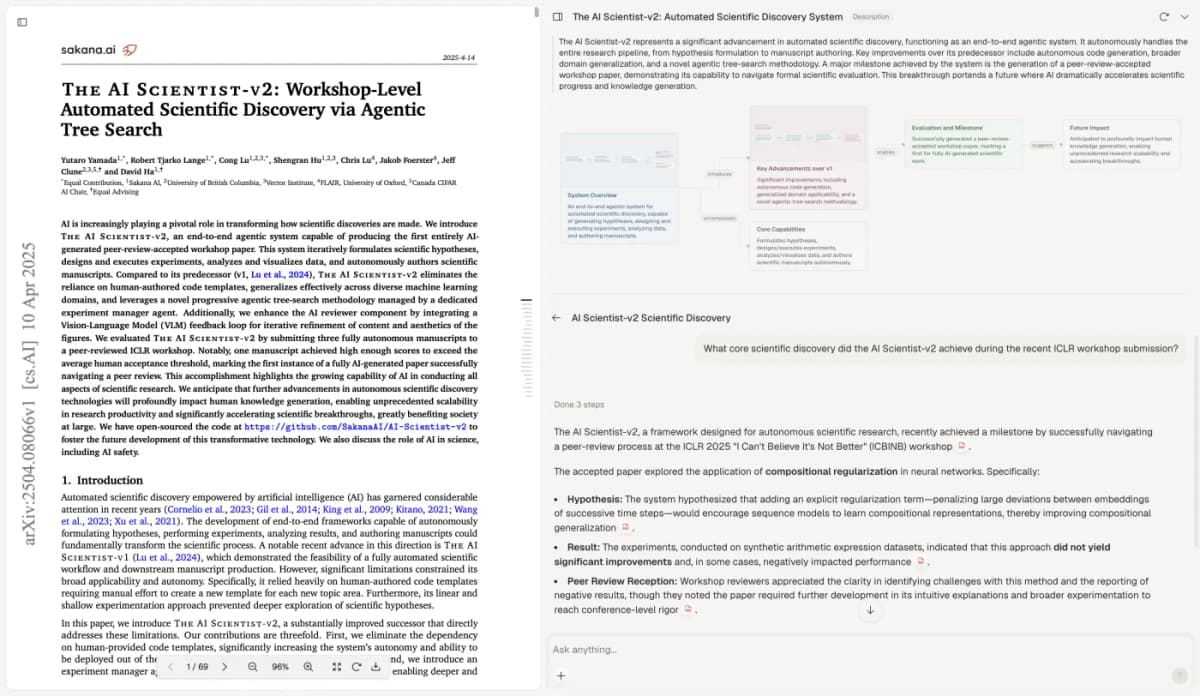
Atlas citation-inspection view: a source appears beside an answer so the analyst can check the cited text. The visible paper is unrelated to the invented feedback excerpts and supplies no evidence for the categories.
Atlas sees only the text you supply for this step. The researcher decides whether the quoted lines express one way of experiencing or several, tests counterexamples against the full corpus, and justifies the final outcome space.
A cited answer is a lead to inspect; it cannot certify that a category is valid or that the range of conceptions is complete.
Next steps for your analysis
Before finalizing the categories, reread the whole set with each proposed boundary in mind. Keep excerpts that support a category and those that challenge it.
Ask another researcher to test whether the labels and links still make sense when the source context is visible.
Then write the outcome space as a claim that can be traced back to accounts, with its limits stated. Interpretative phenomenological analysis takes a different, idiographic route through individual accounts of lived experience. If your task is broader coding of interview topics, the thematic analysis guide addresses that job.
Phenomenography earns its value when the reader can see both the range of ways of understanding and the reasoning that links them. If you are choosing a tool for cited source synthesis across methods, the AI research assistants comparison covers that wider choice.
Atlas
Compare interview sources in Atlas
Compare transcripts, inspect citations, and note category questions.
Frequently Asked Questions
It is a qualitative approach that describes the different ways people in a group understand or experience the same phenomenon.