
Outcome Harvesting: Six Steps and a Worked Outcome Statement
Learn the six steps of outcome harvesting, draft a verifiable outcome statement, and plan independent substantiation with a worked evidence log and questions.
- Byline

Summary
Outcome harvesting is a way to find changes people made and ask how a program may have helped bring them about.
A good outcome statement says who changed, what they did, when it happened, why it matters, and how the program may have helped.
The worked case keeps project claims, source checks, outside checks, and open questions apart.
Outcome harvesting begins with a change that someone made, then asks whether and how a program helped bring it about. In a fictional food-access project, a city food council's decision to publish monthly access data could be an outcome.
Running a workshop for that council is an activity. A project report can point to a change; someone outside the project still needs to check whether it happened.
The person doing the harvest can place the report, council minutes, and interview notes side by side, with each claim tied to its source. Atlas can help compare selected texts and show citations to inspect.
The person still has to ask the council and outside, knowledgeable people what changed and what else may have influenced it. That distinction follows the open method chapter and Pact's account of substantiation.

Atlas

Check outcome evidence in Atlas
Compare program sources and inspect citations before drafting.
What outcome harvesting means
An outcome in this method is a change you can check in what a person, group, or body does. The change may concern a work habit, a relationship, a rule, or an action. That person or group is the social actor.
The team starts with that change, then works backward to ask how the program may have helped. It can find planned or new changes, including harmful ones. The open method chapter explains this direction.
The project's work is distinct from the actor's change. Training a council is an activity; a council adopting a new reporting practice is a possible outcome. Nor is that change proof of an impact on residents' lives. A separate study may be needed to measure later health, income, or access effects.
The people who will use the results help frame the questions. They decide which findings matter for their work. The BetterEvaluation method guide gives six steps that may loop back. A draft claim may change after talks or outside checks.
When outcome harvesting fits
Use the approach when a program works in a changing setting and key results may not match a set target. It can track work in progress or look back after a program ends. The open method chapter describes this fit.
Start with the choice the study's users need to make. Are they learning which relationships changed, explaining unexpected results to partners, or making an accountability claim? If the aim is still broad, the evaluation questions guide shows how to tie a question to a user and a decision.
The answer affects what to collect and how much outside checking is needed. It also shapes the time window, whose changes matter, and which stakeholders should take part.
Put that choice in an evaluation plan that names the users, question, sources, dates, and reporting decision. The harvest then has a clear use and a place in the larger study.
If you need to know how much a program changed a set measure, use a study design that can make that estimate. A harvest can still add detail about who changed and how.
For a narrower cause-and-effect question about one proposed path within a case, see process tracing.
The 6 steps of outcome harvesting
The method's stages are design, draft, engage, substantiate, analyze, and support use. Their order helps, but findings can send the team back to earlier choices.
BetterEvaluation and the open method chapter describe the same structure.
The team may revise a draft after talking with the actor or hearing a new account from an outside source. The method expects that loop as the facts become clearer.
1. Design the harvest
Agree with the main users on the choice the findings will support. Write harvest questions, name the time span and actors, and plan how to learn about both changes and the program's possible role. Leave room to revise the questions as new outcomes appear. A request to prove every planned target was met calls for another or added approach.
2. Review documents and draft descriptions
Read reports, meeting records, and other material for signs that an actor changed what they do. Record the actor and a dated action. Draft why it might matter and how the program may have helped. At this point the description is preliminary. A project's own annual report may supply a lead without proving it.
3. Engage knowledgeable people
Speak with people who know the actor, program, and setting. Ask open questions that can surface changes the team did not predict. Let them correct the draft's timing, actor, and account of the program's role. Do not ask only whether they agree with a flattering statement. The open chapter describes this shared drafting step.
4. Substantiate selected outcomes
Choose the outcomes whose accuracy matters for the planned use. Ask people who know the change but are outside the program to test both the change and the claimed role. Their account may confirm, narrow, or contradict the draft.
Pact's substantiation guidance stresses that the person's independence and knowledge must be balanced in context.
5. Analyze and interpret
Group checked descriptions to answer the harvest questions, such as actor type, kind of change, or program strategy. Look for harmful and unexpected results as well as favorable ones.
Explain the proof for the program's role and other factors. Do not turn the number of harvested statements into a population impact measure.
6. Support use of the findings
Discuss what the findings imply with the users and what remains uncertain. A learning use might change a partnership approach; an accountability use may need a stronger trail of checks.
UNICEF's PBEA evaluation appendix shows how one study joined the stages with reporting and use across several countries. Other teams can set a schedule that fits their own case.
Draft a verifiable outcome statement
A useful statement names who changed, what the actor did differently, when and where, why that change matters, and how the program may have helped. The last two parts are judgments to test.
BetterEvaluation calls for a specific change, a plausible account of the program's role, and significance to someone who will use the finding.
Write the actor's changed action before the program's work. "Our team trained council members" is a project activity. "The council began publishing monthly food-access figures" is a candidate outcome.
Add the date and record that would let someone check the claim. Then name what the project did that may have influenced the choice and what other explanations need attention.
Give each part a source status: observed in an external record, reported by program staff, reported by the actor, or unverified. A cited passage shows what a document says; it does not prove the event happened.
These labels also keep an internal progress report from being treated as outside confirmation.
A worked outcome and evidence log
This made-up teaching case concerns a food-access project and a city food council. It is not a real study and makes no claim that the project caused a change.
The draft report says, "Our workshops transformed the council's policy and improved food access citywide." That wording reaches beyond what the imagined source set can support.
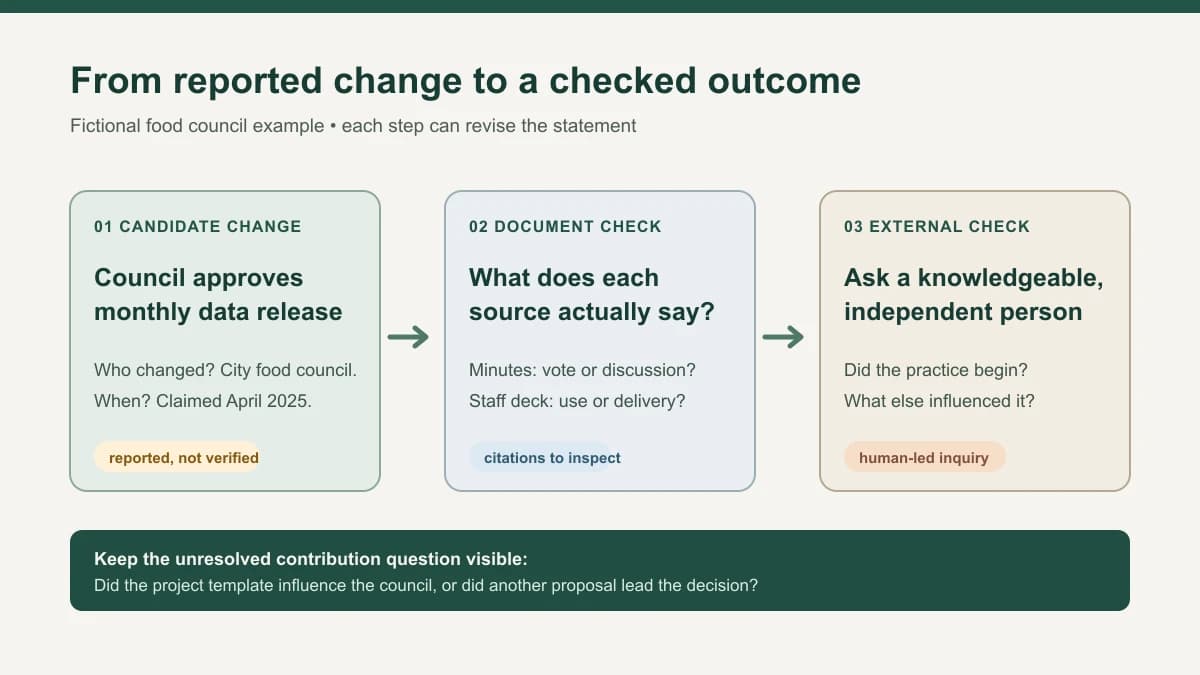
The draft becomes more exact: "In April 2025, the city food council voted to post food-access data each month. Project staff had shown a draft report form in February. The new council rule may help local groups spot gaps. We still need to check whether the rule took effect and whether the project shaped the vote."
| Claim in the draft | Retained source and status | Question before approval |
|---|---|---|
| Council approved monthly reporting in April | Fictional meeting minutes describe a vote; check the signed minutes and final policy | Did the council adopt a rule or only discuss a proposal? |
| Project staff shared a template in February | Fictional slide deck and staff report show delivery; influence remains open | Did council members use it, or was another proposal decisive? |
| Monthly figures were published | No publication record in the fictional set | Can the council website or an independent recipient confirm an actual release? |
| Better data improved food access | No resident or service measure in the fictional set | A later study would need to measure this effect. |
Table 1: This log separates the change, a possible contribution, and an alleged impact. If signed minutes show only that a pilot was proposed, revise the statement to a proposal or remove the approval claim.
If the council chose a different template without the project, narrow the account of its role. The strongest version is the one the sources can support after those corrections.
The case shows why a few clear claims can beat a long list of wins. In the open chapter's Senegal case, the team used group sessions and talks with people who knew the work. That helped them revise claims about rules and work habits. Our table is only a draft aid; it does not report that study's results.
Substantiate and revise the claim
Choose a checker with useful distance
An outside checker needs knowledge of the change and enough distance from the program to challenge its account. For the fictional council, a records officer, community group, or partner who saw the final vote might help.
Check each person's ties to the project and ask who could disagree credibly. Pact notes that the plan for this check must fit practical limits.
Ask the person what the council decided, when the practice began, who influenced it, and what documents they can identify. Ask what part of the draft statement they would change. Record contrary accounts rather than smoothing them into consensus. A council member's confirmation of a vote may still leave the intervention's influence unresolved.
Record the revision decision
After that inquiry, mark the claim as confirmed, narrowed, disputed, or unsupported. Keep the earlier wording and the reason for revision in the audit trail. If the study is for internal learning, a lighter check may be acceptable with its limits stated. For public accountability, skipping external checks makes the claim less credible; the open method chapter makes this distinction.
Next step: compare named evidence in Atlas
For the document review step, add the program report, meeting record, interview notes, and proposed statement to one Atlas project. Mention the selected sources in chat. Ask: "For each clause in this outcome statement, show what each named source supports or challenges and cite the passage. Mark any clause the documents do not establish."
This is a focused version of synthesizing research papers. The same practice of checking each source applies to evaluation records.
Open each citation and read the surrounding passage. If the answer merges a staff report with council minutes, separate their claims and fix the log. Compare the answer with what each source says, including whether the answer goes beyond the cited words. Save the corrected statement and open questions in a project note.
This workflow reduces the time spent finding inconsistencies in the supplied texts. It cannot contact the council, check a public record that you have not supplied, or decide that a witness is independent. The evaluator plans and conducts substantiation outside Atlas, then revises the note.
What the method cannot establish alone
Outcome harvesting asks whether a program helped bring about a change. It cannot show that the program was the sole cause. Other groups, new rules, funds, and local leaders may also have played a part.
Contribution analysis is a related method. It tests a program's cause-and-effect story across many sources.
The method does not measure later effects on people's lives by itself. A council rule could change without residents getting better access to food. The open method chapter keeps the actor's change apart from such later effects.
The findings can reflect who was asked and what the program chose to record. Look for harm, surprises, and clashing accounts. Say why you picked each claim for outside checks. A statement with a clear gap is more useful than one that sounds sure but cannot be checked.
Atlas
Check outcome evidence in Atlas
Compare program sources and inspect citations before drafting.
Frequently Asked Questions
It is a participatory evaluation approach that identifies observed changes in social actors, then works backward to assess the intervention's plausible contribution and the change's significance.