
Contribution Analysis: Test a Causal Story Against Evidence
Learn contribution analysis through a worked program example. Test each link in a theory of change, weigh rival causes, and write a bounded final finding.
- Byline

Summary
Contribution analysis tests whether an intervention plausibly helped produce an observed result by checking its theory of change against evidence and rival explanations.
Map the expected steps from activity to outcome, then record supporting evidence, contrary evidence, and gaps for each link.
A contribution story is a reasoned claim with stated limits; it is not proof that a program alone caused a result or an estimate of its effect size.
Contribution analysis asks whether a program helped bring about a result, and how. It starts with a proposed path from action to change.
The evaluator then checks each link against records, people’s accounts, and other possible causes.
A rise in library visits after an outreach campaign gives the evaluator a lead to test. Did the campaign reach people? Did they use the library? Did a school reading drive begin at the same time?
The UK Magenta Book calls for checking the program’s theory, what staff did, the results, and other influences.
Atlas can help compare selected texts and cite passages. The evaluator decides what the records mean for the causal claim.

Atlas

Compare program evidence in Atlas
Check cited passages across selected reports and save a review note.
What contribution analysis means
Contribution analysis tests whether a program plausibly played a part in a result. The program might be a service, policy, or campaign. The result may also reflect other people, events, and conditions.
The evaluator makes a contribution claim: an account of how the program may have helped bring about a result. The claim rests on a theory of change and records of what staff did.
It also needs proof that expected changes followed and a check of other causes. BetterEvaluation's method guide describes a reasoned claim with clear limits.
Contribution analysis alone does not tell you what share of the change a program caused. It cannot show that each person who changed did so because of the program.
Follow 6 iterative steps
The World Bank Independent Evaluation Group guidance sets out six steps across theory building and testing. Evaluators return to earlier steps as evidence changes the story. Mayne's method brief gives an earlier account.
The Magenta Book calls the result an evidence-backed line of reasoning. Its strength depends on the theory and the proof behind it.
When the approach fits
Use it when a decision needs an account of how a program may have helped. A clean experiment may be unavailable or may answer a different question. The approach can handle several actors and routes to change. It can also expose thin proof behind a hoped-for story.
The question must be narrow enough to test. “Did the outreach program increase visits among first-time users?” gives a clearer search for records. Define the outcome and period first.
- Set the cause-and-effect question. Name the intervention, outcome, people, place, and time. List what else may explain the result.
- Develop the theory of change. Show the path from activities to outputs, behavior, and outcome. State the assumptions behind each link.
- Gather existing evidence. Collect program files, monitoring records, relevant studies, and views from people affected by the program. Note what each source can and cannot establish.
- Assess the contribution claim. Ask whether the expected links occurred and where the story fails or a rival account fits better.
- Seek more evidence. Target weak links and live alternatives instead of gathering more of the same favorable material.
- Revise the story. Narrow, strengthen, or reject the claim and show how new evidence changed the judgment.
The steps form a working loop. If a log shows fewer people attended than expected, revisit the theory’s reach assumption. If a new policy changed the result at the same time, revise the rival-cause test. The checklist guides the inquiry; the evaluator draws the inference.
Draw the causal links to test
A theory of change says why the work should lead to a result. The program theory guide shows how to draft that path and its assumptions. For a library outreach project, a proposed path runs from staff visits to new cards, then to more borrowing and reading.
Staff would need to show what happened at each step. A path drawn on paper is a plan to test.
Each link poses a question. Did staff hold the visits? Did attendees learn how to sign up? Did they get cards?
Were new cardholders the people who borrowed books? Did that borrowing bear on the goal? A final count cannot answer the earlier questions.
The Magenta Book asks evaluators to test what staff did and whether the chain of results fits the theory.
Write down what would weaken each link before reading the program’s success report.
Separate outputs from outcomes
A held workshop is an output. A person getting a card may be an early outcome. More reading over time is a later outcome.
These stages need their own records. Delivery of a workshop says little on its own about the final goal.
The theory should also name conditions beyond the team’s control. A school may run its own reading drive. Library hours may change.
A new bus route may make visits easier. These factors belong in the causal picture from the start.
Work a contribution analysis example
The library, program, dates, IDs, and numbers in this example are fictional. Imagine that a town library ran outreach sessions in 2025. Its dashboard shows new cards rising from 120 to 165 between spring and autumn. The team wants to say the outreach caused the rise.
An evaluator first frames a narrower claim: “The outreach may have helped bring more first-time cardholders to the neighborhoods it visited.” The following work note tests each link. Its source IDs are invented teaching labels for this example.
| Theory link | Fictional evidence reviewed | Challenge or rival | Next check |
|---|---|---|---|
| Sessions reached residents | LO-01 calendar lists eight sessions; LO-02 sign-in sheets cover five. | Three sessions have no attendance record. A schedule is not proof of delivery. | Ask staff for missing sheets and site confirmations. |
| Residents learned how to register | LO-03 feedback forms say some attendees understood the form. | Forms came from only two sessions and self-selected respondents. | Compare with short interviews across sites. |
| Attendees obtained cards | LO-04 dashboard shows a 45-card rise across the town. | It does not link cards to attendance or neighborhoods. | Request privacy-safe matching or a targeted follow-up. |
| Cards led to more reading | LO-05 borrowing total rose in autumn. | A school reading drive began in September; a new bus route also opened. | Compare timing, groups, and borrowing patterns before claiming behavior change. |
Table 1: The table shows two gaps. Some planned sessions lack proof they happened. The card records do not show whether new members came to outreach. The town-wide rise may be real while the proposed path remains untested.
The school drive offers another account of the rise. It may have brought families to the library at the same time. The bus route might also matter. The evaluator would compare dates and groups, speak with participants, and check for changes in places the outreach reached and missed.
Revise the claim when evidence is thin
With these fictional records, the evaluator could report that staff planned sessions, at least five had sign-in sheets, and town-wide card sign-ups rose. The records do not show that outreach caused 45 more cards.
If new records later connect attendance to new cards, the claim can grow. If interviews trace most new members to the school drive, it may shrink. The matrix shows the reader what could change the finding.
Test rival explanations and gaps
A rival explanation offers another account of the same result. It may be another program, a wider trend, or a change in who was counted.
Evaluators should ask what they would expect to see if that account were the main driver.
For the fictional library, a school drive could bring a rise among school-linked homes near its start. A bus route could bring a rise among those newly served by it.
Outreach would suggest more new cards after sessions, among the people or places it reached. The evaluator must test these patterns with real records.
The World Bank guidance asks evaluators to test challenges to the claim and seek more proof where needed.
A tidy timeline cannot replace that test. A result that fits outreach may also fit another cause.
Judge the strength of each source
Ten copies of a program report all trace back to one source. Check who made each record, why, when, and from what data.
A sign-in sheet supports delivery to the people listed. It says little about later reading. An interview may explain a route to change while representing one person's view.
Where groups or settings differ, ask whether a finding travels to the decision at hand. Our external validity guide shows that separate check.
Here the focus stays on the program’s role in the result seen.
Check selected evidence with Atlas
Use the program’s selected files to check what each causal link can support:
- Add program reports, session logs, permitted interview notes, and context files to one Atlas project.
- In chat, mention the selected items with @. Ask for passages that support or challenge each link, with source IDs and gaps marked.
- Open each cited passage. Check dates, groups, and measures before placing it in the work note.
Atlas compares the text in those files and returns citations for review.
The Atlas synthesis guide covers selected-source review. The citation-checking guide shows why a cited answer still needs a human check.
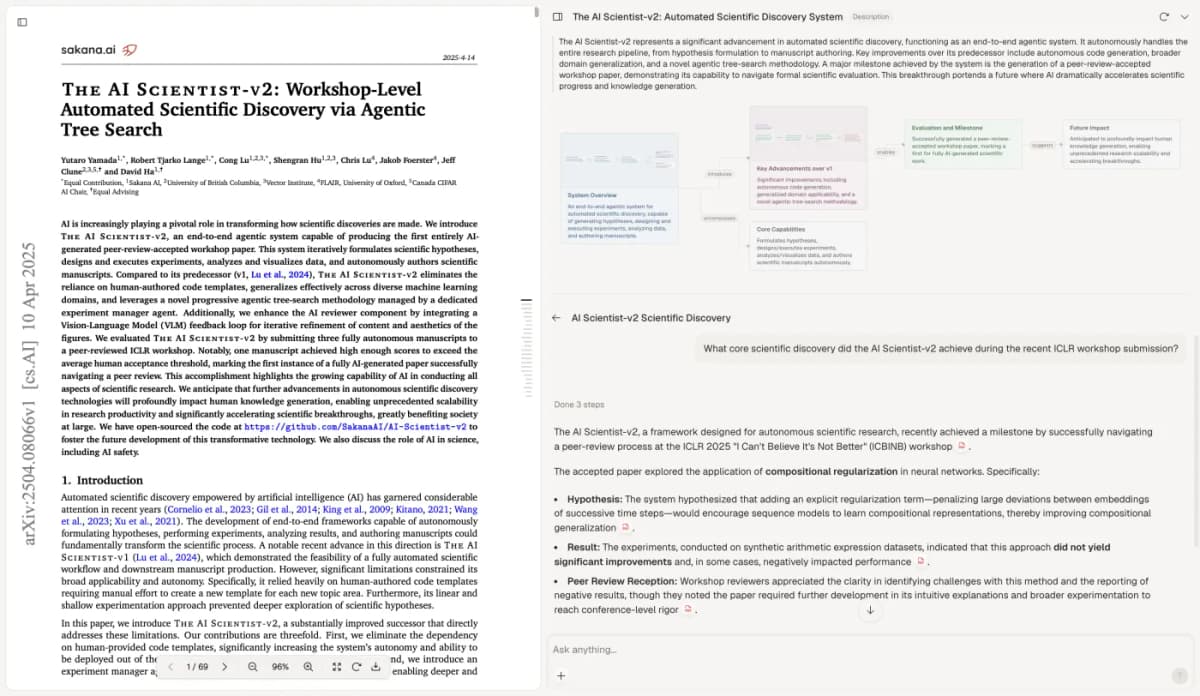
Save a corrected note with the four causal links, the best proof for and against each, and records to request next. The evaluator judges source quality and rival causes. Atlas cannot see a sheet that was never added or infer cause from a matching trend.
Write a bounded contribution story
A useful conclusion tells the reader what happened, why the program might matter, what else could explain the result, and what remains open.
For the fictional library, a draft might say: “New card sign-ups rose during the outreach period. Records show at least five sessions took place, but do not link attendees to new cards. A school reading drive and new bus route began near the same time. Outreach may have helped, but these records cannot yet show how much.”
That conclusion can change. Records that connect session attendance to new cards would strengthen one link.
A rise that began before sessions, or only in school-linked homes, would weaken another. The write-up should make these tests clear.
The Magenta Book cautions that the approach supports a reasoned level of confidence. It cannot give final proof of cause on its own.
Its strength is a clear account of the theory, proof, and other causes. The evaluator makes the final judgment and decides when more data are needed.
Atlas
Compare program evidence in Atlas
Check cited passages across selected reports and save a review note.
Frequently Asked Questions
It is an evaluation approach that tests whether an intervention plausibly contributed to an observed outcome by examining its theory of change, evidence for the causal links, and alternative explanations.