

A learning agenda is a plan for answering the questions a team needs to resolve before it acts. It links priority questions with the work needed to answer them and the people who will use the findings. A list of topics becomes useful when the team can say what an answer might change.
Suppose a program has past study reports, a plan, and a long list of questions. Which gap should it tackle first? Link each question to what is known, a choice the team needs to make, and someone who needs the answer. Mark questions that still need the team's agreement as drafts.

Build your learning-question table in Atlas
Compare plans and evaluations, then save checked questions for team review.
What belongs in a learning agenda
A working agenda sets out questions, why they matter, how to answer them, and how to use the findings. It may cover one program, a whole agency, or a group of projects. The GSA development guide uses priority questions to guide evidence work. One broad question may need several studies.
An agenda for a group of projects helps choose what to study across them. It might ask which forms of support work best in which places. An evaluation plan then sets out the methods, data, staff roles, and reports for one study that helps answer that question.
The term has other uses too. The Public Health Learning Agenda toolkit focuses on learning for systems change: how teams and partners can move toward a shared future. A personal learning plan might list skills and courses. Check that a template fits your task before you use it.
Start with decisions and existing evidence
Ask the people who will use the findings what choices they face. A program director may need to choose whether to extend a service. Staff may need to change how people enter it. They may need to know different things, even when they share a goal.
Gather sources that show what the team knows. These might include past study reports, plans, progress notes, and concerns raised by staff or service users. MSH's learning guidance starts with a scan of past work or a check of current needs. It links the questions that emerge to how the answers will be used.
For each source, note its finding and its limits. A report may show that more people joined, but leave their later outcomes unknown. A result from one site may not answer a question about another group. During a literature review, keep those limits with each finding so a partial answer does not appear to close the gap.
Separate three kinds of uncertainty
Missing evidence means the sources you have do not answer the question. Say “These reports do not track what happens after people leave,” rather than “No one has studied this.” The second claim needs a much wider search.
Conflicting evidence means sources disagree, so keep both findings visible while you check who was studied, when, and what was measured. The gap between the results may lead to a question about why a program works in one place but not another.
An unclear use for findings needs a talk with the person who will act on them. If nobody can say how an answer might change a choice, more research may leave the team with facts it has no use for yet.
Turn knowledge gaps into learning questions
Write the question so the team can say what would help answer it. A goal such as “How can we improve our program?” gives little guidance on what to study. “What stops people from completing the program?” points to a gap in what you know while leaving room for several causes and ways to study them.
Then add a sentence about its use: “The delivery lead will use the findings to choose which barriers to address at intake.” This tests whether the question connects to action while leaving the answer open.
The Innovation Network template links shared questions to strategy and choices about what to do. This helps when people disagree about the problem. Discuss their views before settling on words that might hide the split.
Keep assumptions open to revision
“Why does our successful mentoring model improve retention?” assumes the model worked and caused a change. To ask about people's experience, try “How do people who use the program and its staff describe the role of mentoring in staying enrolled?” Their accounts can help explain that role, though they alone would not prove an effect.
If the team needs to know the size of an effect, ask that and have an evaluator assess the study design it needs. A question can matter a great deal while the data you have cannot answer it.
For a proposed service, concept testing questions can explore how people understand the idea and where it fits their routines, while leaving later use unproven.
The guide to evaluation questions explains how to match a study's purpose with questions it can address.
Work through a learning agenda example
The GSA sample section uses a fictional agency that wants to reduce litter. It links that goal to a question about signs, a plan to roll them out in stages, data sources, and issues the study must address.
The notes in the margin show how the goal gives rise to a question and how the planned work would address it. The final paragraphs state the limits the team would need to address. The page explains a plan for testing signs without reporting that they worked.
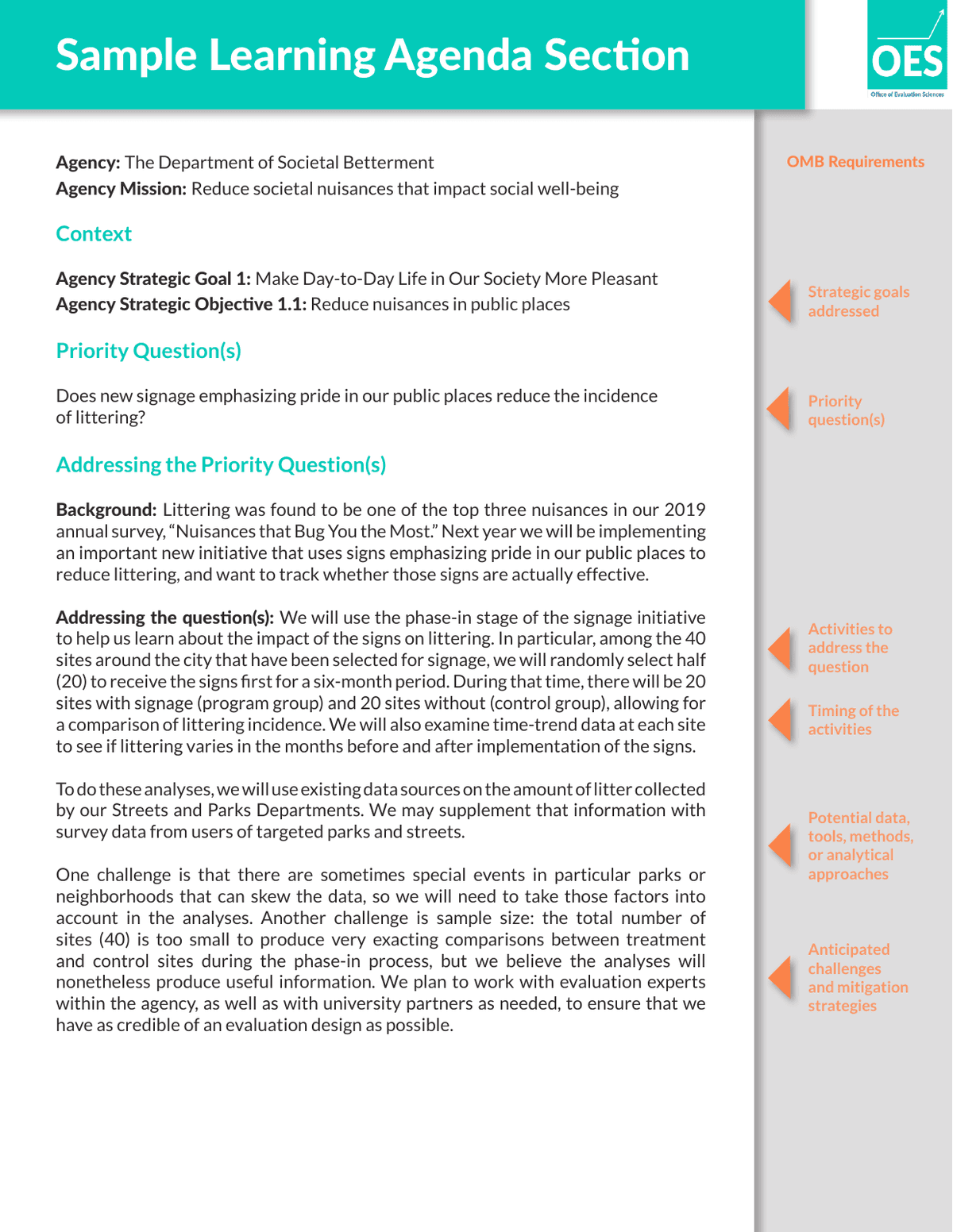
The sample shows the question, the planned work, and the issues the team would need to address on one page.
Build a source-linked priority table
Now consider a hypothetical job-support program. Imagine that a past report tracks attendance, a plan calls for growth, and a partner memo asks what happens after people leave. These invented sources let us work through a draft agenda.
Keep each question beside the source that gave rise to it while the team chooses what to work on first.
| Proposed learning question | Evidence and remaining uncertainty | Decision owner and possible use | Proposed next action |
|---|---|---|---|
| What prevents participants from completing the program? | The imagined prior report covers attendance; it does not explain non-completion. | Delivery lead could revise the intake and support process. | Check available completion records and consult participants about barriers. |
| What happens after participants leave? | The imagined partner memo raises retention concerns; the prior report ends at attendance. | Program director needs evidence before promising lasting outcomes. | Define the follow-up outcome and assess feasible data access. |
| Which locations are ready for expansion? | The imagined plan favors expansion; the partner memo describes uneven local support. | Portfolio lead must decide where additional delivery is viable. | Compare the basis of the expansion claim with local capacity evidence. |
Table 1: The rows show what is known and what is still open, so the team can choose the work each question needs.
For real sources, use a title and checked passage. A detail that is not reported may still have occurred.
The attendance report tells the team who took part. It cannot show what happened after people left. If a draft says “The evaluation proves the program produces lasting employment,” correct that claim before using it to support growth.
The growth plan and the memo about local support raise another issue. Should the team check which sites are ready before it expands? Or is another question more urgent? Keep the disagreement in the table until the team makes that choice.
Prioritize questions with the people affected
Review questions with the people who need answers, staff who run the work, and those affected by it. MSH's guidance includes stakeholder review. Source comparison prepares that discussion; it cannot replace participation.
Ask four questions about each candidate:
- Use: Who would act on the answer, and what could change?
- Timing: When must they act, and could useful findings arrive first?
- Feasibility: What sources and skills do we have, and what else would we need?
- Consequences: Whose needs and views should shape the question and how we read the answer?
These discussion prompts are not a tested scale. If the team scores questions, keep the reasons beside the numbers.
Agree on what comes first
In the hypothetical program, the delivery lead might focus first on why people leave because intake is about to change. The director might need follow-up data before choosing whether to expand. Record both reasons. The people with that authority must agree on what comes first and who has time to do it.
Keep questions set aside in a separate list with a reason. A question may matter even when the team lacks the data, time, or support to tackle it now. Return to it when those conditions change.
Prepare the source comparison in Atlas
Select the sources and ask
Use Atlas to compare the selected plans and reports before the team meets. Put the sources in one project, open a chat, and type @ to select the items to compare. Choose Project only to use project sources without new web or literature search.
Ask a bounded question:
Compare these plans and reports. For each draft learning question, list the choice it could inform, what the sources say, the gap or disagreement, and a citation to the passage. Keep source statements apart from draft questions. Mark an unnamed decision owner as unresolved.
Check citations and save the note
Open the numbered citation beside each key claim. Read the passage and nearby text to check who was studied, when, what was measured, and what limits apply. A draft may reach beyond the source even when it points to the right paper.
If a draft row turns an attendance finding into a claim about later outcomes, ask Atlas to separate the measured result from the open question. Correct the row to say what the source measured. When two sources seem to disagree, open both citations and check their findings side by side.
Use New, then Note, to keep the checked table with its source links and open questions. Add the priority and owner after the team approves them. Wait for Saved before closing the note. When a new study or plan arrives, return to the note to see which gaps it helps fill.
Put the agenda into use
For each approved question, name a lead, next task, deadline, and intended user. The GSA development guide distinguishes broad questions from the activities needed to answer them.
Choose those tasks with someone who knows the methods they need. An interview can help explain a person's experience. When the gap concerns how staff put a practice into routine use, implementation research examines delivery, support, and the conditions that help or hinder use. A claim about a program's effect needs a design that can support it.
State what access, consent, staff time, and skills the work requires. Keep its limits in the plan.
MSH's guidance links questions with ways to share findings and calls for regular review. Name the audience and the form they need. A director may need a policy memo comparing options before a vote, while staff may need a discussion of how to change their work.
Review a question when findings arrive, the choice changes, or the gap no longer matters. Note what was learned, what is still open, and what action followed. In the hypothetical program, a study of why people leave might settle one issue but reveal another to add to the next agenda.
Build your learning-question table in Atlas
Compare plans and evaluations, then save checked questions for team review.