

A policy memo helps a specific reader grasp an issue, compare choices, or decide what to do. Start by naming that reader and the choice they face. Link the main point to checked facts, explain trade-offs, and state the next step.
The plan below keeps the question, options, sources, and gaps together. It includes a hypothetical library-hours example and an original government memo. Neither supplies evidence for your own policy choice.

Connect your policy options to evidence
Compare checked sources and save a memo plan for expert review.
What decision does a policy memo support?
A memo may brief a reader, compare options, or propose an action. MIT's Broad CommLab guide sets out these uses. A memo can also pass on a choice already made. Check which job you have been asked to do before you draft.
For a recommendation memo, state the proposed action early. Give the reader enough context to assess it, then explain the evidence and trade-offs. Boston University's overview places essential information first.
The main claim should survive a quick skim of the headings and opening sentences.
There is no single length for every reader. MIT's guide targets one page. In a 2022 HKS practitioner interview, Mike Firestone described a preference for about two pages. Follow your recipient's or course's rules and keep detailed support in permitted attachments.
Define the reader, question, and constraints
A broad topic is not yet a decision question. “Library access” names a subject. “Should the library change its evening hours next term?” names a choice, although it still needs a deadline and scope.
Check what the reader can decide
Name the reader's role and power to act. Can they approve a pilot, change staff hours, fund a service, or only pass advice to someone else? Your request should fit that role.
The Chicago Harris memo guide, pages 2–4, starts with the client's question. It distinguishes questions about what is happening, whether a policy is working, and what to do next.
Those jobs need different evidence. A clear description of a problem alone may not justify a new intervention.
Before drafting, write down the reader, the question, the deadline, the relevant place or population, and the allowed length. Add any required review route. This short scope note prevents a memo about one local choice from expanding into a general essay.
Set the evidence boundary
List what you need to check and which sources can answer each part. For the library example, that might mean dated usage records, staff schedules, access needs, local rules, and available funds. These are source types to collect, not facts established by this article.
Keep the source date and the period it describes. A recent webpage can still cite old data. When rules or plans have changed, compare the documents and record the exact version used.
Mark a missing record as a gap rather than fill it with a guess.
Compare options against the same evidence
Choose criteria before favoring an option. Readers need to see what “better” means for this decision: more access, workable staffing, manageable cost, or another stated aim. Some aims conflict. The memo should show the conflict.
Separate facts from judgments
A checked count tells you what happened within its scope. Calling that count “too low” adds a judgment. A forecast of demand under new hours adds an assumption. Keep these kinds of claims distinct so the reader can check each one.
Use the same criteria, or standards for judging, for all serious options. If you need help setting them, the policy analysis framework guide covers that prior task. The memo then explains the result in the space your reader has allowed.
Do not give one option detailed costs and another only hoped-for benefits. If evidence differs, say so. MIT's policy memo guidance calls for the pros, cons, and context needed to select among options.
Keep uncertainty visible alongside that comparison.
Work a hypothetical library-hours plan
Suppose a library director must decide whether to change evening hours next term. This is a hypothetical plan. It contains no usage results, budget estimate, or preferred option. It asks how each choice would affect access, staff needs, and cost.
| Option | Question against shared criteria | Evidence still needed |
|---|---|---|
| Keep current hours | Which access needs remain unmet, and what does the present schedule require? | Checked usage records, unmet-needs evidence, current staffing and cost |
| Shift existing staff hours | Would a new schedule improve access while preserving other services? | Staff availability, affected services, applicable rules and cost changes |
| Pilot longer evening hours | Could a bounded trial meet demand within agreed limits? | Pilot scope, authorized funding, staff coverage and review measures |
Table 1: The table is a research plan, not a completed evaluation. It gives each option a fair question and names the evidence needed to answer it.
A pilot is not automatically the best choice; it also needs authority, staff, funds, and a reason to expect useful learning.
Once sources are checked, add the supported answer and its locator to each option's working record. Use a source-checking process to catch claims that go beyond a passage. Keep a separate field for the analyst's judgment and who must review it.
Draft the recommendation and next action
Write the opening after you have enough evidence to support it. State the proposed action, the main reason, and the most important limit. If the evidence cannot yet support a choice, say what must be checked and who should check it.
Put the requested action in plain words
The Harris guide, pages 5–8, connects findings to recommendations and feasible next steps.
Specify who would do what and why. Add timing and conditions when you have a basis for them; do not invent a cost or deadline to make the plan look complete.
A library memo might request permission to assess staffing before proposing a trial. That is a narrower decision than approval to change hours. Make that boundary clear. The conclusion should not quietly ask for more than the opening promised.
Give headings that state useful points. A section called “Staff coverage remains unresolved” tells the reader more than “Discussion.” BU's writing guidance also recommends topic sentences that convey each paragraph's main point.
Keep the full source trail available without making the reader reconstruct the argument from references.
Read an original approval request
The source memo below shows a narrow request. Nancy J. Risque's June 25, 1987 cover memo asks the President to approve sending an attached memo to the U.S. delegation. Its issue, background, discussion, and recommendation lead to choices to approve, disapprove, or modify.
Use it to study how the request works, not as current ozone policy guidance.
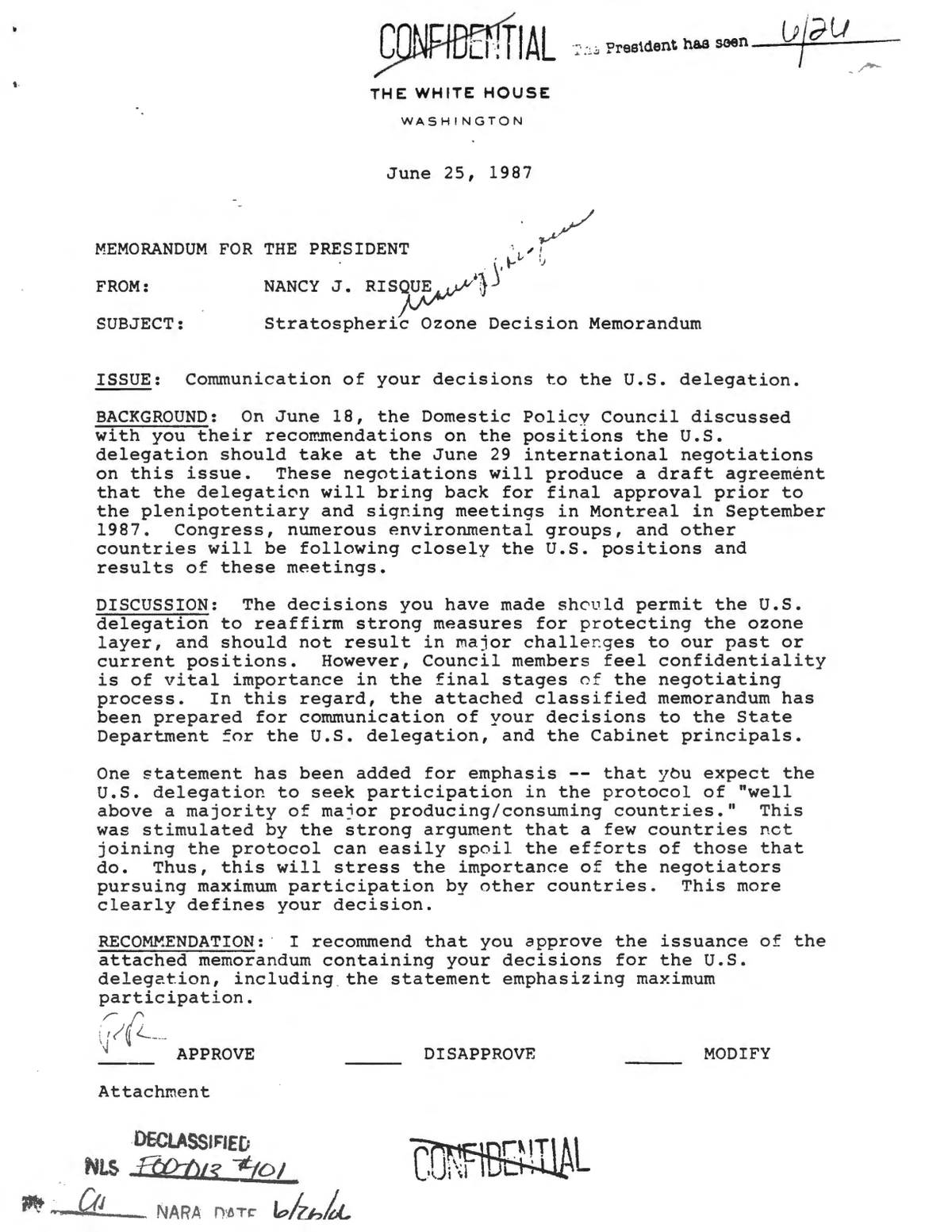
Original White House cover memo, Reagan Library, PDF page 46. Full-page source capture; no added annotations.
The cover memo asks to send orders based on choices already made. The attached presidential memo on the State Department website tells the team what to seek in talks. Neither memo compares all options in one page.
The HKS student review of that presidential memo discusses its directive role. For your memo, confirm whether the reader needs advice, a choice, approval to act, or a record of a decision. That purpose controls what the evidence and closing must establish.
Check currency, trade-offs, and limits
Check source evidence before sending the memo. Read key passages, check dates and scope, and trace each number. A source about a different place or time may add context yet fail to answer your local question. Explain that limit rather than treating the source as a direct forecast.
State the strongest supported objection to the proposed action. Show what would change your recommendation: a missing cost, an authority limit, weak demand evidence, or an effect on another service.
The Harris guide treats a memo as an answer to a client's practical question, so keep that question in view during revision.
Ask experts to check current law, local power to act, costs, and what the next step needs. Old memos can teach structure; they cannot prove that a plan meets today's rules. Atlas cannot approve the plan or make the policy choice.
Before release, check that the start and end request the same action. Options need shared criteria, key claims need sources, and assumptions need clear labels. Name who acts next. Remove any claim of an outcome the evidence cannot support. A reader should be able to tell a fact from a judgment or an open question.
Save a checked policy memo in Atlas
Use Atlas to compare sources you may use and keep a working plan. Start with checked inputs; this step still needs expert review. The research synthesis guide explains how to draw claims from more than one source.
- Add the sources to one project and wait for processing to finish. Include current rules, relevant findings, and checked local records you may use.
- In chat, type
@and select the sources to compare. Give the reader, decision question, scope, and agreed criteria. - Ask for cited evidence under each option. Open the citations and inspect the passages. Correct unsupported claims and label assumptions and gaps.
- Select New, then Note, keep the checked plan, and wait for Saved. Give it to the responsible policy reviewer before drafting final advice.
Try this request: “Using @selected sources, build a policy memo plan for this reader and decision question. For each option, separate source facts, assumptions, and missing evidence against these criteria. Cite supporting passages. Leave value judgments and the policy choice for expert review.”
Connect your policy options to evidence
Compare checked sources and save a memo plan for expert review.