

A policy analysis framework helps you compare ways to address a problem. It guides you to define the problem, find options, check sources, and explain the tradeoffs behind your choice.
For a public health choice, start with CDC's Policy Analytical Framework. It considers health impact, feasibility, and economic and budgetary effects. Keep a source matrix beside your ratings to show what supports them, what is unknown, and where you have made a judgment.
The worked example builds that matrix from a defined source set. It keeps conflicting accounts and missing costs visible so a reviewer can see what needs checking before choosing an option.

Compare policy evidence in Atlas
Compare selected policy sources and check the passages behind each option.
Choose a framework for your decision
Choose among options
First decide whether you need to choose among options or understand how a policy works. CDC's framework suits a public health options choice. The Eightfold Path by Bardach and Patashnik offers a broader approach. Its publisher-hosted chapter describes how earlier judgments may change as you learn more about the problem.
The CDC diagram places policy analysis after defining the problem and before developing a strategy. Stakeholder engagement and education sit at the center, with evaluation around the stages. The matrix below supports the analysis stage. Putting a chosen policy into effect needs further work.
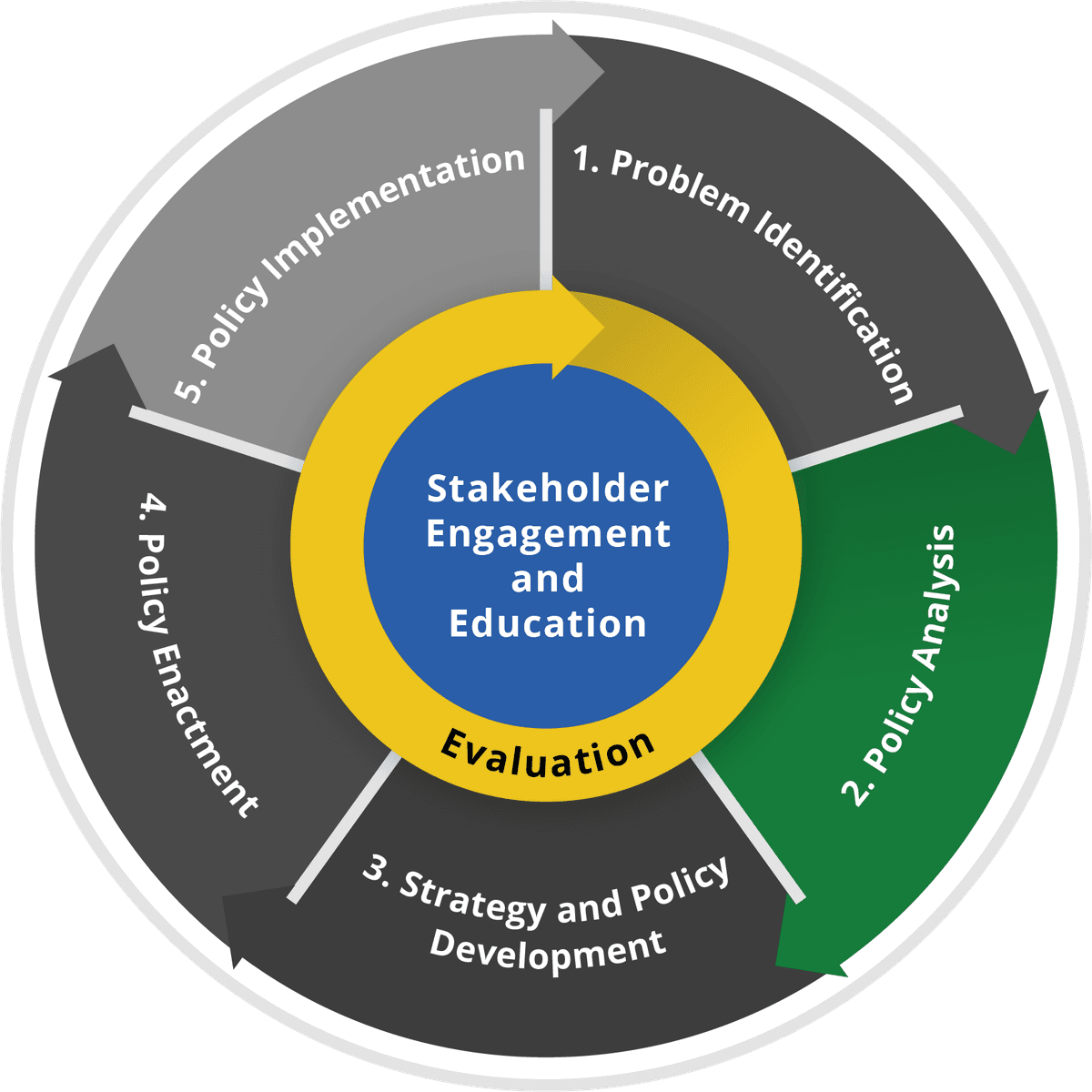
This diagram developed by CDC highlights policy analysis in green within the wider process and is available free from the agency. Its use does not imply endorsement of Atlas by CDC, HHS, or the US government.
Understand policy context
If you need to know who shaped a policy or why delivery differs from the text, consider a contextual lens. The Child Health Task Force resource uses context, content, process, and actors. It helps frame a question such as why an approved access policy failed to reach some residents. Define the question before choosing a table.
Define the problem and evidence boundary
State the problem, affected group, place, and outcome. Leave room to compare options before choosing a response.
"The district needs evening clinics" already favors a solution. "Residents who work during clinic hours report trouble attending" leaves room to compare longer hours, booking changes, transport support, or other responses. You still need evidence of the size and nature of the access problem.
Before reading for option-specific claims, record:
- Decision owner: Who can authorize or recommend a change?
- Population and location: Whose experience is represented, and whose is missing?
- Time horizon: Are you comparing a short pilot or an ongoing service?
- Alternatives: What would each option change, and what would happen without a new policy?
- Source boundary: Which reports, policy texts, interviews, and cost documents are included?
A source boundary tells the reviewer what you read. It does not prove that you found every source you need. If a report refers to an earlier study you do not have, record it as a follow-up. Read that study before adopting its conclusion.
The Berkeley toolkit asks analysts to set their wider goals and read the policy text. A summary can help you find an option. The rules about who qualifies and who must deliver it may change what that option means in practice.
Set criteria before rating options
Write down what counts as a good result under each criterion. Explain a phrase such as "high feasibility" so someone else can apply it.
Define each criterion
For the clinic example, the questions might be:
- Health impact: What links better access to the health outcome you want? More visits may be a step toward that outcome rather than the outcome itself.
- Feasibility: Can the team deliver the service with its staff, facilities, authority, and time?
- Economic and budgetary effects: What resources does the option need, who pays, and which costs are missing?
These questions adapt CDC's criteria to the teaching example. Record your own changes. A formal scoring tool would need evidence that it suits the task.
Check how gains and burdens differ across groups. An option that helps people with standard work hours may exclude shift workers, carers, or those who cannot reach the clinic. Learn which groups need a say through local inquiry.
Distinguish ratings and weights
Keep three choices distinct when you assess an option:
- A criterion says what you assess, such as staffing feasibility.
- A rating records your assessment of an option under that criterion.
- A weight expresses how much the decision values that criterion relative to the others.
New facts can change a rating. A shift in goals can change a weight even when the facts stay the same. CDC's ranking guidance explains why judgments and local context matter.
Worked policy analysis framework example
A clinic team could compare three responses to access problems: keep the current hours, open later, or pilot a new booking process. The clinic, documents, statements, and locators in this example are fictional teaching material. Use your own checked sources before assessing a real service. This teaching packet contains three invented documents:
- Access review, section 2: Some interviewed residents describe difficulty attending during working hours. The review does not measure health effects or include everyone who uses the service.
- Operations note, paragraph 4: The manager proposes using existing staff for evening sessions. A later paragraph records the rota lead's concern that current coverage leaves no spare evening capacity.
- Pilot proposal, cost appendix: A revised appointment process has an initial setup estimate. Recurring administration and evaluation costs are absent.
Use the same criteria across all three options, and keep the evidence gap visible beside the relevant claim.
| Option | Impact evidence | Feasibility evidence | Cost evidence | Follow-up before assessment |
|---|---|---|---|---|
| Current schedule | Access review §2 reports a barrier without measuring health outcomes | Existing arrangement operates with no assessment of improvement capacity | Current expenditure baseline missing | Obtain baseline costs and attendance data |
| Evening opening | Access review §2 suggests a possible fit for some interviewees | Operations note ¶4 proposes staffing that the rota account disputes | Overtime and facility costs missing | Reconcile staffing accounts and estimate recurring costs |
| Appointment-process pilot | Pilot proposal describes an intended but untested access benefit | Implementation responsibilities partly described | Cost appendix covers initial implementation only | Confirm responsibilities, ongoing costs, and an evaluation plan |
Table 1: The matrix holds source claims and open questions. A missing effect stays unknown, rather than becoming a score of zero.
The staffing dispute changes the next step. The manager's proposal alone cannot support a claim that evening opening needs no extra staff. Keep both accounts until the team checks them against the rota and service needs.
The cost gap needs a different check. A low setup estimate does not show the total cost of running the pilot. When real figures are available, keep the scope of each estimate beside its amount.
Document judgments and test tradeoffs
Assess each option using checked sources and input from experts, affected community members, and resource managers, as CDC's policy-analysis guidance recommends. Rankings also depend on judgment and local context.
For a material assessment, preserve a short chain of reasoning:
Evidence: The access review reports trouble attending during work hours. Assumption: Those accounts describe a barrier that the planned service may address. Judgment: Longer hours merit a closer look, with health effects and staffing still unknown. Next check: Check visit patterns and resolve the staffing dispute.
This supports further inquiry. It does not show that opening later will improve health or fit the current budget.
Define low, medium, and high before you rate an option. Use "unknown" when sources cannot support a rating. Record who gave the rating, which passage informed it, and why it applies here.
Ask what could reverse the choice. Would it change if ongoing costs rose, fewer people took part, or delivery took longer? Once estimates exist, someone with the right skills can test how plausible changes affect the ranking.
Explain when one concern affects two criteria. A staff shortage may affect both cost and feasibility. Counting it twice could give it extra weight, so let the decision owner review how you counted it.
Check the evidence matrix in Atlas
Atlas can compare selected sources for you to check before scoring options. For the adjacent reading task, see AI policy analysis. Use a research paper organizer approach to keep the source versions behind each assessment.
- Add permitted sources to one project and wait for processing to finish.
- Open a new chat, type @ in Ask a question, and select the source items.
- Choose Project only to keep new retrieval in the project. Earlier conversation context can contain outside sources, which is why a new chat is useful.
- Ask for a bounded comparison using a prompt like this:
Compare the selected policy sources for the current schedule, evening opening, and appointment-process pilot. Use health impact, feasibility, and economic and budgetary effects as columns. For each claim, name the source and include a supporting citation. Keep disagreements and missing evidence visible. Do not assign ratings, weights, or a recommendation.
Treat the answer as a draft. Open each key claim's citation and read the nearby text. If it opens only the source item, find the right section yourself.
Apply five checks to each row:
- Does the citation open the intended document?
- Does the passage support the wording in the row?
- Does the row preserve the population, setting, time period, and qualifications?
- Does another selected source contradict or narrow the claim?
- Is the evidence ready for assessment, or does it still need a named follow-up?
In the fictional example, "existing staff can cover evenings" needs correction. Find both accounts in the operations note and ask Atlas to show the dispute. Select New, then Note, to save the checked matrix and open questions. Wait for Saved before closing. Revisit affected rows when a new source arrives. A research synthesis workflow helps when the packet contains several studies.
Write a recommendation others can check
Explain why you prefer an option under the stated criteria and conditions. Show the sources and assumptions so the decision owner can challenge your reasoning.
Include the question, options, source set, criteria, judgments, and open questions. Name any gap that could change the choice. A team may be ready to approve a cost study while still lacking grounds to choose a service model.
Name who must deliver the policy and how the team will check its results. Approval alone does not show that delivery will follow. Give the next action an owner, conditions to meet, and findings that would trigger review.
Before handoff, check the source for each key claim and the reason for each rating. Keep legal advice, cost calculations, community input, and final judgments with the people in charge of them. Berkeley's policy toolkit can help frame the goals and groups involved in that review.
Compare policy evidence in Atlas
Compare selected policy sources and check the passages behind each option.