

The SPICE framework helps you turn a broad service topic into a focused research question. Its five elements are Setting, Perspective, Intervention, Comparison, and Evaluation. Use them to state where the question applies, whose view matters, what you are studying, any alternative, and what you need to learn.
This guide builds a made-up museum-service question and checks what could answer it. A filled worksheet is a plan for a question, not a study result. Atlas can help you read and compare named sources; researchers choose the final question and methods.

Check question sources in Atlas
Compare a proposed SPICE question with named methods and service documents.
What the SPICE framework means
SPICE makes the parts of a question explicit. Setting asks where the issue occurs, while Perspective asks for whom or from whose view. Intervention names the service or action, Comparison names any relevant alternative, and Evaluation states what result or experience you want to examine.
Andrew Booth's original paper explains the framework in evidence-based information practice. It splits the place from the stakeholder view and allows a broad account of results. The paper proposes a way to frame questions. It does not show that the acronym is a tested measure of question quality.
The NCCMT methods summary sets out the same five prompts. A school, library, or service question may need to keep context and stakeholder view distinct. The people who run a service and those who use it may have different questions about what counts as success.
SPICE is one way to frame a question. It does not decide how to sample, gather data, assess studies, or analyse findings. GCU's framework guide presents it beside other question frameworks. Choose the approach that fits the job, rather than reshape a useful question just to fill every box. If you have several candidate questions, our learning agenda guide shows how to connect priorities with the decisions their answers could inform.
Separate the setting from the perspective
Begin with the decision or uncertainty that led to the study. For a fictional museum team, the concern might be that visitors ask staff about booking after reading an online guide.
That is a starting topic. It does not yet state whose experience you need or which part of booking you will examine.
Define the setting before broadening the claim. You might focus on online booking for adult workshops at one museum during the autumn term. Keep school trips, walk-in tickets, and other sites outside the plan unless the question needs them.
This makes clear which texts and accounts could be useful.
Then name the perspective: first-time users may explain how they read the guide, while staff may describe common questions. Covidence's SPICE guide treats perspective as the stakeholder viewpoint, so keep these useful but distinct views clear.
Do not use staff views in place of a question about users just because staff notes are easier to obtain.
Describe the service or issue without assuming its effect. “An online booking guide” names something to study. “A guide that improves attendance” builds a result into the wording before you have tested it. Keep the result as a question so the eventual evidence can support, qualify, or challenge your expectation.
Build a fictional service question worksheet
The worksheet below is original, made-up planning material. It describes a museum booking-support question with no data collected, rather than a real service or tested effect.
Each row names an element and a boundary that stops the question from growing into several studies at once.
Use the evidence-needs column to find gaps in your plan. A service document may define how booking should work; it cannot tell you by itself what users think or do. Your real worksheet should name sources you can use and the further research needed. Do not imply that all the support exists.
| SPICE element | Fictional question choice | Scope boundary | Evidence needed |
|---|---|---|---|
| Setting | Online booking for adult workshops at one museum. | Autumn term; exclude school visits and walk-in tickets. | Current service scope and booking documents. |
| Perspective | First-time visitors trying to book a workshop. | Visitor view; staff accounts are separate context. | Suitable visitor accounts or observed tasks. |
| Intervention | The current online booking guide. | Name the guide version and relevant booking steps. | Guide text and evidence of how it is used. |
| Comparison | No direct comparison in this exploratory question. | Do not infer superiority over another guide. | Record the absent comparison in the plan. |
| Evaluation | How visitors describe finding booking requirements and next steps. | Experience and understanding, not attendance effects. | Accounts and task evidence suited to that question. |
Table 1: Fictional SPICE worksheet: question choices and evidence needs are proposed, with no study findings asserted.
A resulting question could ask how first-time users of the museum's online guide describe finding workshop booking details and next steps.
The term and service boundary remain in the plan even if the final sentence is shorter. Keep the full worksheet with the question so others can check the scope.
For a qualitative question, some guides adapt Intervention to an area or phenomenon of interest. TERC's meta-synthesis guide uses this form in its worksheet.
Say which form you use, and check that the terms fit your field and the kind of research you plan.
Check comparison and evaluation fit
Use two criteria to review the question: whether it needs an alternative to compare and whether the planned work can assess the result sought. These are checks for this worksheet, not a tested scoring method. They help reveal a mismatch between a question that sounds clear and a plan that cannot answer it.
Consider comparison even when it is absent; GCU's guide asks what comparison exists, if any.
A question about experience can record no direct comparison. To ask whether one guide works better than another, you need a plan that can assess both, since filling the C box does not provide that support.
Now check Evaluation: do you want to understand experience, describe a process, assess a result, or test an effect? TERC's activity includes experiences among possible concerns. State what you need to know, since the answer may involve what people think or do rather than end in a score.
The team in our example might first ask whether its guide leads to more visits. Accounts of finding booking details cannot prove that effect. Change the question to ask how users describe finding those details. If more visits remain the real priority, keep that priority and work with a researcher on a suitable design. The new question will not answer the old one.
This matters beyond the worksheet. A story about why a service might help is not proof that it does help. Our process tracing guide examines how causal claims need support suited to the claim. SPICE can expose the parts of a question while leaving the choice of methods open.
Plan what could answer the question
Match each part of the question to what a source can show. A policy can define the intended process, and a guide can show the written instructions. Staff notes can describe reported enquiries, while visitor accounts can describe experience. Keep these roles distinct when deciding which evidence is available and which still needs to be gathered.
For a literature review, the question helps shape the search scope and the rules for choosing studies. UTC's synthesis guide treats framing as one step before search, study checks, and synthesis. Filling SPICE does not complete those later tasks.
Plan them in their own right, with a record of how you carry them out.
Use the worksheet as a source of possible search concepts, then check actual language in relevant records. You may find different names for the same service or experience. Keep a record of the terms you try and the decisions you make.
A long question should not become an untested rule that every record must contain every word.
For new field research, check access, permissions, privacy, and feasibility with the people responsible for the study. Question clarity cannot solve missing access or a mismatch between the people available and the perspective you need.
If the evidence plan changes, review the question again before making a claim about what the study can answer.
Our research synthesis guide covers connecting claims across papers once suitable sources have been selected. Keep appraisal and interpretation in the plan as well as retrieval. Finding a paper with the right terms does not establish that its methods or context support your eventual answer.
Check question sources in Atlas
Use methods papers and service texts that you are allowed to process in the tool. For the example planning task, that might mean a SPICE source, the guide text, and a service scope note. Do not upload restricted user data or assume that a policy shows what users experience.
Open the project and mention the chosen items with @. State the question and the element you want to check. Choose Project only to prevent new web or literature searches; earlier chat context remains available.
Judge the response against the named sources, including any limits in the text it cites.
Ask Atlas to map the draft question to the five elements and cite support for their meaning. For example: "Check this question against the named methods and scope notes. Mark the five SPICE elements. Flag any wording that claims more than these sources show." Treat the mapping as a draft to check.
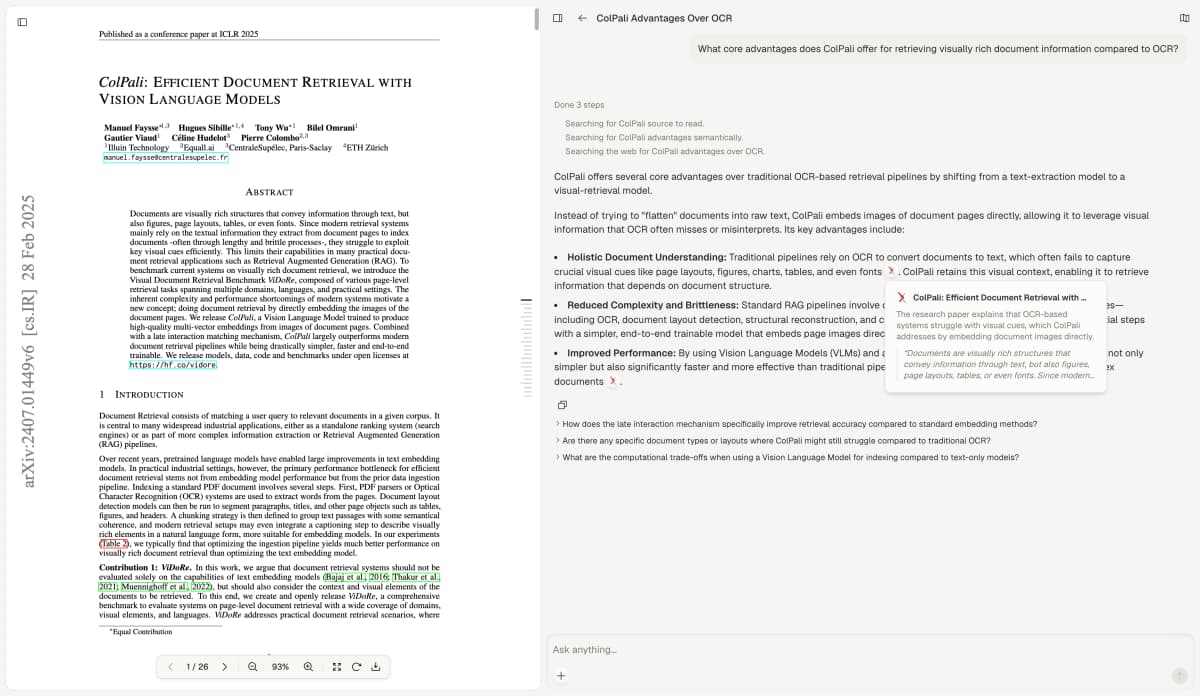
This Atlas capture displays ColPali by Manuel Faysse and colleagues, released under CC0 1.0. The lossless format conversion preserves its pixels. It illustrates citation inspection, with no SPICE evaluation or museum findings and no author endorsement implied.
Open the citations and check the context yourself. In the example plan, reject a change from user experience to proven gains in visits unless the real design and findings support it. Our citation tracking guide explains why source links still need a check.
A neat mapping cannot approve the final question or complete the research.
Save the checked worksheet and the reasons for its boundaries in a note. Select New, then Note, and wait for Saved before closing. Keep open choices clear, including what result you seek and whether you need an alternative to compare.
Researchers choose the final question, search approach, and study design.
Review the question before searching
Read the question with its worksheet and evidence plan. Check that the setting is clear, the perspective matches the people or sources you can study, and the evaluation asks for something the design can address. Remove assumptions that pre-decide a positive result, and make any absent comparison explicit in the plan.
Then ask your supervisor or research lead to review the fit with local methods requirements. A focused SPICE question gives the next phase a clear starting point. The quality of the eventual answer still depends on the evidence, the research process, and the judgments made along the way.
Check question sources in Atlas
Compare a proposed SPICE question with named methods and service documents.