

AtlasBuild a cited policy evidence table
Compare policy themes, gaps, and conflicts with citations you can inspect.

Quick verdict
AI policy analysis tools do different jobs. Some search bills and hearings. Some offer prompts or government guidance. Others compare a large set of bills or help draft a first note. Choose based on the work you need to do:
- Use Atlas to compare policy files, bills, reports, or public comments in a table with citations you can open.
- Use Quorum when you need questions over its own legislative and committee-hearing data specifically.
- Use Policymaking.ai when you want prompt patterns and workflow ideas for public policy prompt tasks.
- Use a general AI model for an early draft or ideas, then check each claim against a source.
- Use computer-based research methods when you need to compare hundreds of bills. These methods can find common topics, similar text, and changes in key terms.
- Use OECD and Harvard Kennedy School guides to learn what safe use should include. They do not recommend one product.
Every option here works best as a research aid. None of them makes the policy call for you.
People on r/PublicPolicy worry that AI policy notes can look deep while missing key details. The OECD and Harvard Kennedy School raise the same risk.
AI can help people review more sources in less time. A person still makes the final call. If your files include contracts or legal filings, see our legal document analysis AI guide.
Evaluation criteria for AI policy analysis tools
Before you compare tools, decide what a good result must include. Use the same checks for a product, research method, or general AI model.
- Which sources can it read? A tool may read files you add, such as bills, reports, comments, and PDFs. Another may search only the vendor's own bill database.
- Can you open the proof? A useful citation should lead to the exact text behind a claim.
- Which places does it cover? A tool with U.S. federal or state data may not cover local rules or another country.
- Can it compare many files? Some jobs need themes and gaps across a source set. Others need one fact from one bill.
- How does it handle private data? Check the terms before you add draft policy or data about members of the public.
- Can a person review the result? A strong tool makes the source easy to check.
For a narrower comparison of document-reading tools that overlap with policy work but aren't policy-specific, see AI document reader and PDF AI assistant.
AI policy analysis comparison matrix
The table groups each option by its job. A bill database, a research method, and a tool for comparing files solve different problems.
| Tool / workflow | Best fit | Source basis | Evidence traceability | Policy scope | Human-review caveat |
|---|---|---|---|---|---|
| Atlas | Cited synthesis across an uploaded policy source set | User-uploaded PDFs, reports, web sources, and notes | Citations link each finding back to the source passage for inspection | Any jurisdiction or topic the user's own source set covers | Citations are a path to evidence. Open and check every important claim before you rely on it |
| Quorum | AI questions over Quorum's legislative and hearing data | Quorum's own federal and state legislative and committee-hearing dataset | Answers are scoped to Quorum's own data product rather than user-uploaded documents | Coverage limited to jurisdictions and data Quorum maintains | Confirm current jurisdiction and dataset coverage on Quorum's product page |
| Policymaking.ai | Prompt patterns for public-policy AI tasks | Community-shared prompts and workflow ideas rather than a source-grounded product | No built-in citation or verification layer described | General public-policy prompt use cases | Treat as a learning resource rather than an official or product-backed source |
| General-purpose LLM assistants | First-pass drafting, ideation, and summarization | Whatever text or context the user provides in a prompt | No independent citation system. Verification is the user's job | Whatever the user pastes in, with no jurisdiction awareness by default | Academic research on AI-generated policy briefings finds outputs need expert evaluation before use |
| Computational policy analysis methods | Large bill-corpus analysis: topic modeling, comparison, definition graphs | Structured or standardized legislative text prepared for the method | Traceability depends on the specific method and how it's implemented | Scales to many bills but needs policy and technical expertise to run | Best for research teams with the technical setup to prepare and validate the corpus |
| OECD AI policy evaluation resources | Governance framing for public-sector AI evaluation | OECD's published policy-evaluation guidance | This is a framing and evaluation-consideration resource rather than a tool | Cross-jurisdictional governance guidance rather than a specific dataset | Useful for evaluators rather than vendor comparison. Adoption is still described as limited |
Table 1: Use this table to shortlist which row matches your task, then confirm current details on the official page before committing.
Best AI policy analysis tools and workflows
1. Atlas
Atlas fits when you already have policy PDFs, reports, public comments, bill text, or web sources. It can help you find themes, gaps, and support across that set.
Atlas can compare several sources and place the findings in a table. Each row can name its source, so points from two bills stay separate.
Each claim has a citation that opens the source text. The citation helps you check a claim, but it does not prove that the claim is correct.
Atlas helps people sort and cite source material. It does not make policy or legal decisions. A person still makes the call.
2. Quorum
Quorum lets users ask questions about its own bill and hearing data. Its page lists bill status, sponsors, hearings, witnesses, penalties, taxes, and changes to laws. It fits teams that already track bills in Quorum.
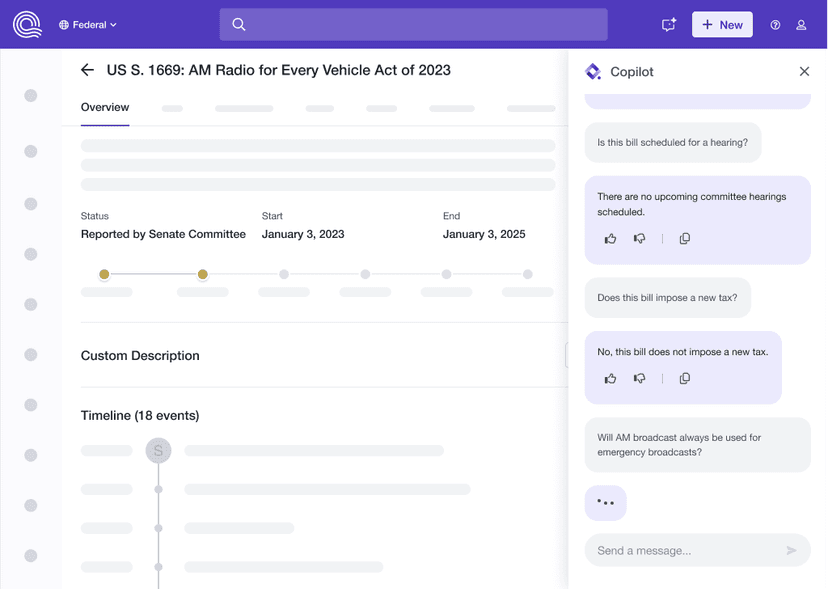
Quorum's product screenshot shows the important scope boundary: its AI assistant answers questions inside a tracked bill record. The visible answers concern the bill's hearing schedule and tax provisions, but a reviewer should still open the underlying bill text before relying on them.
Quorum searches its own data rather than files you add. Check which places and records it covers before you rely on it.
3. Policymaking.ai
Policymaking.ai is a set of prompts shared by a community. The prompts cover policy review, people affected by a policy, privacy checks, and talking points. They can help you learn how to ask an AI about policy work.
It is a community project on an OpenAI forum, with no set database or built-in citation check. Treat its output as an early draft that needs review.
4. General-purpose AI models
A general-purpose AI model can help draft a first-pass policy note, brainstorm angles, or restructure notes into an outline.
A research study tested whether language models can write policy briefs that sound convincing. The text could sound clear while still being wrong. Plan for that risk.
A general model may not link each claim to a source. Give it the source text, ask for direct quotes, and check each quote yourself.
5. Computational policy analysis methods
Research teams can use code to compare hundreds of bills. It can find common topics, similar text, or changes in how drafts define the same term.
Tech Policy Press and an ACLU report show how these methods fit specific jobs. Finding trends across many bills needs a different setup from reading one bill closely.
This is a research method, not a one-click product. A team must prepare the text and have enough policy knowledge to read the result.
6. OECD AI policy evaluation resources
The OECD guide says AI may help people review more evidence in less time. It also says use in public bodies is still limited.
Harvard Kennedy School's guide says public bodies must also plan for privacy, false answers, bias, and false information.
The LSE Public Policy Review also calls for fairness, human judgment, and clear responsibility. Read these guides beside a product page.
These guides explain what safe AI use in policy work should include. They are not tools. Choose the tool from the table above.
Build a policy evidence table in Atlas
A cited evidence table is the most reviewable output format for AI policy analysis, whatever tool produces it. Each row should name a theme, the source it came from, and the exact passage that supports it.
Add a caveat or conflict if one exists, plus a gap and a follow-up question. That structure turns a synthesis task into something a reviewer can audit line by line.
The workflow
Building this table in Atlas follows 4 steps:
- Add each policy source separately. Upload bills, reports, public comments, or web sources as distinct sources in one project so a finding stays tied to the document it came from.
- Ask for a theme-gap-evidence table. A narrow prompt produces a more verifiable result than "summarize these documents." For example: "Compare these sources for stated positions on [issue]. Return a table with theme, source, supporting passage, caveat or conflict, gap, and follow-up question."
- Open every citation that matters. Jump to the cited passage in the source viewer and read the surrounding paragraph. The highlighted sentence alone can miss context that changes the finding.
- Save only verified findings. If a citation doesn't support the claim, or a passage is missing context, narrow the question or ask Atlas to re-cite it before treating the row as settled.
Example output format
| Theme | Source | Supporting passage | Caveat / conflict | Gap | Follow-up question |
|---|---|---|---|---|---|
| Data-sharing exemption | Draft Bill 14, Sec. 4(b) | "Agencies may share de-identified records for research purposes without additional consent." | Term "de-identified" is not defined in this bill | No cross-reference to the state's existing privacy statute | Does the existing privacy statute's definition of de-identification apply here? |
| Public comment concern | Comment set, Filing #212 | "Small agencies lack the staff to comply with the proposed reporting cadence." | Only one commenter raised implementation capacity | No fiscal or staffing impact analysis in the bill text | Has an implementation cost estimate been requested from affected agencies? |
Table 2: Atlas's source support for PDFs and other document types makes this table pattern practical for policy sets. A policy synthesis task usually spans more than one document from the start: the bill, related comments, and background reports.
The citation system exists so a finding like the rows above stays open to review, rather than becoming a note you have to trust on faith. For a narrower single-document version of this same ask-and-verify pattern, see document question answering.
Where AI policy analysis needs human oversight
Every source reviewed for this article agrees on 1 point, even where they disagree on the rest: AI can help organize and speed up policy evidence review. It should not be treated as a policy authority.
- Shallow-looking outputs. Practitioners on forums like r/PublicPolicy report that AI-generated policy analysis can look thorough while it misses nuance an expert would catch. Treat a clean-looking note as a draft that still needs expert review, rather than a finished analysis.
- Hallucination and bias risk. Harvard Kennedy School's guidance for governments names hallucination and bias as standing risks in any AI-supported government work. Privacy exposure and disinformation are named risks too.
- Missing jurisdictions or voices. A tool trained or tuned on one jurisdiction's legislative style can miss another's. A source set that's missing key stakeholder comments will produce a synthesis with gaps it can't flag on its own.
- Opaque methods. Computational methods like topic modeling can surface patterns without explaining why a passage was grouped the way it was. Keep the underlying text open for review rather than trusting the output alone.
- Limited institutional adoption so far. The OECD's own review of AI in policy evaluation notes that current use remains limited. Embedded practice is still developing. That is a reason for caution. It is not a reason to skip verification.
None of this makes AI policy analysis tools useless. It defines what "useful" means here: organizing and surfacing evidence a policy analyst still has to weigh, check, and take responsibility for. For the same rubric applied to a narrower single-document review, see AI document reader.
Which AI policy analysis workflow fits?
Match the option below to the job in front of you:
- For cited synthesis across a set of policy documents, bills, or comments you've collected, use Atlas.
- For AI questions over legislative and committee-hearing data your team tracks today, use Quorum.
- For prompt patterns to learn public-policy prompt tasks, use Policymaking.ai.
- For first-pass drafting or brainstorming you'll verify against sources yourself, use a general-purpose AI model.
- For analyzing a large corpus of bills at scale, use computational policy analysis methods such as the ones described by Tech Policy Press.
- For governance framing and evaluation considerations rather than a product pick, use OECD and Harvard Kennedy School resources.
Keep the source text with each finding, no matter which option you choose. A person must review the result. For contracts or other legal filings, see AI contract analysis.
For related work, see our guides to legal document organizers, AI for articles, and AI notes organizers.
Build a cited policy evidence table
Compare policy themes, gaps, and conflicts with citations you can inspect.