

Concept testing questions help you learn what people understand about an idea, where it fits their lives, and what concerns it raises. Useful questions invite a person to explain their reaction and connect it to a real experience. A positive answer still leaves future use and sales unproven.
Start with the claims in your concept description. For each one, decide what you need to learn and what answer would make you reconsider it. Then write a neutral question and a follow-up probe.
If you have earlier customer notes, compare them with the concept and study goals before drafting. This gives each question a clear purpose and makes unsupported claims easier to spot.

Prepare a checked concept guide in Atlas
Compare concept claims with prior notes and check each proposed question.
What concept testing questions should reveal
A concept is an idea for a product, feature, or service. The text, sketch, or other item you show is the stimulus. Ask people what they think it means and where it might fit in their lives.
Explore what the idea means to the person, what they need, and what concerns them. Ask what they think it does before asking how much they like it. The Compass concept-testing guide treats meaning, fit, and liking as distinct things to learn.
A question about future use records what someone says about the idea you show. It does not show what they will do later. NCI's original manual explains how early tests can help, while warning that they cannot prove a program will succeed.
Tie the questions to your research objectives. If the team needs to know whether a person can complete a task, plan an observed task as well. That asks a different question from whether someone likes a concept.
Define the claim and concept version
Write the choice the study will inform. For a fictional shared-house repair tracker, the team wants to know whether people can tell who will act on a repair. It has not shown that the idea saves time or leads to better follow-through.
Set evidence criteria before writing questions: what would count as support for each claim? A person explaining the next step in their own words shows how they read the idea. A story about a lost handoff gives context for its fit. Daily use still needs to be tested.
Choose people who have faced the issue and note whom the sample covers. Qualtrics' methods guide separates screening from concept questions. Here, a screener would ask about reporting or handling repairs in a shared home.
Prepare a clear concept version without sales claims. Show the same facts and use the same opening instructions. Record the version used in each session so later changes remain visible.
Policy Lab's original project used simple prototypes to explore ideas and concerns. The team explained that a more polished prototype could invite feedback on aesthetics. Choose detail that serves your question, and mark unfinished parts clearly.
If you show more than one concept, plan which people see each one and in what order. Qualtrics explains these study designs. A later response can depend on what the person saw first, so keep the order with the notes.
A worked concept claim-to-question guide
The fictional tracker lets residents report a repair, view an assigned owner, and check progress. Earlier fictional notes describe lost handoffs. They contain no measured time saving, and the proposed feature has not been tested.
| Concept claim or open issue | Neutral participant question | Probe and checking purpose |
|---|---|---|
| Residents understand the idea | What do you think this would let you do? | What in the description led you to that view? Check unaided understanding. |
| It fits a current repair problem | Tell me about the last repair you reported. | What happened next? Compare the idea with a concrete event. |
| The assigned owner is clear | Who would you expect to act next here? | Where did you find that information? Check the meaning of ownership. |
| Progress helps residents judge what to do | What would you do after seeing this status? | What else would you need to know? Look for gaps and uncertainty. |
| The idea could replace an existing step | How does this compare with what you did last time? | What would you still need to do elsewhere? Explore work and tradeoffs. |
| There may be reasons to avoid it | What might make this hard to use in your household? | Can you connect that concern to a recent event? Preserve reasons to reject it. |
Table 1: Each row has one main job. The ownership question checks how the person reads the concept, while the repair story checks past experience. Keep those answers distinct when you later review the notes.
Use plain terms the people in the study know. GOV.UK's interview guidance favors concrete stories and open, neutral prompts. If "assigned owner" is new to them, find wording that fits the setting.
Use the interview protocol guide to place these questions within the opening, consent process, transitions, and close. The question table alone is not the complete plan for running a session.
Rewrite questions that supply the answer
A question can steer a person by naming a benefit, assuming a problem, or combining two issues. Read it aloud and ask what answer it seems to invite. The Compass wording guidance recommends neutral language and one idea at a time.
For the fictional tracker, these rewrites keep the learning goal open:
- Implied benefit: Replace "How much time would this helpful tracker save?" with "How would this fit with the steps you took last time?" The first wording assumes both usefulness and speed. Prior notes support a handoff question, with time saving still untested.
- Two questions at once: Replace "Is it clear and trustworthy?" with a question about what the person thinks happens next. Then ask what would make them trust that status. Understanding and trust may differ.
- Guaranteed use: Replace "How often will you use this?" with "In which situations, if any, could this fit?" Follow with a recent example and what might prevent use. Keep the answer marked as hypothetical.
The source page below shows a historical questionnaire that asks about audience fit and confusion, then follows up on the answer. It also includes ratings of message qualities. These serve different purposes, so a favorable rating should not replace an explanation.
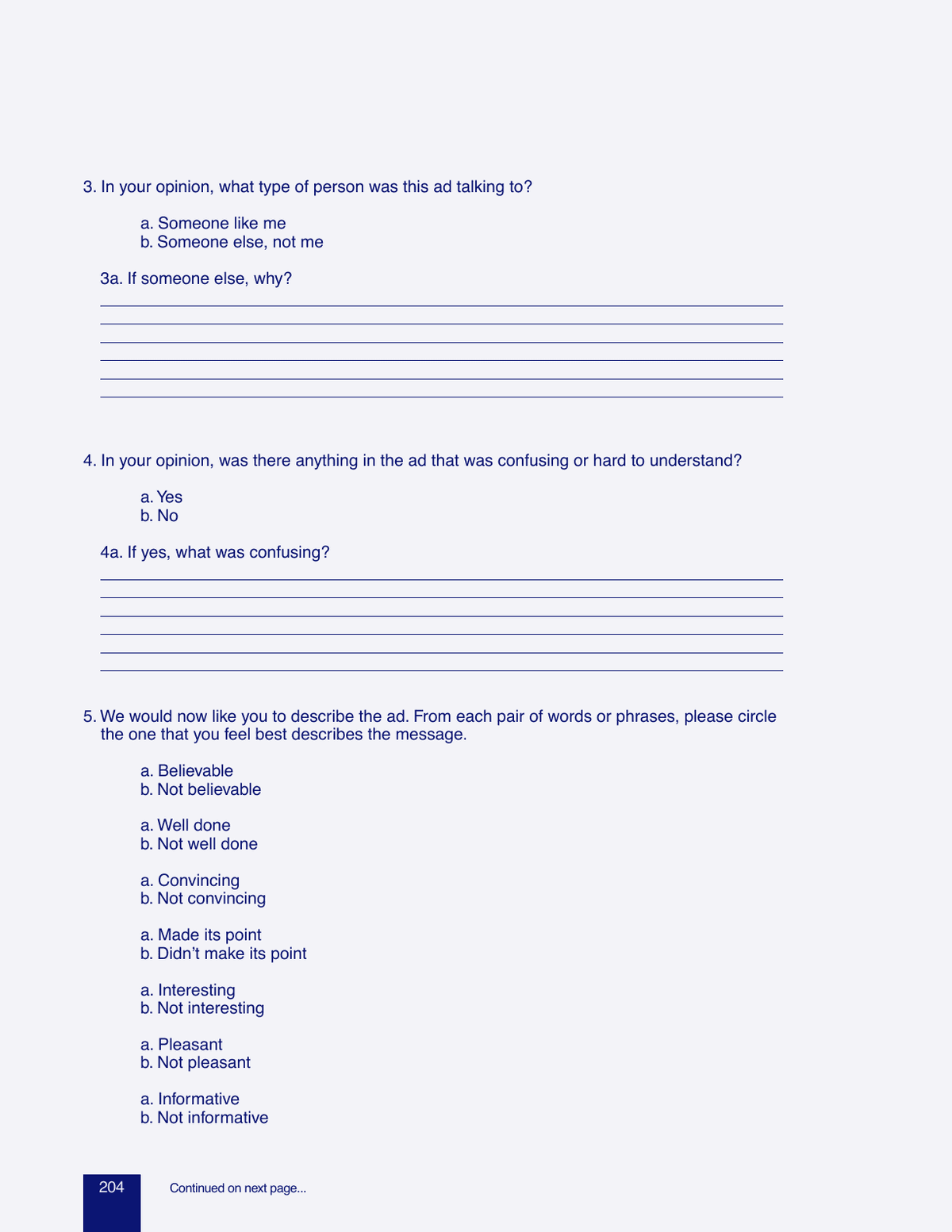
Page 204 of Making Health Communication Programs Work, originally published by the National Cancer Institute, is reproduced unchanged under NCI's reuse policy. It concerns communication pretesting and is not a validated product-testing form.
For your guide, retain the habit of asking why and what was unclear. Adapt the wording to the actual concept, participants, and study goal. Copying an old response scale would not establish that it measures your question well.
Sequence the interview and record help
Start with past events, leave space for a first response, and then explore reasons. GOV.UK's interview guidance supports a guide with core questions and probes you can use when needed.
- Open the session. Explain the study and that the idea is unfinished. Describe the agreed consent, recording, and note-access process.
- Explore past events. Ask about the last time the issue arose before showing the concept's claimed benefits.
- Show the recorded version. Ask what the person thinks it does. Give them time to respond before explaining an unclear part.
- Probe reasons and tradeoffs. Ask what led to the response, what could stop use, and how it fits with what they do today.
- Close and review gaps. Ask what you missed and check that you heard them well. Note open points while the details are fresh.
Keep the person's words, your help, and your interpretation separate. If you explained who owns the repair, note that the later answer followed that help. It shows what the person thought after you explained the idea. Their first response may have been quite different.
Pilot the flow with a colleague and record needed revisions. A semi-structured interview leaves room for useful probes. GOV.UK recommends trying the questions and order before the sessions.
Check the draft against sources in Atlas
Atlas can compare concept text, earlier customer notes, and study goals. Use that comparison to prepare a guide you review. The research team still chooses the method and wording, recruits people, and runs the study.
- Add permitted sources. Bring the concept text, earlier notes, and study goals into the project. Use only sources you have permission to process.
- Name the sources. In Ask a question, use @ to select the concept and notes. Project only keeps new retrieval within the project. Earlier chat context can still be used.
- Request a traceable guide. Ask: "Map each concept claim to a neutral interview question and probe. Cite the prior evidence, mark unsupported benefits, and separate current behavior from hypothetical reactions."
- Read the citations. Check that each passage supports the claim. Exact locations depend on the source. Read the text around the cited part too.
- Correct and save. Revise leading wording and remove claims that lack support. Choose New, then Note, save the guide and source locators, and wait for Saved.
Suppose the guide says the tracker will save time because earlier notes mention missed handoffs. Those notes support a question about handoffs, but give no speed measure. Remove the promised benefit so the question stays within its source.
Keep the source roles clear in the saved note. The concept offers a possible fix, while the earlier notes describe a problem. The new question will explore the link. You have prepared the study, with the result still unknown.
Separate reactions from proof of demand
A person can understand an idea and still see no use for it. They can like it while finding the effort too high. Keep those views distinct so the team can see what needs more work.
Ratings can help when the study needs a defined measure. Qualtrics explains several question formats, including open follow-ups. Ask why the person gave a score, since their reason may show they read the idea in a way you did not expect.
To learn whether people can use a feature, watch them try a task that fits their goal. Digital.gov explains what prototypes can show. GOV.UK's usability guidance asks teams to give neutral tasks that do not hint at the answer.
Do not turn a few responses into claims about market demand or actual sales. The NCI manual's test limits explain why praise cannot prove success. Choose the next study around the team's choice and what you still need to know.
Save the question guide and unresolved claims
Keep the concept version, core questions, optional probes, and source basis together. Add open claims that need later checks. For the fictional tracker, whether it saves time remains open even after the question guide is reviewed.
Use a consistent record so colleagues can see which version was used and how the guide changed. The guide to organizing research notes helps keep the material available for later source checks.
The finished artifact is a plan for learning. A researcher reviews it, pilots it, and decides how the eventual evidence can inform the next step. If this guide belongs to a wider study, place its audience, recruitment, and decision points in a UX research plan.
Prepare a checked concept guide in Atlas
Compare concept claims with prior notes and check each proposed question.