
Secondary market research uses data and reports that already exist to answer a market question. You might review public statistics, industry reports, other firms' offers, or your team's past work. Decide what those sources support for this question and what still needs a closer check.
Start with a dated source inventory. Keep the source, its scope, your claim, and the gap together.
A report about local jobs may help describe the area, but it does not tell you whether residents will buy a particular service. The worked example below shows how to catch that jump before writing a market brief.

Keep market claims linked to their sources
Compare supplied market sources, inspect citations, and save a checked note.
Start with the market question
Define the audience, place, offer, and decision you want the research to inform. A question such as “What existing evidence describes this local service market?” is different from “Will people buy our new service?” The SBA market-research guidance distinguishes broad questions suited to existing data from questions about a specific business or customer that direct research can address.
Secondary research is about reuse. It can include data your team gathered earlier, even if that data was primary research for its first project. Qualtrics' source guidance includes work from inside and outside the firm. Record the first question and who took part before assuming that past work fits today's task.
Set a boundary for the review. Name the questions you will answer from existing sources, the dates and places that matter, and the claims you will leave open. You can finish a useful desk review with an unanswered demand question. The inventory should show why that question remains unanswered.
Gather sources that fit the question
Check the internal records you have
Look for past studies, support records, sales reports, and feedback you can reuse. Rev's overview of internal sources includes past in-house studies and customer accounts. These sources may help you understand who buys from you now. A new audience may have other needs.
Record who gathered the data, why, when, and which people or sales it covers. Check how you may reuse it before adding it to a new project.
An old interview may explain a past choice without showing how often people make that choice now. A sales file shows what people bought from your firm. It does not cover all sales in the market.
Find outside sources for specific gaps
Search for sources that match each question. Public statistics can describe an area, study reports can give findings, and a firm's website can show what it offers. Each source has a distinct job. The OpenStax market-research chapter explains how data that already exists can answer broad questions. A question about a new product may need fresh research with the people who might buy it.
Read the producer's page and methods where you can. A news story may shorten a term or leave out a limit. Qualtrics' collection guidance asks you to check dates, source trust, fit, and methods. Keep the report page or table number in the note.
The next reader can then check the finding against its source instead of relying on your summary alone.
Keep the three kinds of date
Record when the source was published or released, when its data were gathered or what period they describe, and when you accessed it.
These dates answer different questions. Accessing a report today does not make its study current. Tailor Brands' discussion of dated data shows why fit depends on how fast the relevant market changes.
Keep multi-year periods intact. The Census guide to ACS products distinguishes estimates built from one year of data from those built from five years. A five-year estimate describes a period, not a fresh count for the final year alone.
Choose the product whose coverage and period fit the question, then record that choice beside the value.
Build a dated source inventory
Imagine a team exploring a local phone-repair service. They want to know which sources could describe the area and repair shops before they talk to people who might buy. The offer is invented for this guide. No county was chosen, no market figures were taken from tables, and no demand was measured.
Record the source-fit review
The inventory below records real program guides checked on 2 October 2026. This date tells you when the guides were read. Each row names what the source measures and a gap for the invented offer. To use actual figures, you would also need to choose a release and area, check the industry group, and record the table, values, and any error margins or withheld cells.
| Source reviewed | Support found in its documentation | Open check for this question |
|---|---|---|
| Census County Business Patterns glossary | Establishments are business locations; counts cover locations with paid employees during the year | Choose release, geography, and industry; nonemployers are excluded, so this is not all repair businesses |
| BLS QCEW overview | Reports covered employment and wages by area and industry | Choose a period and coverage; employment and wages do not show repair purchases or willingness to buy |
| Census ACS product guide | One-year and five-year estimates use different collection periods and geographic coverage | Choose the right product and population measure; area background does not establish service demand |
Table 1: The table records checks on source fit, with data selection still open. It reports no county findings or market-size estimate.
Explain the definitions behind the rows
The CBP glossary distinguishes a business location from the company that owns it. It also states that CBP excludes nonemployer businesses. Thus an early draft claim that “CBP lists every repair company” does not survive the source check. A chosen industry category would need its own review before any count was used.
The QCEW overview describes covered jobs and wages, with groups left out and some detail withheld. The ACS product guidance explains how to choose a time span and area. These sources have distinct roles. Do not put their figures into one column labeled “potential customers.”
Correct the claim and preserve the gap
A revised teaching note could read: These programs may help describe the area and its employers. Check who they cover, their time spans, and how well the industry groups fit before using any figures. On their own, they do not show demand for the proposed repair service. The note gives a narrower claim and a reason for the next step instead of a guessed market total.
There is also a currentness check. The CBP overview page warns that its information is no longer current and that guidance is being updated. Do not apply an older methods description to a new release without checking the documentation for that release. The inventory keeps that check open rather than claiming the program has been fully verified for this use.
Compare definitions before comparing findings
Keep the unit of measurement clear
Check whether a source counts people, households, jobs, shop sites, sales, or revenue. A firm's five shops could be five sites under one owner. The CBP definitions of firms and establishments explain that difference. Decide which count your question needs and keep the source's own unit visible.
Check the BLS coverage notes for groups excluded from QCEW, then ask whether those gaps matter to your question. A source's size does not settle how well it covers your audience.
Do not change a covered-employment label into “all people working here” or treat wage data as the money households have available to spend on your offer.
Match the periods and places
Compare sources only after checking their reference periods and boundaries. A county, city, and service area may include different people. A quarterly figure and an annual average answer different time questions.
Keep those differences in the note before calling two results a trend.
For ACS work, use the Census product-selection guidance to understand why one-year and five-year figures are not interchangeable. For a study report, check when respondents were contacted and which places they lived in. A new edition may still rely on an old fieldwork period. Report that period alongside the claim.
Trace repeated claims to their producer
When two articles quote the same report, they lead back to one finding rather than independent evidence. Trace both accounts to that original report before deciding what supports your claim.
Keep the first report and later coverage distinct. The CRAAP source-use guide helps frame checks on currency, relevance, authority, accuracy, and purpose for the claim you plan to make.
When sources disagree, check definitions and methods before choosing the larger number. Appinio's limitations discussion identifies problems with incompatible data. Use the research synthesis workflow to retain what each source contributes. A disagreement may become a useful gap in the brief rather than a number to average away.
Keep unresolved market claims visible
Treat background as background
A population or employment measure may help describe an area. It does not establish that the people counted need your service, prefer it to existing options, or will buy at the proposed price. The SBA distinction between existing and direct research keeps that move tied to the question rather than the size of the data source.
In the repair-service example, record the demand question separately. Name what would help answer it: relevant existing purchase data if available, or new research with the intended audience.
Do not turn a missing answer into either “no demand” or “strong demand.” Both claims need evidence.
Keep purpose and selection in view
Check who produced the report, why, and how the data were gathered. A provider may publish useful work while framing it around a commercial aim. Secondary data is not automatically free of bias. Appinio's source limitations include bias and the new researcher's lack of control over the original work.
Keep the scope of existing customer feedback visible, since people who contacted support may differ from those who never bought or never complained.
Use the material to frame a question about those accounts, then seek broader evidence before making a claim about the whole market.
Leave unavailable values unresolved
Read footnotes and data flags. A blank, withheld cell, or missing table is not proof of zero activity. BLS's confidentiality guidance explains why some detailed values are not published. Preserve the flag and look for an appropriate published measure without claiming to recover the missing value.
For purchased or restricted reports, verify the version and permitted use. Do not imply you reviewed a full report when you only saw a summary or search snippet. Qualtrics' discussion of research gaps supports checking whether available material answers the original question.
State the access limit when it affects the conclusion.
Review supplied market sources in Atlas
Atlas can help compare the market texts and methods notes you supply. Add only sources you may use. The research team must check the numbers and decide what the findings mean for the market.
A cited answer helps you find support. You still need to check whether that source fits the question.
-
Add the selected documentation, permitted reports, research question, and draft claims to one project. Confirm that processing has finished.
-
Start a chat and use @ to select the exact source items and claim note.
-
Ask: “Compare these sources for our local repair-service question. Record producer, measured unit, coverage, data period, access date if supplied, supported claim, and open gap. Give citations. Do not invent missing values or treat area statistics as measured demand.”
-
Open each numbered citation. Read the source and nearby definitions or notes. Check the actual table directly before retaining a number.
-
Correct the claim list. If the answer calls CBP a count of all repair companies, restore the business-location unit and nonemployer gap. Keep unselected releases and the CBP currentness check open.
-
Choose New, then Note. Save the checked inventory, source locations, revised claims, and further evidence needs. Wait for Saved before closing.
The real capture below shows a ColPali paper beside a cited Atlas answer. The paper is unrelated to the repair-service question. The capture illustrates source inspection; it does not show a live market review or demand benchmark.
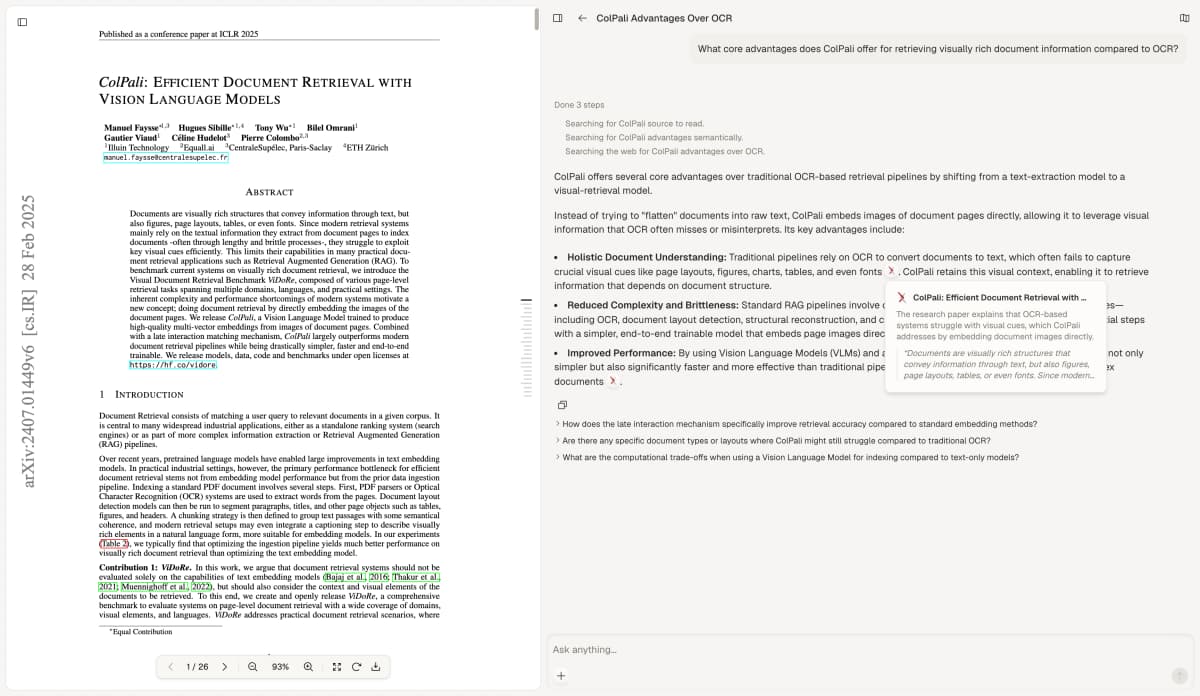
Atlas capture reused without pixel changes. The paper is Faysse and colleagues’ ColPali: Efficient Document Retrieval with Vision Language Models, version 6 (2025), CC0 1.0. The paper is unrelated to the repair-service question.
Read the cited source passage and nearby text before keeping a market claim.
If a citation opens the wrong source, name the intended item and ask again. If it cannot open, locate the source directly. The AI citation checker workflow explains that support check. A missing methods page remains a gap in the inventory.
Write the evidence and gap note
State the narrow finding you can support
Write what the review established, what each source contributes, and the limits on using it. For this example, the finding is about candidate source fit. It is not a market-size estimate or a decision to launch. Keep the selected-source boundary explicit so readers know what you actually reviewed.
The OpenStax discussion of specific offer questions helps frame the next research step. For scholarly context, the literature review process can help develop the review beyond a list of reports. Retain the original source inventory so the argument stays connected to its evidence.
Assign the next check and revisit trigger
Name the evidence needed for each important gap and who will check it. Choosing a release and category is a data-fit task. Asking intended customers about their needs is a different task. Keep them separate in the handoff instead of assigning a vague request to “do more research.”
Review the note when a source is revised, the offer or area changes, or new research answers an open question. Preserve the earlier judgment and its date so you can explain why the claim changed. The finished note should let another researcher continue the work without guessing its scope.
Keep market claims linked to their sources
Compare supplied market sources, inspect citations, and save a checked note.