
Whimsical Alternatives (2026): 7 Best Diagramming Tools
The 7 best Whimsical alternatives in 2026 for flowcharts, wireframes, mind maps, and visual collaboration. Atlas, Miro, FigJam, Lucidchart, Excalidraw, Mural.
- Byline

Summary
Pick a Whimsical alternative by job: Figma boards, workshops, diagrams, sketches, or AI mind maps.
FigJam is the cheapest paid team pick and Diagrams.net is the free self-hosted pick.
Use FigJam for Figma teams, Miro for broad boards, Lucidchart for diagrams, and Atlas for source maps.
Whimsical stays fast and focused. Rivals win on team fit, diagram depth, price, or AI source synthesis.
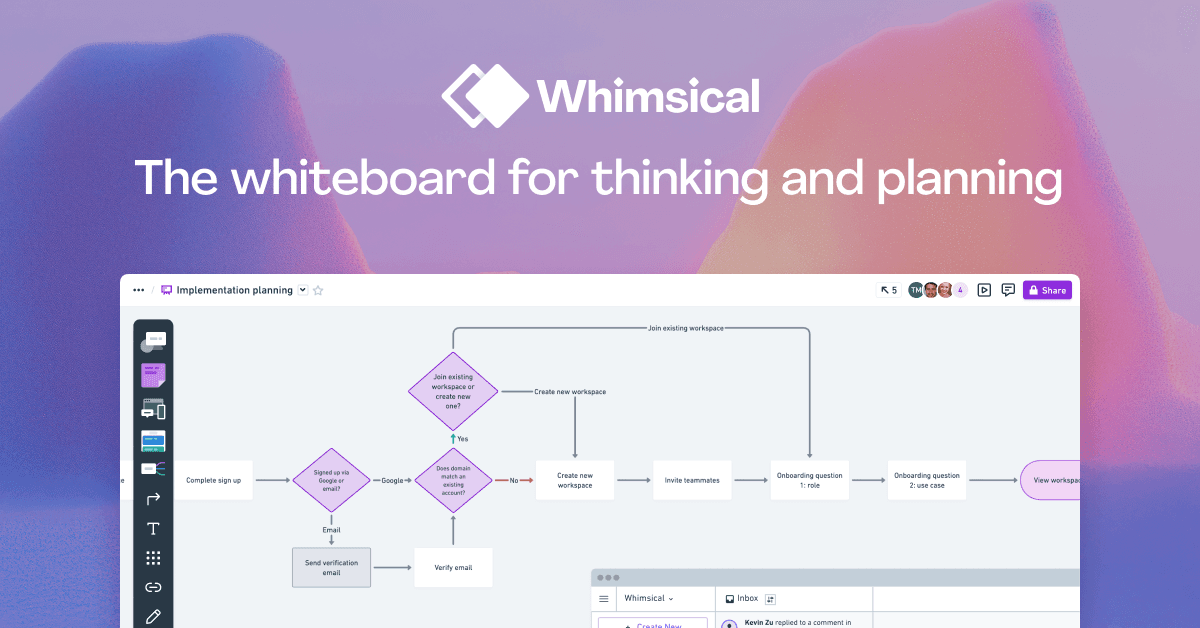
Whimsical earned a loyal product and engineering audience because it is fast and focused. It handles flows, wireframes, mind maps, and sticky notes without much setup. Teams switch when they need broader boards with Miro, tighter Figma work, AI source maps, or deeper diagram tools.
This guide compares 7 Whimsical alternatives across the four jobs people hire Whimsical for: collaborative boards, wireframes, formal diagrams, and mind maps.
Before switching, rebuild one board your team used in the past month. Include the objects that make it representative, invite an editor and a commenter, run the meeting or review it supports, then export the result. That single trial reveals editing friction, permission gaps, and export loss that a feature list cannot show.
 Atlas
AtlasSee Atlas for source-grounded mind maps
Explore Atlas research maps built from papers, notes, and source documents.
How to Choose a Whimsical Alternative
Start with the job you want to replace. A design team may need Figma files and fast comments. A product team may need a bigger whiteboard for planning. An engineering team may need formal flowcharts. A research team may need a map created from source files.
Use these checks before switching:
- Price. Whimsical Pro is $10/user/month. FigJam and Lucidchart can cost less for small teams.
- Tool fit. Whimsical is tuned for fast creation. Miro offers more board templates. Lucidchart goes deeper on formal diagrams.
- AI fit. Whimsical AI can start diagrams from prompts. Atlas is different: it turns source content into a map with cited Q&A.
- Migration fit. Import or rebuild one active board, then check text, connectors, comments, permissions, and export quality before moving the rest.
For a side-by-side benchmark of nine mind-mapping tools, see our mind-mapping software guide.
7 Best Whimsical Alternatives
Each alternative below is strongest for a different use case. The ranking starts with collaborative design and whiteboarding tools, then covers source-grounded mapping, formal diagrams, workshops, and free or self-hosted options.
1. FigJam: Best for Design Teams
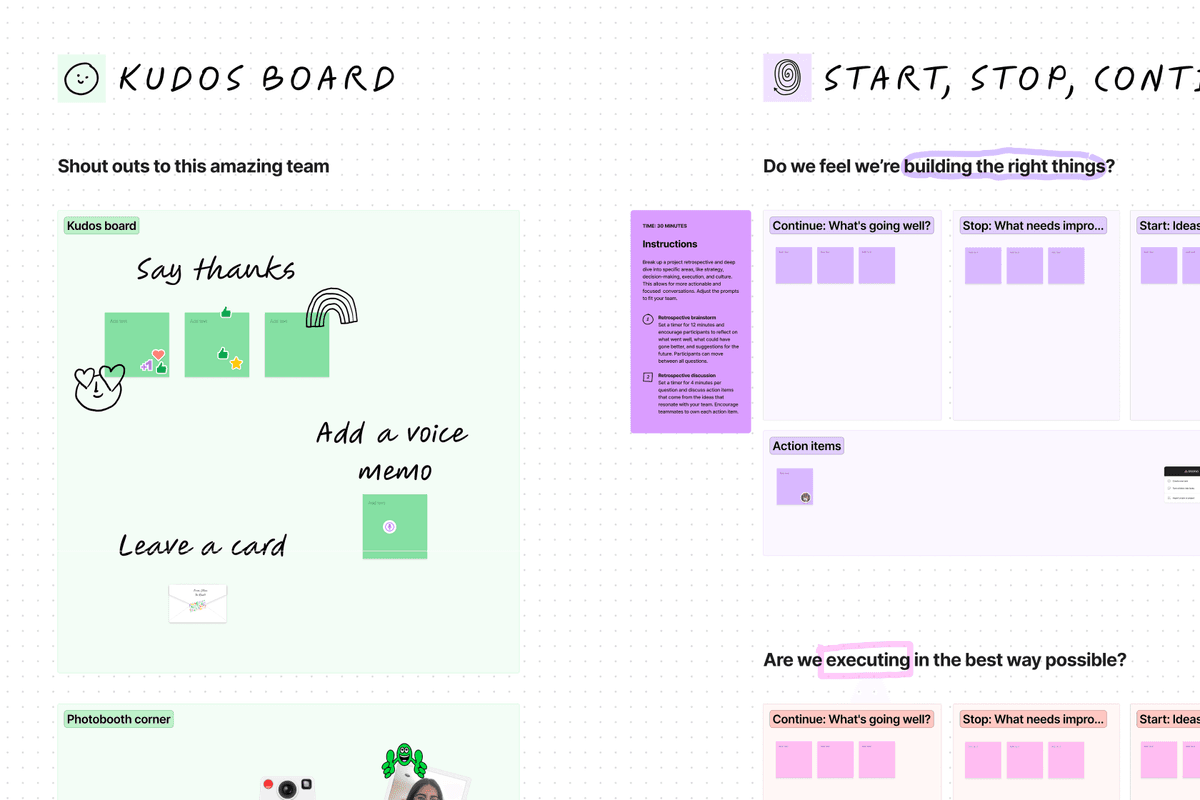
FigJam is Figma's whiteboard. It costs $5/editor/month on annual billing and has a free tier with three files. Choose it when your diagrams sit next to Figma work.
Design teams already using Figma will get the most value from FigJam. Pricing starts with a free tier, then $5/editor/month on annual billing.
2. Miro: Broadest Whiteboard Alternative
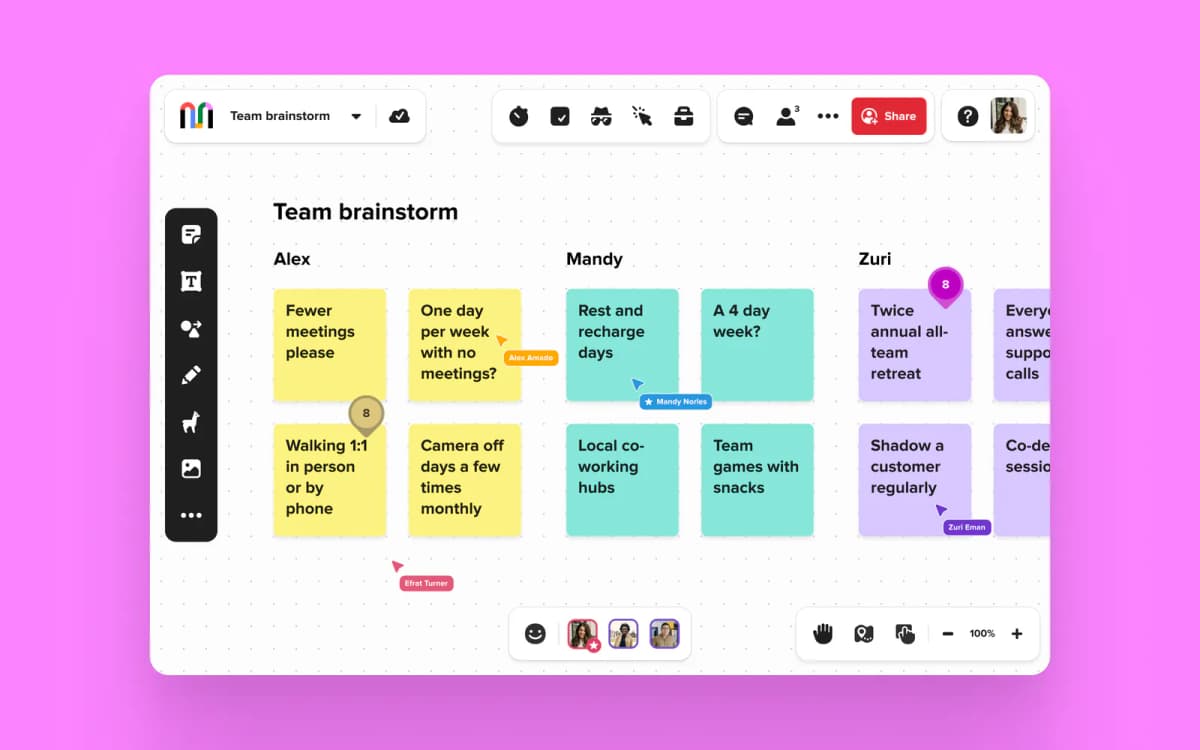
Miro is the broader team whiteboard with templates, integrations, and SSO. Choose it for cross-team planning, large boards, and workshop programs.
Cross-functional teams get the most from Miro. Pricing starts with a free tier. Starter is $8/user/month on annual billing.
3. Atlas: Best for AI Mind-Map Synthesis
Atlas turns notes, PDFs, and research into a mind map with AI-suggested links and cited Q&A. It is not a general whiteboard replacement. It helps when a map should come from source files instead of blank-canvas drawing.
Researchers and knowledge workers are the best fit. Atlas Pro is $20/month.
4. Lucidchart: Strongest Diagramming Alternative
Lucidchart is built for flowcharts, network maps, ER diagrams, and BPMN. Choose it when the diagram needs formal shapes and clear notation.
Engineering teams creating technical diagrams are the best fit. Pricing starts with a free tier. Individual is $7.95/month.
5. Excalidraw: Best Free Open-Source Pick
Excalidraw is an open-source whiteboard with a hand-drawn look. It runs in the browser and needs no account for basic use.
Use Excalidraw for quick sketches or open-source preference. The core tool is free. Plus starts at $6/month for collaboration.
6. Mural: Best for Workshop Facilitation
Mural specializes in workshops with sticky notes, voting, timers, and structured templates. It is heavier than Whimsical, but stronger for live sessions.
Workshop and design-thinking teams are the best fit. Pricing starts at $9.99/user/month.
7. Diagrams.net: Best Self-Hostable Free Tool
Diagrams.net (formerly Draw.io) is free, browser-based or desktop, and self-hostable. Supports Whimsical-style flowcharts, wireframes, and ER diagrams.
Use Diagrams.net when the team wants a free or self-hosted diagram tool. The core tool is free.
Comparison Table
Use this table to narrow the first shortlist. If the job is design work, start with FigJam. If the job is a formal diagram, start with Lucidchart or Diagrams.net. If the job is a source-backed mind map, Atlas is the relevant option.
| Tool | Best For | Free Tier | Paid From | AI Features |
|---|---|---|---|---|
| FigJam | Design teams | Yes (3 files) | $5/editor/mo | Limited |
| Miro | Enterprise breadth | Yes | $8/editor/mo | Miro AI |
| Atlas | AI synthesis | Yes | $20/mo | Mind-map + Q&A |
| Lucidchart | Diagramming depth | Yes | $7.95/mo | Lucid AI |
| Excalidraw | Open-source | Yes | $6/mo (Plus) | None |
| Mural | Workshop facilitation | Limited | $9.99/mo | Mural AI |
| Diagrams.net | Self-hostable | Yes | $0 | None |
Table 1: Whimsical rivals by job, free tier, starting price, and AI support.
Best Whimsical Alternative by Use Case
Choose the tool that matches the board your team creates most often. FigJam is best for Figma-connected design work, Miro is best for broad planning boards, and Lucidchart is best for formal technical diagrams.
Use cost, deployment, and facilitation needs to break a tie. Excalidraw suits quick free sketches, Diagrams.net suits self-hosting, Mural suits facilitated workshops, and Atlas suits mind maps generated from source files.
Costs, Collaboration, Privacy, and Migration
The shortlist can change once you account for the annual bill, the number of simultaneous collaborators, where sensitive diagrams are stored, and how much work it takes to move existing Whimsical boards.
Annual Cost for Five Editors
Sticker prices hide the real annual bill. A team of 5 editors paying monthly looks roughly like this:
| Tool | Monthly per editor | Annual (5 editors) | Notes |
|---|---|---|---|
| Whimsical Pro | $10 | $600 | Unlimited boards, viewers free |
| FigJam | $5 (annual) / $8 (monthly) | $300–$480 | Free 3 files, viewers free |
| Miro Starter | $8 (annual) / $10 (monthly) | $480–$600 | Free 3 boards, per-user only for editors |
| Lucidchart Individual | $7.95 | $477 | Single seat each, team plan from $9 |
| Mural Team+ | $9.99 | $599.40 | Annual billing, visitors free |
| Excalidraw Plus | $6 | $360 | Most teams use the free version |
| Atlas Pro | $20 (single user) | $1,200 (5 users) | Built around individual research workflows |
| Diagrams.net | $0 | $0 | Free, pay only for Confluence/Jira plug-in |
Table 2: One-year cost for five editors across Whimsical and seven rivals, using public starting prices.
The calculation multiplies the listed per-editor price by five seats and 12 months. A range appears when the public annual-billing and monthly-billing prices differ. It excludes taxes, enterprise discounts, storage add-ons, AI credits, and migration labor, so use it to compare the shortlist rather than forecast a final invoice.
The viewer/editor split matters more than the headline price. Whimsical, FigJam, Miro, and Mural bill editors and let viewers comment for free. Lucidchart's free tier ends after three editable docs. Atlas is priced for individual research work, so a five-seat chart makes it look costly for whiteboarding. Teams usually buy Atlas for AI maps and cited Q&A, not as a seat-for-seat Whimsical replacement.
Real-Time Collaboration and Performance
Performance depends on the board, device, connection, and number of active editors. Test the conditions your team actually creates instead of relying on a generic speed claim.
Use one representative Whimsical board for every finalist. Rebuild its main flow, add the same images and comments, invite the same test collaborators, and repeat the same zoom, search, edit, and presentation tasks. Record where the team waits, loses context, or needs a workaround. A tool fails the trial if the weekly board cannot be edited and exported without losing a required element.
Workshop teams should also test facilitation controls during the trial. Diagramming teams should test connector routing and notation. Design teams should test the handoff to their design files. These are different collaboration jobs, so one shared cursor test cannot choose among them.
Privacy, Compliance, and Data Residency
Diagrams can contain org charts, customer flows, network maps, and unreleased product plans. Confirm the current security and privacy terms with the vendor before uploading that material.
| Question | Evidence to request | Reject the tool when |
|---|---|---|
| Where is board data stored? | Current data-hosting and residency documentation | Required residency is unavailable |
| Who can open or export a board? | Role and guest-permission documentation | Guests receive broader access than the project allows |
| Can access be removed centrally? | SSO, user-provisioning, and audit-log documentation | Departing users cannot be revoked reliably |
| What leaves the workspace through AI features? | AI data-use, retention, and model-training terms | The terms conflict with company policy |
| Can the team leave with usable files? | Export formats tested on a representative board | The only export is unusable for archiving or rebuilding |
Table 3: Security and privacy claims change by plan and region. Treat the vendor's current documentation and your own contract as the evidence, not a comparison article.
Migration From Whimsical
Do not assume that importing a picture of a board produces editable shapes, connectors, comments, or permissions. FigJam's current import documentation, for example, separates supported image and document imports from board formats that translate into FigJam objects.
Use this migration sequence for any destination:
- Inventory active boards, reference-only boards, templates, and boards that can be archived.
- Export one representative board using the formats available in your current Whimsical workspace. Keep both the source board and a static archive copy.
- Import the file into the destination and mark text, shapes, connectors, comments, links, and permissions as editable, static, or missing.
- Rebuild only the missing elements needed for the next real use of that board.
- Ask the board owner to run the normal meeting or review before approving the destination.
Mind maps deserve their own test because a visible hierarchy can survive while node relationships become static. If the outline matters more than the canvas styling, preserve the text structure first and rebuild the visual map second.
Next Step for Source Maps
Use this final check when the shortlist is down to the job you need done this week. Atlas belongs only in the source-backed map row.
| Job | Start with | Why |
|---|---|---|
| Figma team boards | FigJam | Lowest paid team cost and native Figma fit |
| Large planning boards | Miro | Broader templates and stronger team controls |
| Formal technical diagrams | Lucidchart | Better notation for flowcharts, networks, and BPMN |
| Free diagrams | Diagrams.net or Excalidraw | No paid seat required for basic use |
| Source-backed mind maps | Atlas | Builds maps from uploaded sources with cited Q&A |
Table 4: Final Whimsical alternative shortlist by weekly job and recommended tool.
Most Whimsical alternatives start with a blank canvas. Atlas is only worth adding when the map should come from PDFs, notes, or research files. In that case, upload one source to Atlas and compare the generated Knowledge Map against a manual Whimsical map.
Final Recommendation
Whimsical is still strong when you want fast creation and a clean canvas. Choose FigJam for Figma teams, Miro for broad boards, Lucidchart for technical diagrams, Excalidraw or Diagrams.net for free diagrams, and Mural for workshops. Pick the tool that matches the weekly job.
AtlasSee Atlas for source-grounded mind maps
Explore Atlas research maps built from papers, notes, and source documents.
Frequently Asked Questions
FigJam ($5/editor/month, free tier) is the best Whimsical alternative for design teams. Miro ($8/editor/month) is the broadest enterprise alternative. Atlas (Pro $20/month) leads for AI-grounded mind-map synthesis. Lucidchart ($7.95/month) is the strongest dedicated diagramming alternative. Excalidraw is the best free open-source pick. Mural ($9.99/month) for workshop facilitation. Diagrams.net (formerly Draw.io) is free and self-hostable.