
A cluster randomized trial gives groups their study-arm labels rather than giving each person a separate random arm label. The groups may be schools, clinics, or worksites.
Outcomes can still be measured for people within those groups. Check this distinction first when you read the paper.
A report may include hundreds of people but only a few groups that received random arm labels. Keep both counts and both roles in your note.
The worked example shows twelve schools with arm labels and scores from students within them. The students do not each get their own random arm label.

Keep trial units linked to passages
Compare the trial's assigned groups and measured outcomes.
What makes the trial cluster randomized
The NIH parallel-trial guide defines a design in which groups receive study conditions and their members provide observations. In a parallel design, the groups stay in their arm rather than cross to a different condition during the trial.
Find the passage that states how arm labels were given. If each school gets one label and students follow their school's arm, the school is the unit of assignment. A student can provide a reading score without a separate random label. The largest sample count in the abstract does not name the unit.
Group delivery alone does not identify the design. The NIH individually randomized group-treatment guide describes trials in which people get separate random labels but receive some treatment in groups or through a shared provider. Check who got the label before naming the trial.
CONSORT 2025's trial-design explanation calls for a clear design description and unit of randomization. Those details help you distinguish a parallel cluster trial from a cluster crossover or another arrangement. This guide focuses on reading a parallel cluster report, not choosing a design for a new study.
Separate assignment, observation, and analysis
The assignment unit is what receives the random arm label. The observation unit is what supplies a measurement. A school may get the label while each student supplies a score.
Write those facts apart, with a source location for each. Avoid using sample as though it names only one level.
The outcome's form also matters. A report might give student scores, a school's mean score, or a school-level measure such as a new policy.
State what the outcome measures, when it is assessed, and whose data enter it. A person's score does not become a group outcome just because the school got the random label.
Check the method used to compare outcomes. The paper should explain how the design is handled. The official cluster checklist asks how clustering was taken into account. Record the actual steps described. A label such as adjusted may refer to other factors, not groups.
People in the same group can have related outcomes. They may share staff, routines, or surroundings. The Health Knowledge chapter explains this dependence. Intracluster correlation, or ICC, describes relatedness within a cluster for an outcome. It is not a measure of whether the intervention worked.
That relatedness can affect the result's precision. The NIH methods account explains why treating all such data as independent can give misleading results.
For reading, find what the authors say they did to handle the design. An expert needs to check whether the model fits the task and was used well. A familiar name does not prove the work is sound.
Worked allocation and outcome-unit note
All records below are invented for teaching. There is no actual school trial, trial plan, dataset, student recruitment, or treatment effect. The source labels belong only to this example.
Suppose a report compares a new reading routine with the usual routine across twelve schools, six in each arm.
The trial plan gives schools the random arm labels. The paper reports reading scores for 360 students within those schools. Its method says the model uses a school-level random effect. It does not state whether students joined before or after schools got arm labels. Keep that missing detail open.
| Invented source record | What the passage states | Unit or role supported | What it does not establish |
|---|---|---|---|
| Protocol P1, allocation | Twelve schools are assigned, six per arm | Schools are the units of assignment | That each student received a separate random assignment |
| Report R1, outcome | A reading score is measured for each of 360 students | Students supply outcome measurements | That all student outcomes are independent |
| Report A1, analysis | A school-level random effect is included | The report describes one way of addressing school structure | That the model was correctly fitted or is suitable in all respects |
| Report F1, flow | All twelve schools and 360 measured students appear in the reported sample | Cluster counts and measured-person counts are available | Recruitment timing, eligibility of all students, or absence of selection bias |
Table 1: The note supports a precise account. This invented parallel trial gives schools arm labels and reports student scores. It states that the model includes a school term.
It does not support saying that 360 students got separate random arm labels. The school count and the student count answer different questions.
Correct the unit mix-up
A summary that says 360 students were randomized into two groups blurs the process. Revise it to say twelve schools were randomized, with scores for 360 students within those schools. Keep six schools per arm separate from the count of students in each arm. Those student totals are not supplied here.
Equal school counts do not imply equal student counts; schools can have different sizes. Do not add an ICC value, effective sample size, or confidence interval when none is given. A source-linked note should preserve the facts and missing details. Do not fill gaps with numbers that merely sound plausible.
Keep analysis review separate
The model statement supports saying that the authors report a school-level random effect. It does not prove that the model handles all clustering concerns. You would need the full method and how it was used to judge that. Atlas can help find and compare the passages; it cannot certify the model.
The next question concerns recruitment. Were students chosen before schools got arm labels, and what did recruiters know? A missing answer is a gap in the report. It is not proof that the trial chose students in a biased way. Keep the question with the note for further source or methods review.
Check recruitment and reporting gaps
Read how both groups and their members entered the trial. The cluster checklist separates group enrollment, member inclusion, and consent before or after assignment. These steps are related. One statement about joining the trial does not settle them all.
Flow can change at both levels. A cluster can leave the trial, or people within a retained cluster can lack outcome data. Record which happened and whose data were used for each result. The paper's account of losses needs source support. A large person count does not fill a missing account of group flow.
The protocol, paper, and analysis plan can clarify the sequence. CONSORT's protocol-access guidance explains why these files help readers understand the trial and its changes.
Dates and reasons for changes matter to that account. If the files conflict, keep both statements until the source explains which applies.
Reporting versions also need accurate names. As checked in October 2026, the official extensions index lists the cluster extension under CONSORT 2010, while the core statement is now CONSORT 2025.
EQUATOR's cluster record identifies the extension as the 2012 publication. Do not rename it a new 2025 cluster checklist.
For a reporting task, consult the actual current journal requirements and the extension for the trial's design. The broader CONSORT checklist workflow helps locate reporting evidence. A completed checklist does not by itself prove low bias, a correct model, or a causal claim's validity.
Compare trial passages in Atlas
Add the trial paper, protocol, analysis plan, and guidance you are allowed to use. Check that the files show who got arm labels, whose outcomes were measured, how people and groups left, and how results were compared.
Before comparing the files, wait until their processing finishes. A missing supplement should stay missing rather than be filled from a likely design.
Start a fresh chat if earlier outside sources would confuse the reading. Choose Ask a question and mention the trial files with @.
Select Project only beside + to keep new retrieval within the project. Earlier outside chat context can remain; this control alone does not remove it.
Ask: “Compare the assignment, outcome, flow, and model passages. State each unit, count, source location, and missing detail. Keep clusters with arm labels separate from people with scores. State the clustering method the authors describe without judging it correct. Flag conflicts between plan and report.”
This asks for a reading note, not a new statistical result.
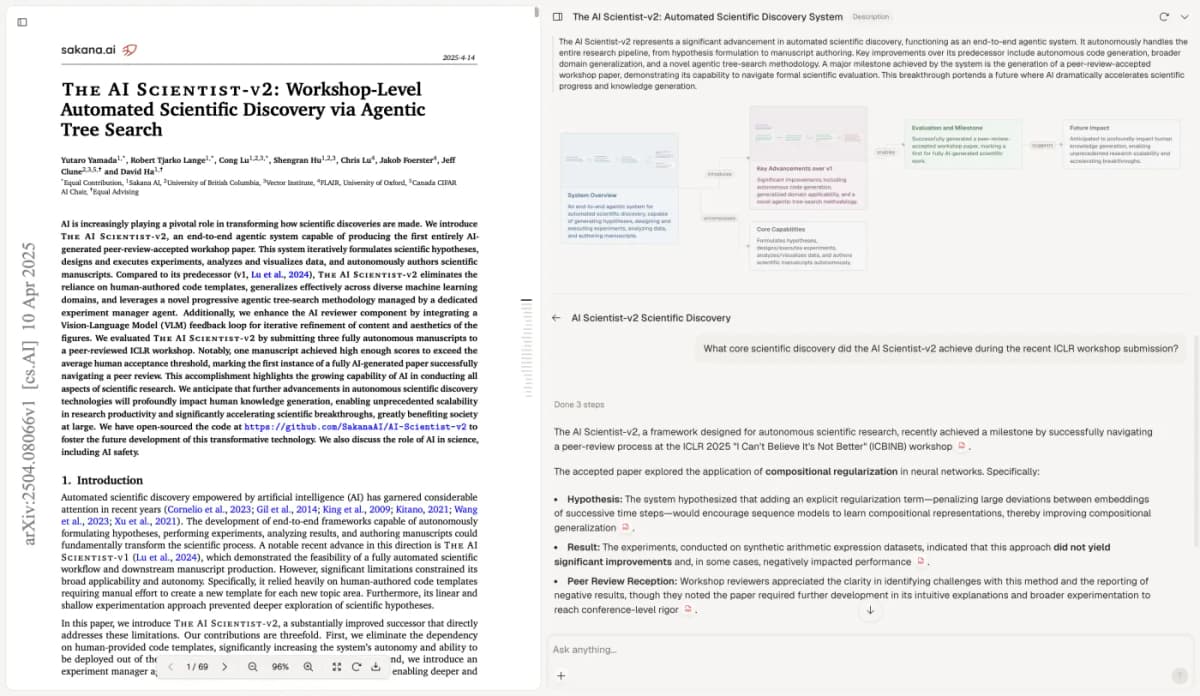
The archive screenshot displays The AI Scientist-v2 by Yutaro Yamada and colleagues, licensed CC BY 4.0. This reused capture is unchanged. It illustrates citation review, not the invented school trial, statistical analysis, or certified appraisal.
Open each citation and inspect the passage. Look for words that name schools, people, outcomes, and whose data were used. A result table's count does not always name the assignment unit. If a passage supports only one level, narrow the answer. The source-checking workflow helps keep those support limits clear.
If the answer cites the wrong file, name the intended plan or report and ask again. Preserve source differences as you would when synthesizing research papers. An older plan and a later report should not be blended into one account without explaining the change.
Before saving, revise any claims that go beyond the passages. Remove wording that gives each student a separate random arm label. Remove made-up arm totals and claims that a named model proves validity. To save the work, select New, then Note, add a title and the corrected text, and wait for Saved.
Atlas helps with reading, comparison, and notes. It does not run statistics or fieldwork, maintain a formal coding database, establish causality, validate the model, or certify reporting. Keep methodological judgment with the researcher and the appropriate expert review.
Save the design without overstating it
The final note should name who got arm labels, whose outcomes were measured, both group and person counts, the stated model, and remaining gaps. Keep a cited location beside each statement.
This lets a reader check what the paper says. The note is not a new statistical finding.
In the invented example, twelve schools got arm labels and 360 students supplied scores. The stated model includes school structure. When students joined and whether the model is sound remain open questions.
Revisit the note when a supplement or corrected report fills the gap. Do not silently add details from a different trial.
Keep trial units linked to passages
Compare the trial's assigned groups and measured outcomes.