

Community-based participatory research (CBPR) gives community and research partners a shared say in the work. To review a plan, trace who helps set the question, shape the study, explain findings, and decide how to use them.
A label or meeting list describes the partnership; a role record shows who can shape its choices. Build a note linking stated roles and recorded partner input to their sources. Keep open questions for joint review. The case below uses a published project; it adds no new study of a community.

Trace partnership roles to the source record
Compare permitted plans and notes, then save questions for joint review.
What makes the research partnership participatory?
CBPR treats community members as partners who bring knowledge and help make choices. Detroit URC's adopted principles call for shared control across the work, learning from each other, local strengths, and use of findings. Discuss those aims with partners and look for them in the plan. They are not a score that proves fair practice.
Recruiting residents or asking for one round of feedback can help a study. Those acts alone do not show shared power. NORC's guide to community engagement sets out roles from giving advice to being an equal partner or leading the work. Check the role offered and how it can change a choice.
CBPR is a way of partnering, rather than one data method. It can use interviews, surveys, or other methods suited to the question. The 2019 Partnering with Communities paper describes work together from the question through sharing findings. Keep that choice distinct from the choice of qualitative research design.
Trace community roles through the research plan
Start with the community and the choice the partners face. People in one place may have different needs and histories. Do not assume that one group or contact speaks for everyone affected by the question.
Name partners and their agreed roles
Name the partners, relevant groups still missing, and the roles each partner has agreed to take. A plan might name who sets goals, reviews a question, chooses methods, explains results, or decides how findings are shared.
Detroit URC's guidance on community identity allows for a group linked by who they are, not just where they live. Ask partners how they define that community, then record their reasons and any different views.
The research team should not settle this without them.
Use the same role questions across the supplied sources. A document comparison workflow can help you spot where a plan promises shared review but later notes mention only researcher decisions.
Keep the source version and section beside each finding.
Check power, resources, and review routes
For each key choice, ask who can propose a change, who can approve it, and how the group will handle a dispute. An advisory group may offer comments without the right to change the plan. State that limit clearly.
NORC's shared-power guidance asks teams to agree on governance and parameters for data ownership and use. These need discussion with partners.
A reviewer can find the stated arrangement in a document without proving that it works fairly in practice.
Check whether partners have the time, access, language support, and resources needed for the promised role. The 2019 perspective's funding and caveat sections describe resource constraints and the time needed to build relationships.
Do not treat unpaid partner work as a free input or assume trust follows from a signed plan.
Read a published example of partner feedback
The 2024 ARISE paper, methods phases 2–5, reports how the authors developed a framework using sources and partner knowledge. You can trace input and the authors' later synthesis. That does not show how each person felt about the process.
Separate documented input from decision authority
This compact review follows the published methods. The final column contains questions a reviewer could ask; these are not claims that the project failed to answer them elsewhere.
| Source phase | Role and evidence use reported | Question for a fuller record |
|---|---|---|
| Phase 2 | Consortium feedback added experience and evidence | Which partners contributed, and whose input was missing? |
| Phase 3 | Feedback informed revisions to the framework's language and form | How were conflicting suggestions resolved? |
| Phase 4 | Community researchers reviewed use and accessibility | Which changes followed their review? |
| Phase 5 | Core authors synthesized feedback across findings | Who agreed to the final interpretation? |
Table 1: Keep the cited phase beside the finding. A separate decision record may answer a follow-up question. If it is absent from your supplied files, mark it “not found in these records.”
That wording describes your evidence boundary without claiming that the decision never occurred.
Follow the original development sequence
The original figure shows five steps: a scoping review; added experience and evidence; a published working framework; use within a project; and a synthesis of cross-cutting competencies and conditions. It shows this project's development path, not a required sequence for all CBPR studies.
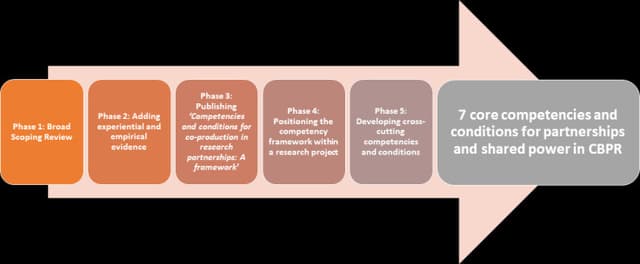
Original Ozano and colleagues, Figure 1, BMJ Global Health, 2024. CC BY 4.0; unchanged source image.
The paper notes that partners' time, priorities, and capacity affected how much input they provided. Keep that limit with the case. The diagram records the method described; it does not prove an equal say or a health effect.
Compare plans, interpretations and evidence use
A plan states what should happen. Notes and reports show what was written down later. Compare both before saying that a role was carried out. Keep planned roles, recorded input, and open questions distinct.
Trace how partner input affected the account
Look for a link from a partner's input to a changed question, method, reading of results, or next action. A comment can be heard without being used. There may be a reason; keep that reason in the record for review.
Keep different views when they matter. “Partners discussed the results” is not the same claim as “all partners agreed.” Use a source-checking workflow to test the exact sentence against the passage.
An AI theme should not erase a dispute or add consent that the record does not show.
Rochester's community advisory board principles call for shared duties and, for CBPR, joint work on study aims and the meaning of data. Use those principles and your partnership's own agreed roles as prompts to read the record.
Check evidence access and sharing rights
Read the plan for who can access and own data, review its meaning, and share findings. Check whether the planned form meets partners' needs. A journal paper may reach one group while a local meeting or plain-language report serves another.
Detroit URC's guidance on sharing findings gives partners a role in their meaning and use. That goes beyond sending a final report after choices are made. Ask what partners can revise before release and how the results will help them.
The UNM CBPR model links context, partner work, research actions, and outcomes to help groups reflect. A note on roles can inform that discussion. It cannot fill missing field evidence or prove that the partnership caused an outcome.
State what the documents cannot prove
A document review can show stated roles and recorded decisions. It cannot establish trust, consent, or fair practice by itself. Ask partners to check whether the note reflects their experience and what the written sources leave out.
Keep source evidence within its scope. A framework-development paper is not an effect estimate for your project. A model's proposed links are not proof that an action improved health. Researchers choose and justify the methods needed to study such questions.
Use only records you may process and share. Partner governance and participant consent are separate issues; one does not automatically settle the other. Keep identifying details and sensitive community knowledge within the agreed access boundaries.
Before accepting the comparison note, check the source version, role, decision point, supporting passage, interpretation, and open question. Name who will review the issue with whom.
A research synthesis workflow can help compare accounts, but the partnership decides how to resolve them.
Save a source-linked partnership note in Atlas
Use Atlas to compare permitted plans and interpretation records. It can help draft cited text for review. Community and research partners retain choices about roles, methods, privacy, consent, and final meaning.
- Add the plan, agreed role records, and interpretation notes you may use to one project. Wait for processing to finish.
- In chat, type
@and select the relevant sources. Ask who is assigned each role and where input or a decision is recorded. - Open the citations and inspect the passages. Correct unsupported claims, preserve different views, and mark missing evidence within the supplied source set.
- Create a New Note, save the checked comparison, and confirm the Saved state. Bring the open questions to the appropriate partners for joint review.
Try this request: “Using @selected sources, compare community roles in the plan with the interpretation records. For each decision point, cite the stated role and any recorded input or change. Keep facts, my interpretation, and open questions distinct. Do not infer consensus, consent, fair practice, or an outcome that these sources do not establish.”
Trace partnership roles to the source record
Compare permitted plans and notes, then save questions for joint review.